B.F. Skinner
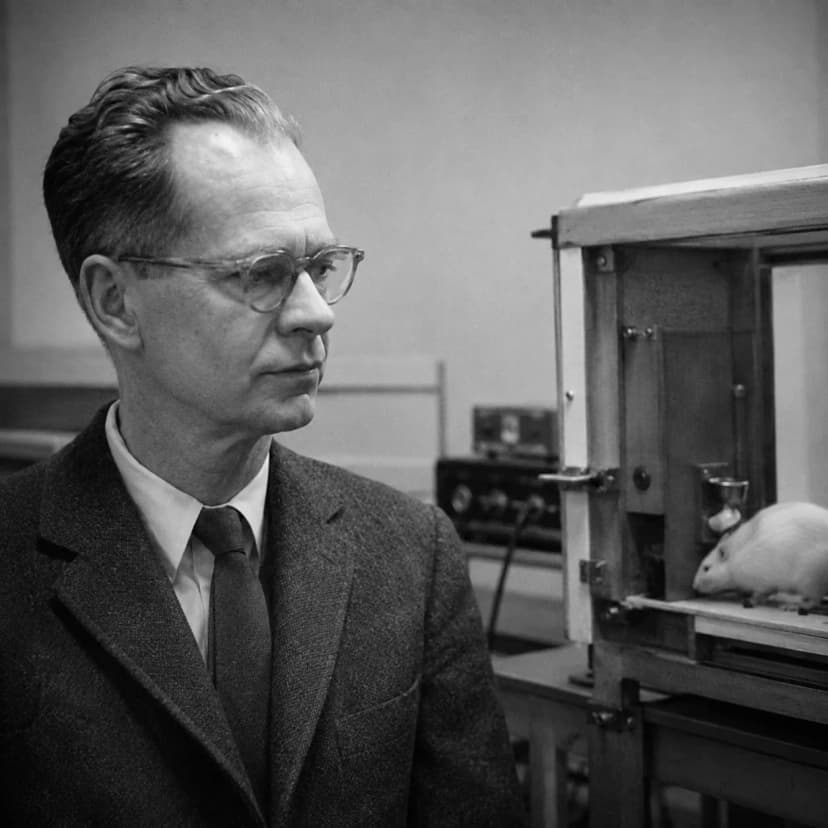
B. F. Skinner founded radical behaviourism, built the apparatus that made reward schedules measurable, and established that reinforcement delivered on an unpredictable schedule produces behaviour far more persistent than reinforcement delivered every time. The book that documents that result is not his alone. Schedules of Reinforcement was written with Charles Ferster, who did five years of the experiments and whose name comes first on the title page.
Who they are
Burrhus Frederic Skinner was born in Susquehanna, Pennsylvania in 1904 and died in 1990. He graduated from Hamilton College in 1926 intending to be a novelist, spent two unproductive years trying, and enrolled at Harvard to study psychology in 1928. He took his doctorate there in 1931 and spent most of his career at Harvard.
His method was to remove from the study of behaviour everything that could not be observed and counted. The operant conditioning chamber, which everyone else calls the Skinner Box, is that commitment turned into hardware: an animal, a lever or a key, a food dispenser, and a rule connecting them, with a cumulative recorder drawing the result. What the apparatus made possible was the systematic study of the rule itself, the schedule on which reinforcement arrives, rather than of the reward.
The Behavior of Organisms (1938) set out the framework. Walden Two (1948) was a novel imagining a community run on it. Verbal Behavior (1957) extended the analysis to language. Beyond Freedom and Dignity (1971) argued the social case and made him, for a while, one of the most argued-about people in American public life. During the Second World War he ran Project Pigeon, training pigeons to peck at a target on a screen in order to steer a missile towards it.
The finding this site draws on most is the one about schedules, and it is important to be accurate about whose it is. Schedules of Reinforcement was published in 1957 by Appleton-Century-Crofts, runs to more than 700 pages, and came out of five years of joint work at Harvard with Charles Ferster, who is its first author. The book is cited constantly, and almost always as Skinner's alone. It is Ferster's book too, and the correct citation is Ferster and Skinner.
The result itself: the variable-ratio schedule, where reinforcement follows an unpredictable number of responses averaging to some ratio, produced the highest and steadiest response rates of anything they ran, and behaviour trained on it was the hardest to extinguish. That mechanism is the one everyone reaches for when explaining slot machines, and then feeds. Worth noting where the analogy strains: a casino designs its schedule deliberately, and a recommendation system arrives at one as a by-product of being accurate but not certain. The schedule is the same at the point of use. How it got there is a different question, and it has never been tested.
Key papers
Skinner, B. F. (1938), The Behavior of Organisms: An Experimental Analysis, Appleton-Century. The founding statement of the operant analysis of behaviour.
Ferster, C. B., & Skinner, B. F. (1957), Schedules of Reinforcement, Appleton-Century-Crofts. The catalogue of what different payout rules do to behaviour, and the source of the variable-ratio result. Ferster is first author.
Skinner, B. F. (1957), Verbal Behavior, Appleton-Century-Crofts. The attempt to extend the analysis to language.
Skinner, B. F. (1971), Beyond Freedom and Dignity, Alfred A. Knopf. The social argument, and the book that made him a public controversy.
Also: Walden Two (1948), a novel describing a community organised on behavioural principles.
Key ideas
Behaviour is shaped by its consequences, and the rule connecting the two is the thing to study.
The schedule matters more than the reward. A variable schedule produces more persistent behaviour than a consistent one and is far harder to extinguish.
Schedules of Reinforcement is Ferster's book as much as Skinner's, and Ferster is first author.
The straight line runs from the pigeon key to the pull-to-refresh gesture, but a mechanism arriving by design and a mechanism arriving by accident are different claims, and only one of them has been demonstrated.
Concepts on this site
Find them elsewhere
Lifespan: 1904 to 1990. No social accounts, and none are claimed on their behalf.
Deceased, so no social accounts. Reference is the B.F. Skinner Foundation biographical page, written by his elder daughter
Checked 2026-09-10. Handles and affiliations go out of date, so treat this block as a snapshot rather than a standing fact.
Sources
- Skinner, B. F. (1938), The Behavior of Organisms: An Experimental Analysis, Appleton-Century.
- Ferster, C. B., & Skinner, B. F. (1957), Schedules of Reinforcement, Appleton-Century-Crofts.
- Skinner, B. F. (1957), Verbal Behavior, Appleton-Century-Crofts.
- Skinner, B. F. (1971), Beyond Freedom and Dignity, Alfred A. Knopf.
- Harvard University, Department of Psychology, historical record. (Dates, degrees, career.)