Bhikkhu Nanananda
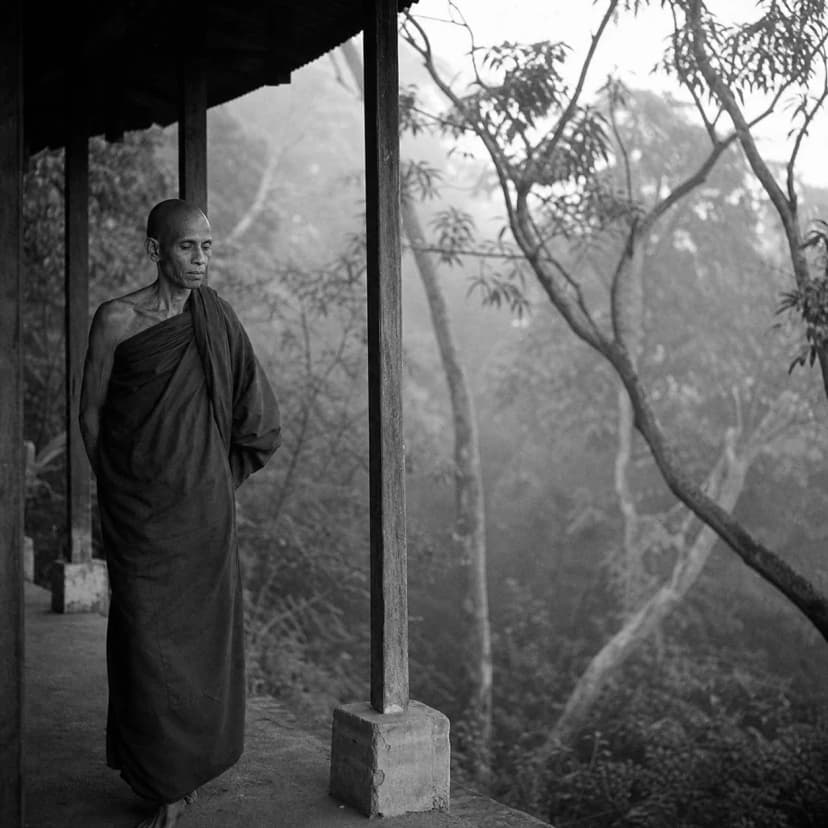
Kaṭukurunde Ñāṇananda was a Sri Lankan Theravada monk and Pali scholar, born on 10 July 1940 and died on 22 February 2018. His 1971 monograph Concept and Reality in Early Buddhist Thought gave English the phrase that carries the Buddhist account of thinking into modern psychology: papañca as conceptual proliferation. Nearly every popular description of the mind spinning stories out of a bare perception is downstream of that translation choice. It is worth knowing that it is a translation choice, made by a named scholar in a datable book, rather than something the Pali texts hand over ready-made.
Who they are
Ñāṇananda graduated from the University of Peradeniya in 1962, specialising in Pali, and served for a short period as an assistant lecturer in Pali at the same university before ordaining as a monk. He later became abbot of Pothgulgala Aranya, a small forest monastery at Devalegama in Sri Lanka. He was a working monastic rather than an academic, and his output reflects it: a small number of dense books, and a long series of sermons delivered in Sinhala to fellow monks and afterwards translated.
The book that matters here is his first. Concept and Reality in Early Buddhist Thought: An Essay on Papañca and Papañca-saññā-saṅkhā, published by the Buddhist Publication Society in 1971, is a study of two difficult terms in the Pali discourses, concentrated on the Madhupiṇḍika Sutta. Ñāṇananda argued that papañca describes the mind's tendency to spread a screen of concepts over experience, and rendered it in English as conceptual proliferation. The reading challenged parts of the traditional Theravada commentarial exegesis, which is one reason it has been argued over by specialists ever since rather than simply absorbed.
For a psychology audience the interesting thing is what the phrase did once it left the monastery. Conceptual proliferation is a formulation Western readers can immediately map onto rumination, mind-wandering and intrusive thought, and the mapping is close enough to feel like a translation and loose enough to smuggle in assumptions. The Buddhist term sits inside a doctrinal structure where craving, not thinking, is the root of suffering, and where the commentaries tie papañca back to craving, conceit and false view. Modern usage tends to strip that structure out and leave the thinking behind as the villain. The rendering is not responsible for the misuse, but it is the bridge the misuse crosses.
Books
Ñāṇananda's output is small and mostly published by the Buddhist Publication Society in Kandy. The two research monographs below are the ones his reputation rests on. His sermon series was published separately and much later.
Key papers
Ñāṇananda, Bhikkhu (1971), Concept and Reality in Early Buddhist Thought: An Essay on Papañca and Papañca-saññā-saṅkhā, Buddhist Publication Society, Kandy.
Ñāṇananda, Bhikkhu (1974), The Magic of the Mind: An Exposition of the Kālakārāma Sutta, Buddhist Publication Society, Kandy.
Ñāṇananda, Bhikkhu, Nibbāna: The Mind Stilled, seven volumes, English translation published from 2003. Sermons delivered in Sinhala between August 1988 and January 1991.
Key ideas
Papañca as conceptual proliferation. The rendering that made the idea legible in English. See papanca.
The screen of concepts. His reading is that the mind does not merely register experience, it differentiates and elaborates it, and the elaboration then returns as something the person has to contend with.
A translation is an argument. His rendering departed from parts of the traditional commentarial reading, and specialists have contested it in the scholarly literature. Popular writing that treats conceptual proliferation as the plain meaning of the Pali is skipping that debate.
The word travelled further than the doctrine. The term arrives in Western psychology detached from the framework in which craving, not thinking, is the root. See tanha.
Concepts on this site
Find them elsewhere
Lifespan: 1940 to 2018. No social accounts, and none are claimed on their behalf.
Deceased, so no social accounts. No authoritative reference page recorded, as his publishers site seeingthroughthenet.net is currently offline
Checked 2026-09-10. Handles and affiliations go out of date, so treat this block as a snapshot rather than a standing fact.
Sources
- Ñāṇananda, Bhikkhu (1971), Concept and Reality in Early Buddhist Thought: An Essay on Papañca and Papañca-saññā-saṅkhā, Buddhist Publication Society, Kandy.
- Ñāṇananda, Bhikkhu (1974), The Magic of the Mind: An Exposition of the Kālakārāma Sutta, Buddhist Publication Society, Kandy.
- Ñāṇananda, Bhikkhu, Nibbāna: The Mind Stilled, seven volumes, English translation published from 2003. Sermons delivered in Sinhala between August 1988 and January 1991.
- Madhupiṇḍika Sutta, Majjhima Nikāya 18, the discourse his 1971 monograph is built on.
- Dhammadinnā, Bhikkhunī, "Bhikkhu Ñāṇananda's Concept and Reality: A Reply to Stephen Evans." Cited as evidence that the rendering has been contested in the specialist literature, not for any claim in the prose above.