Britta Hölzel
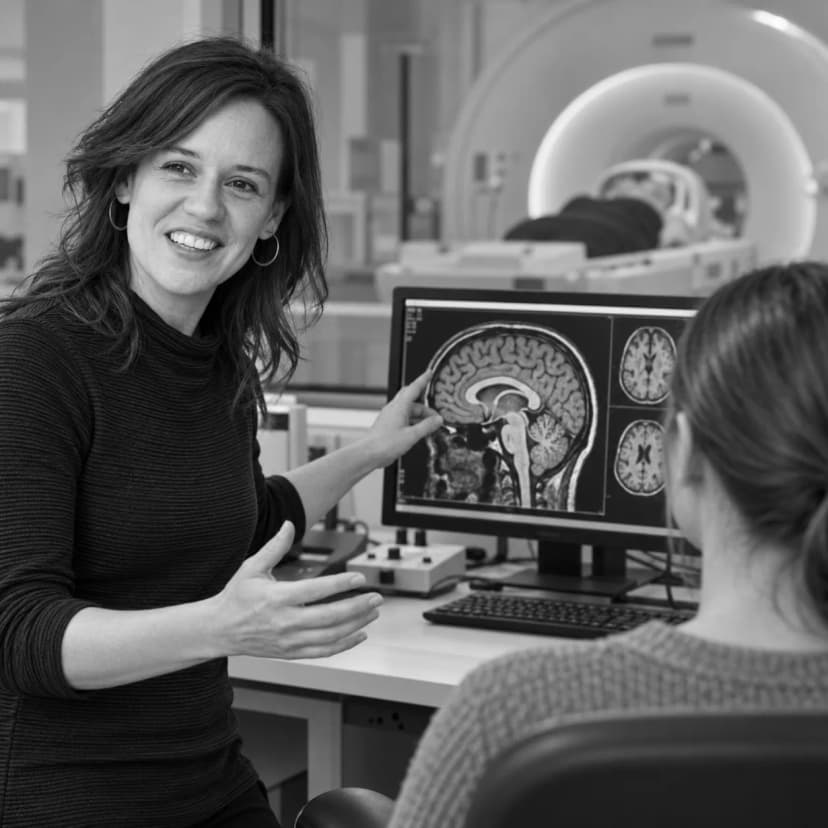
Britta K. Hölzel is first author of a 2011 study in Psychiatry Research: Neuroimaging that reported increased grey-matter density in the left hippocampus after an eight-week mindfulness-based stress reduction course. Sara Lazar is the final author. The vault records it as the study that books on meditation and the brain cite for the claim that a short course changes brain structure. It was a first result in a small sample.
Who they are
Hölzel is a neuroscientist and the first author of the 2011 paper. The paper was written with Sara Lazar and five other authors: Carmody, Vangel, Congleton, Yerramsetti and Gard. In the vault's record it is the study that books on meditation and the brain cite for the claim that eight weeks of practice produced visible change in the brain.
The paper opens from a gap its abstract names: mindfulness-based therapies had become increasingly popular, but little was known about the neural mechanisms behind them. Mindfulness-Based Stress Reduction, in the abstract's description, is one of the most widely used mindfulness training programmes and had been reported to produce positive effects on psychological well-being and to ease the symptoms of a number of disorders. The study set out to test one mechanism, a change in grey-matter concentration, in a controlled longitudinal design with before-and-after scans. It did not measure the well-being outcomes themselves, so a brain-structure result in it was never evidence about how participants felt.
A citation of this paper is best read alongside the 2022 trials led by Tammi Kral, which tested the same structural question in a much larger randomised sample and did not find the effect. The vault's standing rule for the pair is that Hölzel is not cited without Kral.
Key papers
Hölzel, B. K., Carmody, J., Vangel, M., Congleton, C., Yerramsetti, S. M., Gard, T., & Lazar, S. W. (2011). "Mindfulness practice leads to increases in regional brain gray matter density." Psychiatry Research: Neuroimaging, 191(1), 36 to 43.
The study took anatomical MRI scans before and after an eight-week mindfulness-based stress reduction programme from 16 healthy adults who had no prior meditation experience, and compared them with 17 people on a waiting list. Using voxel-based morphometry, the researchers found increased grey-matter concentration in the left hippocampus within a region chosen in advance. Whole-brain analyses reported increases in the posterior cingulate cortex, the temporo-parietal junction and the cerebellum in the mindfulness group relative to controls.
The authors linked these regions to learning and memory, emotion regulation, self-referential processing and perspective taking. The comparison was with a waiting list, not a matched active programme, which matters for what the result can say about mindfulness in particular.
Key ideas
A first result. With 16 participants in the course group, the study was a first look at whether a short course changes brain structure. First results of this size are valuable because they say where to look, and weak because small samples produce estimates that larger trials often shrink or remove.
A region chosen in advance. The left hippocampus finding came from a region of interest, which is a stronger form of evidence than an effect found by searching the whole brain, though the paper also reported whole-brain results.
The test that followed. In 2022 Kral and colleagues pooled two randomised trials of 218 adults, with a waitlist and a matched active control, and found no evidence of structural change in the whole brain or in regions drawn from earlier mindfulness research. They report that the earlier findings did not replicate.
What this does and does not settle. The 2022 result is about brain structure after a short course in novices. It does not make the 2011 paper wrong about what its 33 scanned participants showed, and it does not address any other outcome of mindfulness training. It does mean that the 2011 result cannot be cited alone as evidence that an eight-week course restructures the brain.
Sources
- Hölzel, B. K., Carmody, J., Vangel, M., Congleton, C., Yerramsetti, S. M., Gard, T., & Lazar, S. W. (2011). Psychiatry Research: Neuroimaging, 191(1), 36 to 43. doi:10.1016/j.pscychresns.2010.08.006. The author list, participant numbers and findings were checked against the Europe PMC record on 2026-10-26, not the full paper.
- Kral, T. R. A., Davis, K., Korponay, C., Hirshberg, M. J., Hoel, R., Tello, L. Y., Goldman, R. I., Rosenkranz, M. A., Lutz, A., & Davidson, R. J. (2022). "Absence of structural brain changes from mindfulness-based stress reduction: Two combined randomized controlled trials." Science Advances, 8(20), eabk3316. doi:10.1126/sciadv.abk3316.