Carl Sagan
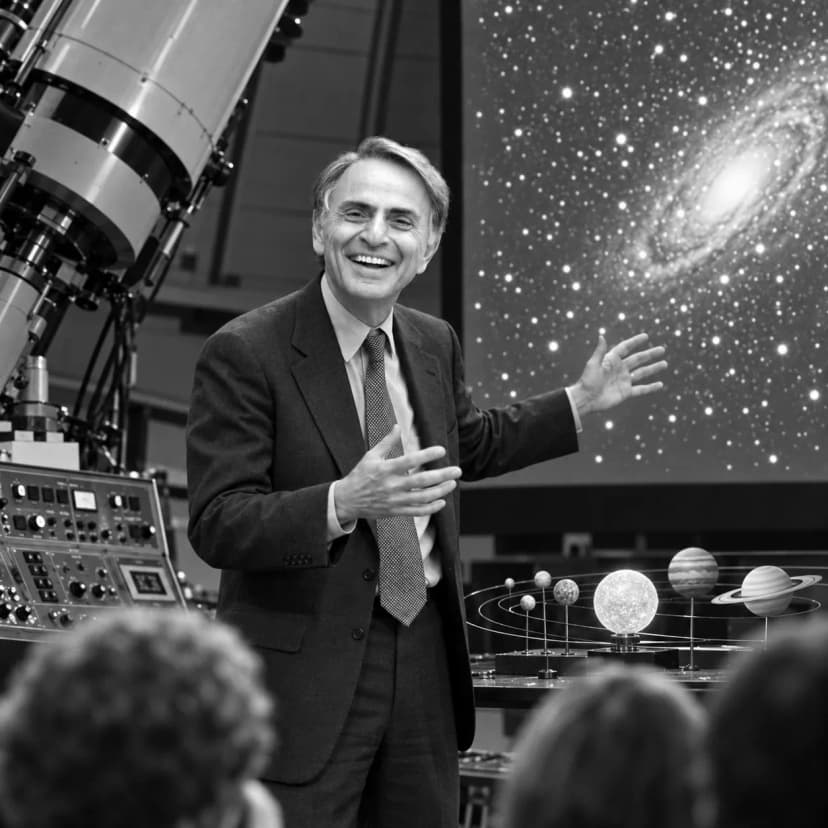
Carl Sagan, 1934 to 1996, was an American astronomer and the most widely read science populariser of his generation. He appears on this site for one book. The Dragons of Eden: Speculations on the Evolution of Human Intelligence (Random House, 1977) won the 1978 Pulitzer Prize for General Nonfiction and took Paul MacLean's triune brain to a mass audience. It is the main route by which the reptilian brain entered general circulation, and from there the lizard brain of marketing writing.
Who they are
Carl Edward Sagan was born on 9 November 1934 in Brooklyn, New York, and died on 20 December 1996 in Seattle. He was the David Duncan Professor of Astronomy and Space Sciences and director of the Laboratory for Planetary Studies at Cornell University. His biography credits him with a leading role in the Mariner, Viking, Voyager and Galileo spacecraft missions. His research subjects included amino acids, chemical synthesis, extraterrestrial life and the origin of life, and he played a role in the search for extraterrestrial intelligence.
He reached the widest audience through writing and television. He hosted the 1980 television series Cosmos, and his books include Contact and The Demon-Haunted World: Science as a Candle in the Dark. His 1977 book on the evolution of human intelligence was a separate venture into neuroscience, written by an astronomer for general readers.
Key papers
Sagan, C. (1977). The Dragons of Eden: Speculations on the Evolution of Human Intelligence. New York: Random House. Winner of the 1978 Pulitzer Prize for General Nonfiction, a category the prize describes as a distinguished book by an American author that fits no other category. The Pulitzer page carries a clip of Sagan on The Tonight Show with Johnny Carson on 20 May 1977, discussing many of the book's ideas, which shows how directly the model reached a mass television audience. The book presents MacLean's triune brain at length. Sagan returned to the image in Cosmos, where, as reported in a Big Think article, he wrote that "there is something like a brain of a crocodile" inside every person's skull.
Key ideas
The reptilian layer for a general reader. Sagan presented the triune brain as the account of how human intelligence arrived: an older reptilian core, a limbic layer and a neocortex, each added on top of the last. The book's subtitle calls its contents speculations, and the model was taken seriously when he wrote.
The transmission is the point. A model that had begun to lose comparative neuroscientists reached the public through a bestseller, and the public version has outlived the scientific one by half a century. Lisa Feldman Barrett names Sagan among those who popularised the layered model in How Emotions Are Made (2017) and calls the model one of the most successful misconceptions in human biology.
What the evidence says now. Joseph Cesario and colleagues reported in 2020 that researchers who study nervous-system evolution have long rejected the idea of newer structures added over older ones, and a 2022 study in Science found that the brain of a bearded dragon cannot be cleanly separated from a mouse's into ancestral and novel areas. The picture Sagan gave readers is not the one comparative neuroscience supports.
A fair reading. He was popularising the best available account of his time, and the page records the path, not a fault. The same path runs from researcher to populariser to received wisdom to trade-book advice, and it is the route the lizard brain took into marketing.
Sources
- Sagan, C. (1977). The Dragons of Eden. New York: Random House. The 1978 Pulitzer Prize for General Nonfiction is recorded at https://www.pulitzer.org/winners/carl-sagan
- Britannica, "Carl Sagan", https://www.britannica.com/biography/Carl-Sagan, for his dates and the 1980 Cosmos series. BookBrowse biography (last updated 1997) for his Cornell positions and spacecraft roles.
- Big Think, "Carl Sagan reptile brain", https://bigthink.com/neuropsych/carl-sagan-reptile-brain/, for the Cosmos line, as a secondary report.
- Barrett, L. F. (2017). How Emotions Are Made. Pp. 81 to 82, as recorded in the vault digest of the book. Cesario, Johnson and Eisthen (2020), Current Directions in Psychological Science, 29(3), 255-260. Hain, D., et al. (2022), Science, 377(6610), eabp8202. Each read at the level of the abstract.
- Vault note: [[Carl Sagan]].