Daniel Haun
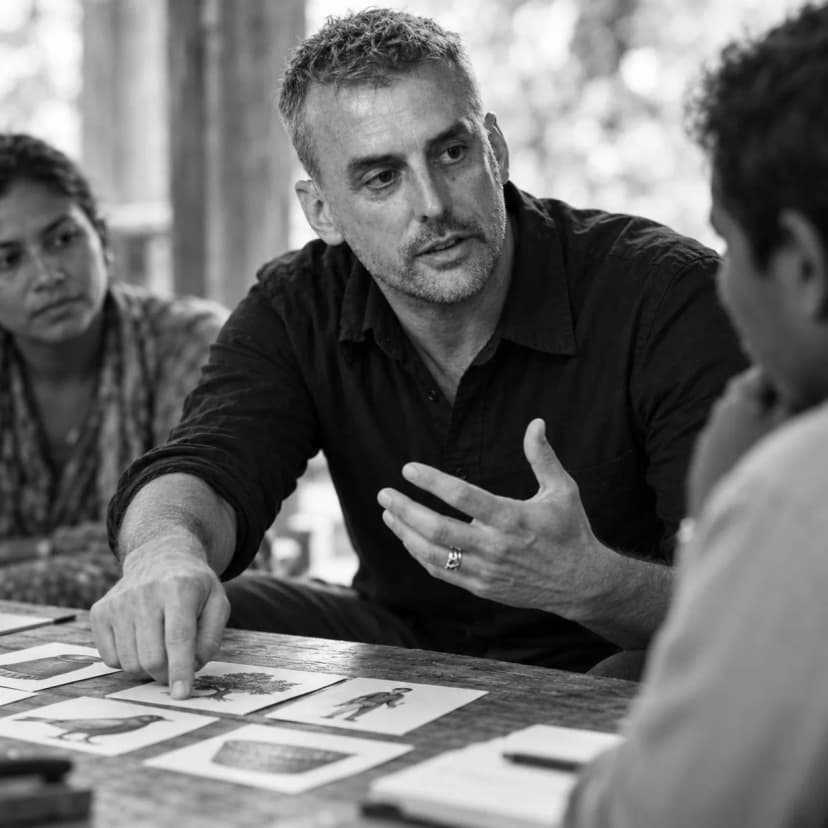
Daniel Haun is a psychologist who directs the Department of Comparative Cultural Psychology at the Max Planck Institute for Evolutionary Anthropology in Leipzig and is Professor of Comparative Cultural Psychology at Leipzig University. He is first author of a 2014 Psychological Science paper, written with Yvonne Rekers and Michael Tomasello, comparing how two-year-old children, chimpanzees and orangutans respond when peers show them a different way to solve a problem.
Who they are
According to the Max Planck Institute's staff page, Haun has been Director of the Department of Comparative Cultural Psychology at the Max Planck Institute for Evolutionary Anthropology in Leipzig since 2019, and Professor of Comparative Cultural Psychology at Leipzig University since the same year. He studies what sets human cognition apart, comparing humans with close evolutionary relatives, across cultures and across stages of development. His topics include social cognition, physical cognition, social learning and cooperation.
The staff page lists a career that includes a doctorate in psychology completed between 2002 and 2007 at the Max Planck Institute for Psycholinguistics and the Donders Centre for Cognitive Neuroimaging, a postdoctoral post at the Max Planck Institute for Evolutionary Anthropology in 2006 and 2007, and a research group leader post in Comparative Cognitive Anthropology at that institute and the Max Planck Institute for Psycholinguistics from 2008 to 2013. He was Professor of Developmental Psychology at the University of Jena in 2014 and 2015 and Professor of Early Child Development and Culture at Leipzig University from 2015 to 2019. He also held lecturer posts at the University of Portsmouth from 2007 to 2014.
The page lists field research with the Hai//om in Namibia, with orphaned orangutans in Indonesia, at the Chimfunshi Wildlife Orphanage in Zambia, and on Rossel Island in Papua New Guinea. The 2014 paper lists Haun's affiliations at the time as the University of Jena, the Max Planck Institute for Evolutionary Anthropology in Leipzig and the Max Planck Institute for Psycholinguistics in Nijmegen.
Key papers
Haun, Rekers and Tomasello (2014), Children Conform to the Behavior of Peers; Other Great Apes Stick With What They Know, Psychological Science, volume 25, issue 12, 2160-2167.
The first study involved 18 two-year-old children, 12 chimpanzees and 12 orangutans. Each participant first learned by trial and error that one section of a three-hole box gave food. Three familiar members of the participant's own species then demonstrated a different section that worked equally well, and the participant dropped three balls into the box and could choose any section. Children switched to the demonstrated section in more than half of all their choices. On the first test trial, 12 of 18 children switched, against 2 of 12 chimpanzees and 2 of 12 orangutans.
A second study tested 72 children in a two by two design that varied whether the demonstrators stayed or left and whether there were one or three of them. Children switched more when the demonstrators were present than when they had gone, and the number of demonstrators made no difference.
Key ideas
The paper's question is whether primates conform to peers in the sense of abandoning a behaviour learned individually to match what group members do. The authors reported that children did so readily and that the two ape species mostly kept their own strategy. They read the extra switching when demonstrators were present as evidence that children's conformity is at least partly driven by social motives.
The authors proposed that this difference between human and ape social learning might help explain why human cultures show greater variability and more socially acquired behaviour. They also noted that general behavioural conservatism in the apes could not be ruled out as an alternative explanation and that further research was needed.
The study is used in the article Why do people conform as the developmental step of the argument, showing that peer matching is visible in two-year-olds and responds to whether the peers are present.
Sources
- Haun, D. B. M., Rekers, Y., & Tomasello, M. (2014), Children conform to the behavior of peers; other great apes stick with what they know, Psychological Science, 25(12), 2160-2167. https://doi.org/10.1177/0956797614553235
- Max Planck Institute for Evolutionary Anthropology, staff page for Daniel Haun, Department of Comparative Cultural Psychology.