Daniel Nettle
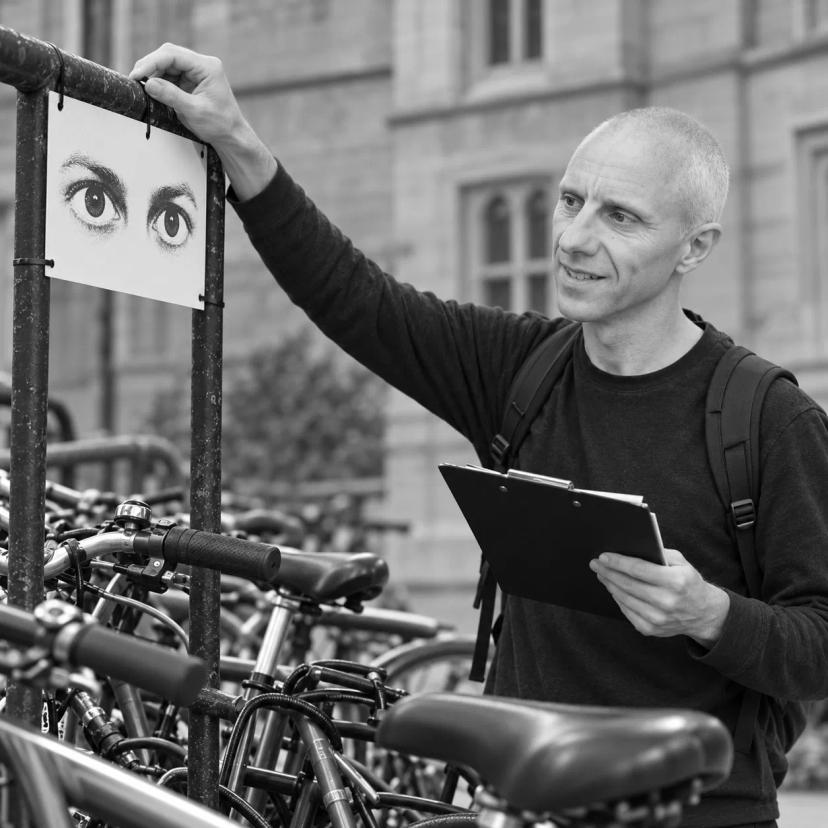
Daniel Nettle is first author of the 2012 bicycle-stealing signage study in PLoS ONE and a co-author of the 2006 coffee-room honesty-box study. Together they are the two field studies most often cited for the watching eyes effect.
Who they are
Nettle's name sits on both of the field experiments that made watching eyes a policy idea as well as a laboratory curiosity. His current affiliation was not checked for this page.
In the 2012 paper he led, with Kenneth Nott and Melissa Bateson, signs showing watching eyes and a related verbal message were placed above bicycle racks at three locations with high bicycle stealing. The rest of the university campus served as the control. Reported thefts were monitored for 12 months before and after the intervention. Thefts fell 62 per cent at the experimental locations, while control locations saw a 65 per cent increase. The reported odds ratio for the intervention was 4.28, with a 95 per cent confidence interval of 2.04 to 8.98.
The authors stated one limit in the abstract: the signs may have displaced offending to locations with no signs. They recommended using such signs as an adjunct to other measures.
Outside commentators raised further points. Tom Stafford, in a 2013 Mind Hacks column, noted that the control sites had no sign at all, so the study cannot say whether the eyes or the message ("we are watching you") caused the fall. He added that thefts rose at nearby unsigned spots, that a thief warned of watched bikes would reasonably pick an unwatched rack, and that security-minded owners may have chosen the signed racks.
The 2006 paper, with Melissa Bateson and G. Roberts, was the earlier study. In a university coffee room, a pair of eyes or a picture of flowers above an honesty box alternated weekly for ten weeks, and people paid about 2.76 times as much per litre of milk in the eye weeks.
Key papers
Nettle, D., Nott, K., & Bateson, M. (2012). Cycle thieves, we are watching you: Impact of a simple signage intervention against bicycle theft. PLoS ONE, 7(12), e51738. doi:10.1371/journal.pone.0051738
Bateson, M., Nettle, D., & Roberts, G. (2006). Cues of being watched enhance cooperation in a real-world setting. Biology Letters, 2(3), 412-414. doi:10.1098/rsbl.2006.0509
Key ideas
The idea his work supports is that a cheap visual cue can reduce a specific kind of rule-breaking in a specific place, which is the narrow version of The Watching Eyes Effect that the later reviews leave standing. A 2019 review by Dear and colleagues pooled 15 experiments and linked eye images to a 35 per cent lower risk of antisocial behaviour.
The same work shows the limits of the evidence. A field study with one intervention and a campus-wide control cannot separate eyes from words, and it cannot separate a real reduction from a move to the next rack.
Sources
- Nettle, Nott and Bateson (2012), abstract read on the Northumbria University research portal. Bateson, Nettle and Roberts (2006), read from the Newcastle University copy.
- Stafford, T. (2013). Did the eyes really stare down bicycle crime in Newcastle? Mind Hacks, 16 May 2013.