David Dunning
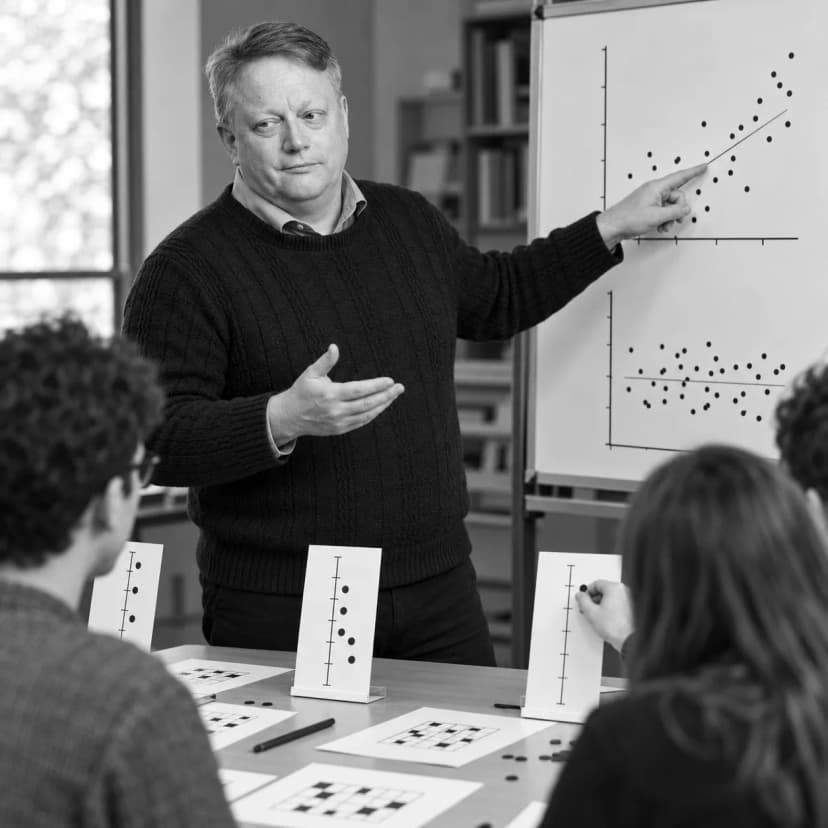
David Dunning is the second author of "Unskilled and unaware of it", the 1999 paper with Justin Kruger that reported that people who score lowest on tests of humour, logic and grammar rate their own performance well above their standing. The effect carries his name first, though Kruger is first author. Dunning is a psychologist, and this page covers him only through that paper and the critical literature it started.
Who they are
This publication has verified one thing about Dunning, the 1999 paper, and it describes him only through it. Nothing about his position or career was checked for this page, so none is stated.
The paper reports four studies of Cornell undergraduates. In the logical reasoning study, 45 students sat a 20-item test drawn from an LSAT preparation guide, and those in the bottom quarter scored at about the 12th percentile while estimating their test performance at about the 62nd. The authors explained the gap as a double burden, in which the knowledge needed to do a task is the knowledge needed to judge it. In the fourth study, with 140 students, a short training packet in logical reasoning improved low scorers' calibration while an unrelated task did not.
The order of the names matters for citation. The paper lists Kruger first, and the effect is popularly named in the reverse order. Elsewhere in this publication the paper is cited as Kruger and Dunning.
Key papers
Kruger, J., & Dunning, D. (1999), "Unskilled and unaware of it: How difficulties in recognizing one's own incompetence lead to inflated self-assessments," Journal of Personality and Social Psychology, 77(6), 1121-1134. The paper that named the effect.
Key ideas
Incompetence is partly hidden from the incompetent, because the skill needed to judge an answer overlaps with the skill needed to produce it.
The effect is tied to a domain. Furnham's chapter in The New Psychology (2024) reads it as unskilfulness in a particular task, not low intelligence.
Training can reduce the gap. In the fourth study, low scorers who received a short logic training judged their answers more accurately.
The explanation has been contested since 2002, on statistical grounds and on the grounds of task difficulty, and a small effect survived the most recent replication.
Sources
- Kruger, J., & Dunning, D. (1999). Journal of Personality and Social Psychology, 77(6), 1121-1134. doi:10.1037/0022-3514.77.6.1121. Abstract and study details read in an openly hosted copy of the paper.
- Furnham, A. (2024). The New Psychology. Bloomsbury Business, chapter 35.