Keith Dear
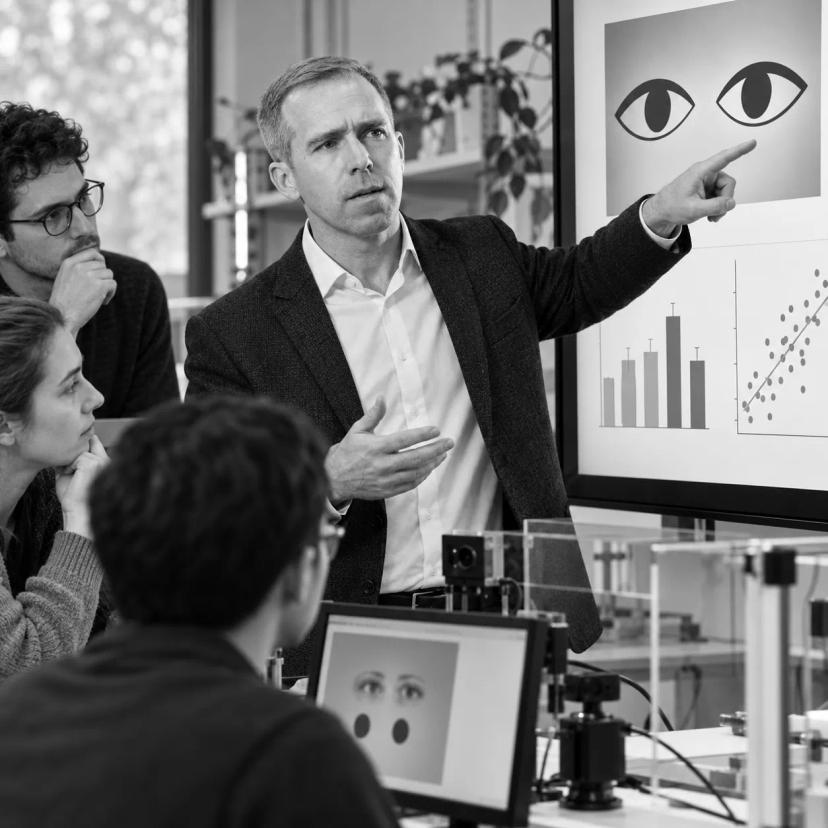
Keith Dear is the first author, with Kevin Dutton and Elaine Fox, of a 2019 systematic review and meta-analysis in Evolution and Human Behavior that linked eye images to a 35 per cent reduction in the risk of antisocial behaviour across 15 experiments.
Who they are
The paper, "Do 'watching eyes' influence antisocial behavior? A systematic review & meta-analysis", appeared in Evolution and Human Behavior, volume 40, issue 3, pages 269 to 280. The Crossref record for the paper lists the authors as Keith Dear, Kevin Dutton and Elaine Fox. The vault note is still filed under the surname, Dear, so existing links keep working.
The review began from a gap. The effect of eye cues on generosity had been questioned through failed replications and two meta-analyses, but the effect on antisocial behaviour had not been reviewed systematically. The authors hypothesised that the effect would be more consistent for antisocial behaviour, given humans' heightened sensitivity to threat.
It included 15 experiments from 13 research papers, with 2,035 participants. Eye cues, such as photographs or stylised images of eyes, were associated with a 35 per cent reduction in the risk of antisocial behaviour. The authors compared that with systematic reviews that estimate CCTV cameras reduce crime by about 16 per cent, and argued there was enough evidence to support eye images as a low-cost crime-reduction measure, particularly in United Kingdom public policy. They also called for more research on how perceived surveillance affects decisions and actions.
The abstract does not set out a separate limitations section, and this library has not read the full paper. The policy conclusion is a strong claim from a single review of 15 experiments.
Key papers
Dear, K., Dutton, K., & Fox, E. (2019). Do "watching eyes" influence antisocial behavior? A systematic review & meta-analysis. Evolution and Human Behavior, 40(3), 269-280. doi:10.1016/j.evolhumbehav.2019.01.006
Key ideas
The review is the main support for the narrow version of The Watching Eyes Effect: that eye images may reduce small acts of rule-breaking even though they do not raise generosity. It sits beside the Newcastle bicycle study by Nettle and colleagues, in which thefts fell 62 per cent at signed sites, a study whose design Tom Stafford criticised in 2013.
This library's earlier note summarised the 2019 paper as finding effects on antisocial behaviour such as littering. The abstract read for this page does not mention littering, so the claim is not repeated here.
Sources
- Dear, Dutton and Fox (2019), abstract read on the University of Birmingham research portal. DOI 10.1016/j.evolhumbehav.2019.01.006, confirmed on the University of Oxford research archive record and at Crossref, which also gives the authors' given names.