Edward R. Murrow
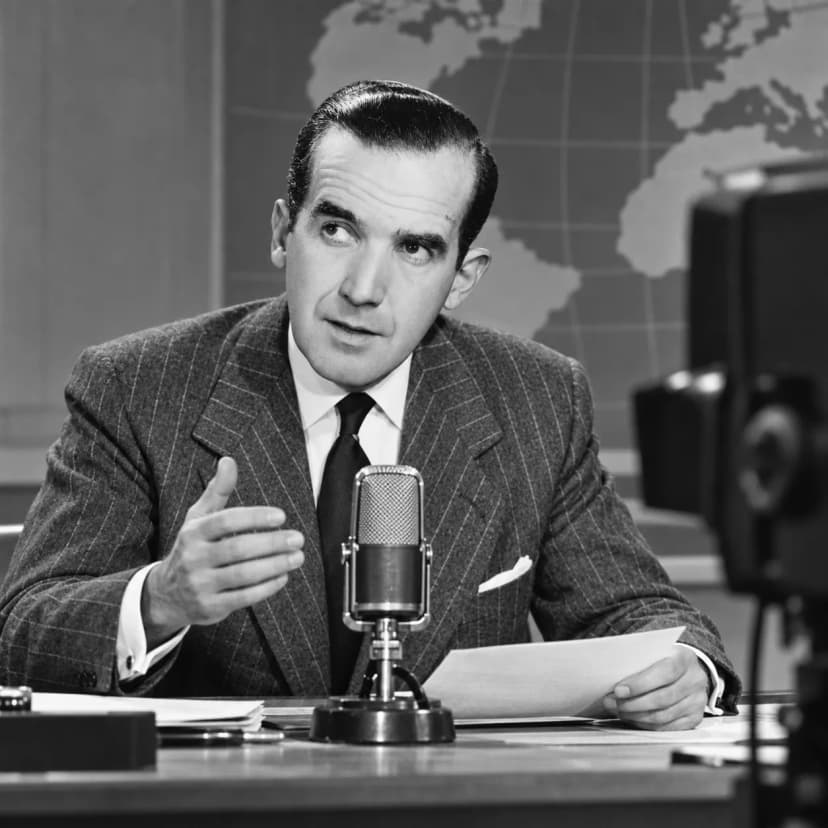
Edward R. Murrow was the CBS broadcaster whose wartime radio reports and television programme See It Now made him, in Tim Wu's account, the first bona fide star of broadcast news. His October 1958 speech argued that television insulated viewers from the realities of the world during peak viewing hours, and that it could teach only to the extent that people were determined to use it so. On this site he is the counter-case to Neil Postman's claim that the form of television rules out serious news.
Who they are
In Wu's account in The Attention Merchants, William Paley sent a twenty-nine-year-old CBS employee, Edward R. Murrow, to Europe in 1937 as director of operations, to collect material for rebroadcast. When Hitler invaded Austria Murrow was pressed into service as a reporter, proved a natural, and became the first bona fide star of broadcast news. His wartime reports from London began "This... is London", and Wu likens their immediacy to teleportation. Wu writes that the approach was objective but not neutral, with Murrow standing on the roof during bombardments while most reporters retreated to bunkers.
Murrow came to television in 1951. His programme See It Now, produced by Fred Friendly, offered weekly news analysis with clips, and The New York Times, in a review Wu quotes, called it a striking and compelling demonstration of the power of television as a journalistic tool. In 1954 the programme challenged the senator behind the Red Scare. Wu reads the episode as the private sector's attention industries defeating official propaganda, which he says had never happened before, and credits it partly to the medium: the same screen that made Murrow appear serene and dependable made his target look like a monster.
The commercial side followed. Alcoa, the programme's sponsor, dropped it in 1955, saying it wanted something different, perhaps fictional. CBS sold the vacated slot to a tobacco company for a quiz show, and in 1958, Wu writes, See It Now was cancelled for good, despite spectacular ratings by present standards, because it was no match for the game shows or for westerns such as Gunsmoke. Wu reports that Murrow left CBS for the Kennedy administration in the early 1960s, and that he could not stand what Paley had done with television. He also records that Murrow opened the National Educational Television service in 1962.
Murrow is evidence for two claims on this site that point in different directions. He shows that the television screen could carry serious journalism to a mass audience. He also shows how that journalism was squeezed out when sponsors and competing programmes set the terms. That is why his story is used against the form theory in the article and not as support for it.
Key papers
Murrow's best-known statement on the subject is his speech of October 1958, reprinted in the Columbia Journalism Review in the Summer 1965 issue. The passages used on this site are below.
Murrow, E. R. (1958). Speech of October 1958 on radio and television, reprinted in Columbia Journalism Review, Summer 1965. https://www.cjr.org/60th/edward-r-murrow-indictment-of-broadcasting.php
He asks the audience to look at the networks' schedules from eight to eleven in the evening, observes that such programming rarely mentions that the nation is in mortal danger, and says: "during the daily peak viewing periods, television in the main insulates us from the realities of the world in which we live". He suggests altering an advertising slogan to read "Look Now, Pay Later". He says the sponsor of an hour's programme is "not buying merely the six minutes devoted to his commercial message". He proposes that sponsors give up some airtime for public-affairs programming, with the sponsor getting name credit and nothing to do with the content. He closes on the instrument itself, which can teach, illuminate and inspire, "but it can do so only to the extent that humans are determined to use it to those ends", and otherwise "is merely wires and lights in a box".
Key ideas
Television can carry serious news. See It Now's 1954 programme on the Red Scare senator and Wu's account of 60 Minutes as a bid to resurrect it.
The schedule and the sponsor decide. His 1958 speech places the problem in the evening schedule and in what a sponsor buys, not in the glass of the screen.
Use is the variable. Television can teach only to the extent that people are determined to use it to those ends. Wu quotes this as the credo of the moderate view that the medium was essentially neutral.
Quality could not win a ratings war. In Wu's reading, once sponsors and competition set the terms, a programme of this kind could lose to game shows and westerns.
How the article uses him
The article Was Amusing Ourselves to Death Right uses Wu's account of See It Now and Murrow's 1958 speech to argue that the same medium carried serious and unserious programmes and that the market, not the form of the screen, chose between them. The vault holds Wu's account from The Attention Merchants, and the speech was read through the Columbia Journalism Review reprint. A fuller treatment of the speech would use the full text.
Sources
- Wu, T. (2016). The Attention Merchants: The Epic Struggle to Get Inside Our Heads. Knopf. The Murrow, See It Now, Alcoa, 60 Minutes and public broadcasting passages, from the vault's source notes on the television chapters.
- Murrow, E. R. (1958). Speech of October 1958, reprinted in Columbia Journalism Review, Summer 1965. https://www.cjr.org/60th/edward-r-murrow-indictment-of-broadcasting.php