Elaine Hatfield
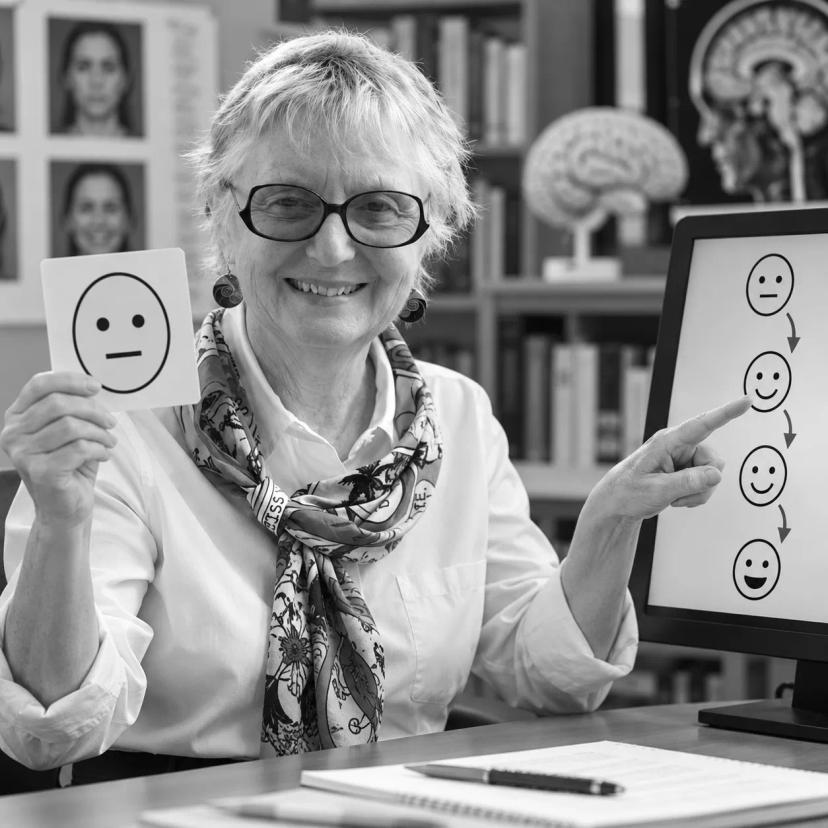
Elaine Hatfield is a psychologist who, with John Cacioppo and Richard Rapson, set out the standard account of emotional contagion: people automatically copy the expressions, voices and postures of others, the copying changes their own feeling, and the feeling spreads. The account appeared in a 1993 paper and in a 1994 book from Cambridge University Press, both titled Emotional Contagion.
Who they are
Hatfield is named in the vault as a psychologist and as first author of the work that gave emotional contagion its modern definition. The book version, Emotional Contagion (1994), was written with John Cacioppo and with Richard Rapson, whom the vault's notes on a popular book describe as a historian. The same notes record that the popular book names no affiliation for her, and this page does not supply one.
Her place in the literature is that of an originator of a framework and not of a single experiment. The 1993 paper in Current Directions in Psychological Science set out the argument in four pages. The 1994 book developed it. Later studies of moods in groups and in service work cite the framework as their starting point.
Key papers
Hatfield, E., Cacioppo, J. T. & Rapson, R. L. (1993). "Emotional contagion." Current Directions in Psychological Science, 2(3), 96-100.
Hatfield, E., Cacioppo, J. T. & Rapson, R. L. (1994). Emotional Contagion. Cambridge University Press.
Key ideas
The central proposal is a sequence of three steps. First, people mimic: they copy, mostly without noticing, the facial expressions, vocal patterns and postures of the people around them. Second, the copying feeds back: the body's own configuration shapes the person's feeling. Third, the feeling has spread, without either party deciding anything. The appeal of the sequence is its speed. Emotional convergence in a room happens faster than any process that involves working out what another person feels.
The evidence for the sequence is uneven. That moods converge in groups is supported. Sigal Barsade's 2002 laboratory study, in which a trained confederate displayed different moods to groups of managers, found that moods spread and that a positive mood improved cooperation. The first step, mimicry, is also supported: a 2006 study of real service encounters by Patricia Barger and Alicia Grandey found that customers' smiles followed the employee's. The middle step is the weakest. It leans on the facial feedback hypothesis, which failed in a 17-laboratory registered replication of its best-known study in 2016 and survives in a small form in later meta-analysis.
A further result complicates the application of the framework to service. In a staged encounter reported by Thorsten Hennig-Thurau and colleagues in 2006, how much actors smiled did not change customers' emotions, while the genuineness of their display did. The same pattern appears in Barger and Grandey's data, where satisfaction followed customers' appraisal of the service and not their own mood. The framework describes a real process, and it does not follow that every display of feeling at a counter sets that process off.
Sources
- Hatfield, E., Cacioppo, J. T. & Rapson, R. L. (1993). "Emotional contagion." Current Directions in Psychological Science, 2(3), 96-100.
- Hatfield, E., Cacioppo, J. T. & Rapson, R. L. (1994). Emotional Contagion. Cambridge University Press.
- Barsade, S. G. (2002). Administrative Science Quarterly, 47(4), 644-675.
- Barger, P. B. & Grandey, A. A. (2006). Academy of Management Journal, 49(6), 1229-1238.
- Hennig-Thurau, T., et al. (2006). Journal of Marketing, 70(3), 58-73.
- Wagenmakers, E.-J., et al. (2016). Perspectives on Psychological Science, 11(6), 917-928.
- Vault notes on The Tipping Point and on Emotional Contagion, verified 2026-09-25.
Studies on this site by Hatfield
- Emotional Contagion
Hatfield (1993) · Current Directions in Psychological Science
Articles that cite Elaine Hatfield
- Emotional Contagion at the Counter
Studies of service encounters split on whether a staff member's mood reaches the customer. A staged encounter found that genuine feeling moved customers and extra smiling did not.
Concepts on this site
- Emotional Contagion
Emotional contagion is the transfer of emotional states between people through mimicry, vocal matching, posture and shared attention. Elaine Hatfield, John Cacioppo and Richard Rapson named and…
- Mimicry
Mimicry is the copying of another person's posture, gesture, speech rhythm, word choice or facial expression during an interaction, usually without either person noticing. The phenomenon is not in…