Eleanor Maguire
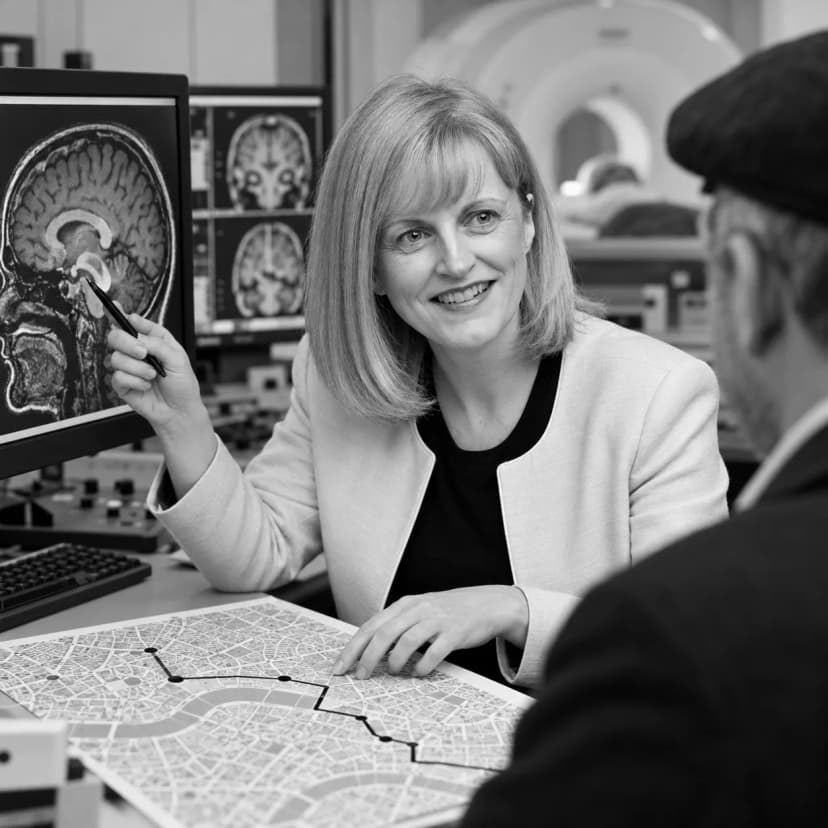
Eleanor Maguire is a cognitive neuroscientist at University College London, working at the Wellcome Centre for Human Neuroimaging. She is first author of the 2000 study that found larger posterior hippocampi in licensed London taxi drivers, and co-author, with Katherine Woollett, of the 2011 study that followed trainee drivers through the years it takes to qualify. Together the two papers are the clearest human evidence that adult brain structure changes with a demanding, specific kind of practice.
Who they are
Maguire is an Irish neuroscientist whose work concerns the hippocampus and how people learn and move through space. London taxi drivers gave her an unusual natural experiment. To be licensed, a driver has to learn the layout of the city, a process known as the Knowledge, and the training typically takes three to four years. Few everyday skills ask so much of one kind of memory over so long a period, and the end of the process is a clear line: a trainee either qualifies or does not.
Her 2000 paper was written with a team that included Chris Frith and Richard Frackowiak, among others. It belongs to the line of work that tested whether the structure of a healthy adult brain differs with experience, against a view that for much of the twentieth century held it did not. The vault records that at least two popular books on attention and the brain use the taxi-driver result without naming her in the body text, which is one reason her name is less familiar than her finding.
Key papers
Maguire, E. A., Gadian, D. G., Johnsrude, I. S., Good, C. D., Ashburner, J., Frackowiak, R. S. J., & Frith, C. D. (2000). "Navigation-related structural change in the hippocampi of taxi drivers." Proceedings of the National Academy of Sciences, 97(8), 4398 to 4403.
The study used structural MRI to compare licensed London taxi drivers with control participants who did not drive taxis. The drivers had significantly larger posterior hippocampi, and the controls had a larger anterior hippocampal region. Hippocampal volume correlated with time spent as a taxi driver, positively in the posterior hippocampus and negatively in the anterior. The authors argued that the posterior hippocampus stores a spatial representation of the environment and can expand regionally when navigational demands are high, and concluded that the structure of the healthy adult human brain can undergo local plastic change in response to environmental demands.
Woollett, K., & Maguire, E. A. (2011). "Acquiring 'the Knowledge' of London's layout drives structural brain changes." Current Biology, 21(24), 2109 to 2114.
The follow-up scanned 79 trainee taxi drivers at the start of training and again afterwards, together with 31 control participants who were not training. Only 39 of the trainees, 51.9 per cent, qualified. Those who qualified had more grey matter in the posterior hippocampus than they had before training. Trainees who did not qualify and the controls showed no such change, and no change appeared in the anterior hippocampus in any group.
Key ideas
Plasticity can be local and specific. The 2000 result is not a claim that the whole brain grows with effort. It is a claim about one region, the posterior hippocampus, in people who spent years on one task, with a trade against the anterior region in the cross-sectional comparison. That specificity is what separates measured neuroplasticity from the general statement that brains can change.
A longitudinal design answers the self-selection objection. A comparison of drivers with non-drivers cannot rule out that people with larger posterior hippocampi are drawn to the job or pass the training more easily. The 2011 study measured the same people before and after, and it had a built-in comparison: trainees who failed the Knowledge had also been trainees and did not show the change. The effect tracked qualifying, and the controls did not change.
There was a cost. Qualified drivers performed worse than controls on other memory tasks, such as recalling complex visual information, and trainees who did not qualify did not show that deficit. The Wellcome Trust press release on the 2011 paper reports this. A structural gain bought by years of practice on one task was not a general improvement in memory.
What the studies do not show. Neither paper tested a product, a course lasting weeks or a test of everyday thinking in the general population. They do not say how much training is needed to produce a change, whether a shorter programme would produce any, or whether the change would carry to a different task. The result is a strong case for the first step of a three-step argument, that adult brains change with use, and it is silent on the second and third.
Sources
- Maguire, E. A., Gadian, D. G., Johnsrude, I. S., Good, C. D., Ashburner, J., Frackowiak, R. S. J., & Frith, C. D. (2000). "Navigation-related structural change in the hippocampi of taxi drivers." Proceedings of the National Academy of Sciences, 97(8), 4398 to 4403. doi:10.1073/pnas.070039597. Checked against the indexed abstract on 2026-10-26, not the full paper.
- Woollett, K., & Maguire, E. A. (2011). "Acquiring 'the Knowledge' of London's layout drives structural brain changes." Current Biology, 21(24), 2109 to 2114. doi:10.1016/j.cub.2011.11.018. The participant numbers and the qualification rate were checked against the author's copy of the paper, and the cost on other memory tasks against the Wellcome Trust press release of December 2011, on 2026-10-26.