Eric Kandel
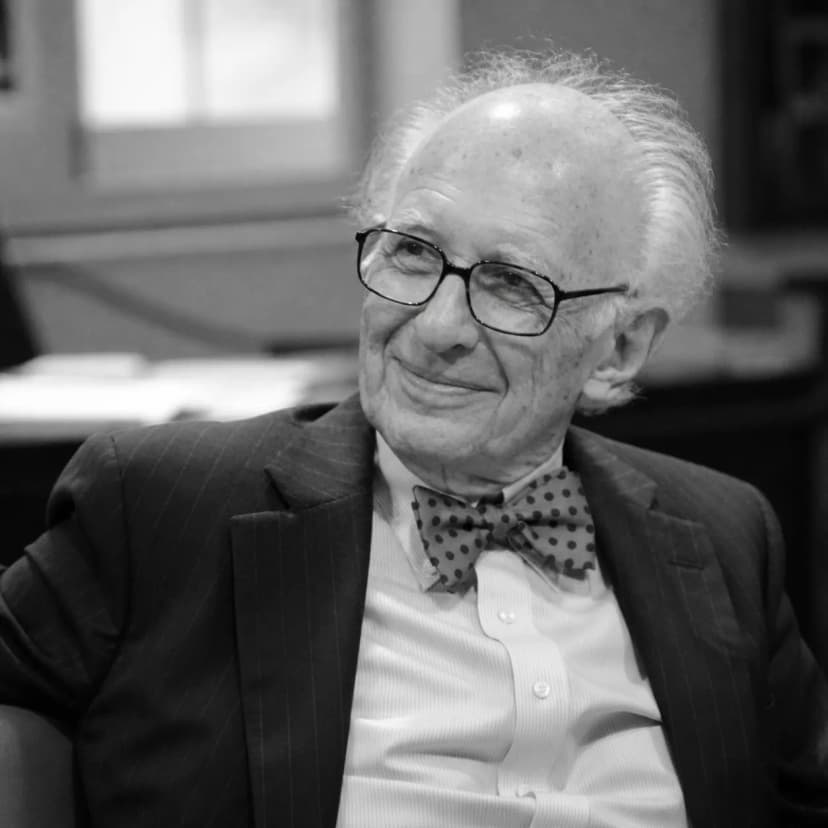
Eric Kandel is an Austrian-American neuroscientist at Columbia University who shared the 2000 Nobel Prize in Physiology or Medicine for establishing the physiological basis of memory storage in neurons. He worked in the sea slug Aplysia, chosen because its nervous system is simple enough that individual connections can be counted, and found that forming a long-term memory means physically building new synaptic connections. That result is why the computer-storage metaphor for human memory is wrong in kind rather than in degree.
Who they are
Kandel was born in Vienna in 1929 and left after the Anschluss, reaching Brooklyn in 1939 at the age of nine. He trained in medicine at New York University, in neurobiology at the National Institutes of Health and in psychiatry at Harvard, and joined Columbia in the mid-1970s as founding director of the Center for Neurobiology and Behavior, now the university's Department of Neuroscience. He was a senior investigator at the Howard Hughes Medical Institute from 1984 to 2022. The 2000 Nobel Prize was shared with Arvid Carlsson and Paul Greengard.
The choice of animal is the interesting decision in his career. Most memory research infers structure from behaviour, because the structure in a mammal is not observable while the behaviour is happening. Aplysia has a nervous system of a few tens of thousands of neurons, many of them large enough to identify individually from one animal to the next, which turns questions about memory into questions about specific cells and specific connections between them.
What that bought is arithmetic. In Aplysia, about 90 per cent of a gill's sensory neurons connect to motor neurons at baseline; after forty touches, about 10 per cent do. Learning that something is harmless shows up as a change in what is wired to what, with nothing metaphorical about it. The same programme supplies the counts for long-term memory: a sensory neuron holds roughly 1,300 synaptic connections normally, rising to around 2,700 once a long-term memory has formed, and settling around 1,500 if the memory is allowed to fade. Something is physically built, and it does not fully unbuild.
Those figures belong where they were measured. Aplysia is an invertebrate, selected precisely because it is simple, and the numbers are a demonstration that memory is structural rather than a measurement that transfers to human synapses. Within that limit, the vault treats this as the most solid science in both The Shallows and Indistractable, and safe to cite without caveat. Nicholas Carr uses it to argue that offloading memory to search engines costs something. The bridge from Kandel's slugs to the internet is Carr's, not Kandel's, and it rests on evidence that has not held up as well as the cell biology has.
Books
Kandel writes for general readers as well as for the field, and the list below was verified against publisher pages on 2026-09-02. Only In Search of Memory appears in the vault note; the rest were checked before being added here.
Separately, and not a book he wrote: Principles of Neural Science, the standard neuroscience textbook, first published by McGraw-Hill in 1981 and edited by Kandel with James H. Schwartz and Thomas M. Jessell. It is an edited multi-author reference work, now in its sixth edition, and should be cited as such rather than as an authored book.
Key papers
The Aplysia work on the cellular and molecular mechanisms of learning, for which he shared the Nobel Prize in Physiology or Medicine in 2000. It established that memory storage has a physical substrate that can be counted: in Aplysia, about ninety per cent of a gill's sensory neurons connect to motor neurons at baseline and about ten per cent after forty touches, and a sensory neuron holds roughly 1,300 synaptic connections normally, rising to about 2,700 once a long-term memory forms and settling around 1,500 if it fades. No single citation for this programme is recorded in the vault, and none is invented here.
Kandel, E. R. (2006), In Search of Memory. His account of the work for a general reader.
Key ideas
Long-term memory is a structural change. Holding something briefly involves temporary chemical changes at synapses that already exist; making it permanent requires the growth of new connections, which takes time and protein synthesis.
The counts in Aplysia: roughly 1,300 synaptic connections at baseline, around 2,700 after a long-term memory forms, around 1,500 after it fades. The residue is the point.
Habituation is visible as wiring. About 90 per cent of a gill's sensory neurons connect to motor neurons at baseline, about 10 per cent after forty touches.
The computer-storage metaphor for memory fails in kind rather than in degree. A computer writes the same file whether it writes it now or in an hour, and nothing in it grows.
A simple animal chosen well answers questions a complicated one cannot, which is a methodological argument as much as a biological one.
Concepts on this site
Memory Consolidation, the process his Aplysia work supplied the cellular account of
Neuroplasticity, the general capacity that consolidation is one instance of
Working Memory, the temporary store on the near side of the change his work describes
Operant Conditioning, the learning machinery this research is the cell-level account of
The vault files him under all four. The first two are his directly. The second two are neighbouring literatures his work sits underneath rather than fields he originated.
Sources
- Kandel, E. R. The Aplysia research programme. Nobel Prize in Physiology or Medicine, 2000, shared with Arvid Carlsson and Paul Greengard. Synaptic connection counts of roughly 1,300 at baseline, 2,700 after long-term memory formation and 1,500 after fading, as recorded in the vault.
- Kandel, E. R. (2006). In Search of Memory: The Emergence of a New Science of Mind. W. W. Norton.
- Kandel, E. R. (2012). The Age of Insight. Random House.
- Kandel, E. R. (2016). Reductionism in Art and Brain Science: Bridging the Two Cultures. Columbia University Press.
- Kandel, E. R. (2018). The Disordered Mind: What Unusual Brains Tell Us About Ourselves. Farrar, Straus and Giroux.
- Kandel, E. R. (2021). There Is Life After the Nobel Prize. Columbia University Press.
- Kandel, E. R., Schwartz, J. H., & Jessell, T. M. (Eds.) (1981). Principles of Neural Science. McGraw-Hill. An edited textbook, not an authored book.
- Carr, N. (2010, updated 2020). The Shallows: What the Internet Is Doing to Our Brains. Chapter 9, where the Aplysia counts reach a general readership.
- Book titles, years and publishers verified against publisher pages on 2026-09-02. Biographical details, the Howard Hughes Medical Institute dates of 1984 to 2022 and the shared Nobel verified the same day.