Francis Galton
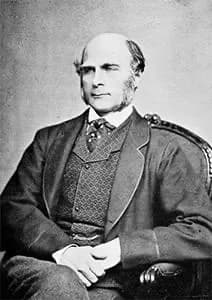
Francis Galton was a Victorian polymath and a half cousin of Charles Darwin. He is the origin of regression to the mean and of the word regression in its statistical sense, which he arrived at while studying inherited stature. He also coined the word eugenics and argued for a programme built on it. Both belong on the same page. The statistical result is arithmetic and cannot fail; the eugenic programme is discredited, and this site records it as his position and never restates it in its own voice.
Who they are
Take the statistics first, because it is what this site cites him for.
Galton published "Regression towards Mediocrity in Hereditary Stature" in 1886, following a Royal Institution lecture given on 9 February 1877. Measuring parents and their grown children, he found that very tall parents had children who were tall but less so, and very short parents children who were short but less so, and he named the pull towards the average regression. The term stuck and the mathematics under it is now one of the load-bearing pieces of the discipline.
The reason it is the most useful item in that literature is that it is not an empirical claim at all. Wherever two measures are imperfectly correlated, extreme scores on the first will on average be followed by less extreme scores on the second, and the weaker the correlation the stronger the pull. Nothing acts on the second measurement. There is no force. That makes it the one finding on this site that cannot fail replication, and the one most reliably mistaken for a cause.
Now the rest of the record, which is documented and which this page carries rather than omits.
Hereditary Genius, 1869, is the study in which Galton attempted to show that eminence runs in families and is therefore inherited. He assembled lists of men he judged eminent, traced their relatives, and argued that the proportion of distinguished kin falls away with the distance of the relationship. It introduced the statistical treatment of a human trait distributed across a population, and the reasoning in it led him towards correlation and regression. It also carries proposals that the state should encourage the reproduction of those he classed as able, and explicit rankings of racial groups. Those are his claims, recorded here as his position and not as findings, and this site does not reproduce them.
Inquiries into Human Faculty and Its Development, 1883, is where the word eugenics first appears in print and where the programme is stated as a programme. The same book contains the questionnaire on visual imagery usually treated as the first survey of individual differences in a mental process, and the twin comparison he offered as a way of separating what he called nature from nurture. The measurement apparatus led to the anthropometric laboratory he opened in 1884, where members of the public paid to be tested.
Where the record stands now, stated plainly. The central inference of Hereditary Genius has long been rejected, because inherited wealth, schooling and social position are nowhere separated from descent in the analysis. His 1880 breakfast table study of mental imagery failed to replicate in Brewer and Schommer-Aikins, Review of General Psychology, 2006, who also found that Galton's own published data do not support the conclusion he drew from them. The eugenic and racial claims are discredited. The historical account this vault relies on for the tradition, David Brydan's Smart, is explicit that its own verdict is a historian's judgement on a political movement rather than a technical refutation, and that resistance to intelligence testing came substantially from the communities the tests were used against. This page follows that book's practice: every such claim is attributed, dated and sourced, and none is paraphrased into this site's voice.
The two halves are not in tension and neither cancels the other. A correct piece of mathematics does not launder the programme it was developed alongside, and the programme does not make the mathematics wrong.
Key papers
Galton, F. (1886). "Regression towards Mediocrity in Hereditary Stature". The paper that names regression and the source of the result this site cites him for. It followed a Royal Institution lecture of 9 February 1877.
Galton, F. (1869). Hereditary Genius. The hereditarian study of eminence, which introduced the statistical treatment of a human trait across a population and which also sets out the proposals he later named eugenics, together with explicit racial rankings. Recorded as his position, not as findings. Not read in this vault.
Galton, F. (1883). Inquiries into Human Faculty and Its Development. The first appearance in print of the word eugenics, and the statement of the programme. Also the visual-imagery questionnaire and the twin comparison. Not read in this vault.
Brewer, W. F., & Schommer-Aikins, M. (2006). Review of General Psychology. The replication attempt on the 1880 breakfast table study of mental imagery, which failed, and which found Galton's own published data inconsistent with his conclusion.
Key ideas
Regression to the mean. Where two measures are imperfectly correlated, extreme scores on one are followed on average by less extreme scores on the other. It is arithmetic rather than an empirical finding, and nothing acts on the second measurement.
The test it gives a reader is the cheapest debunking tool on this site. Any claim of the form "we intervened at the low point and things improved" needs regression ruled out before it needs an explanation. Remedial teaching, sports slumps, sales coaching and treatments begun at the worst moment all qualify.
The word regression is his, in its statistical sense, and it entered the language from a study of inherited height.
Eugenics is also his word, coined in 1883, and the programme attached to it is his position. It is discredited. This site names it, dates it, sources it and does not restate it.
His statistical innovations and his hereditarian beliefs were not separate enterprises for him. The measurement work was undertaken in service of the programme, which is a fact about the history and not a verdict on the arithmetic.
Sources
- Galton, F. (1886). "Regression towards Mediocrity in Hereditary Stature".
- Galton, F. (1869). Hereditary Genius. Vault book page, written from the public record for the book. Not read here.
- Galton, F. (1883). Inquiries into Human Faculty and Its Development. Vault book page, written from the public record for the book. Not read here.
- Brewer, W. F., & Schommer-Aikins, M. (2006). Review of General Psychology. Reported via the vault's reliability audit of Bizarre, which records the dispute accurately.
- Brydan, D. Smart. The vault's historical source for the eugenics and intelligence-testing tradition, whose own handling rule is followed here: hereditarian and racial claims appear only as attributed reported speech, and the book's rejection of them is a historian's verdict rather than an evidence review.
- Kahneman, D. (2011). Thinking, Fast and Slow, ch. 17. Kahneman's exposition of regression to the mean, and the route by which it reaches this site. Not a source for Galton himself.
- Vault note: [[Francis Galton]], whose scope note records that the vault holds him primarily as the source of a statistical result.