Gerd Gigerenzer
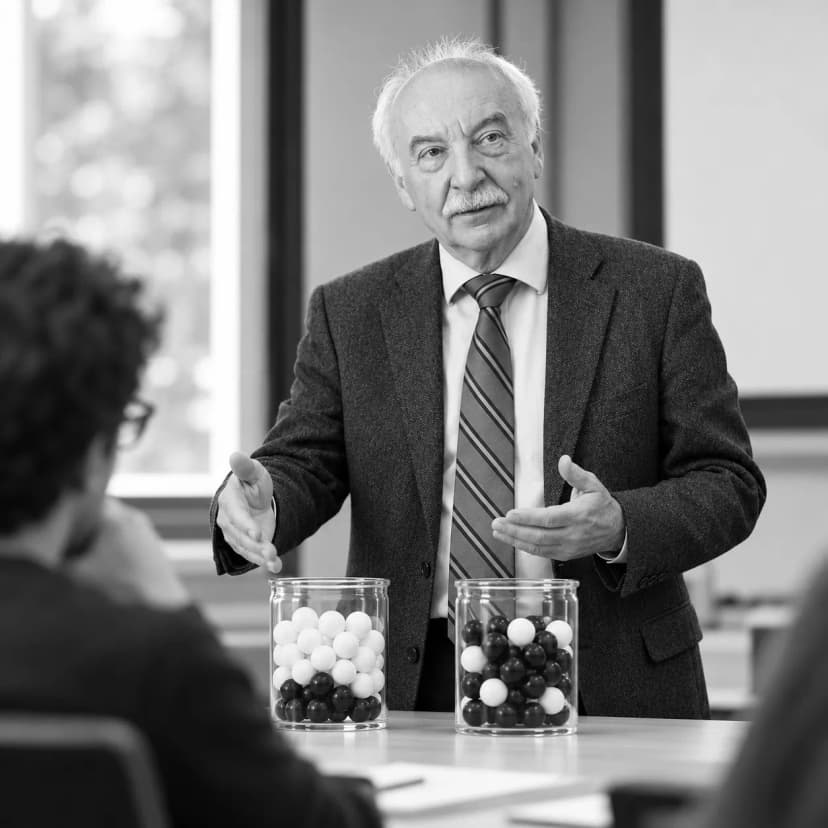
Gerd Gigerenzer is a psychologist and the most persistent critic of the heuristics-and-biases programme, arguing not that its experiments are wrong but that the conclusion drawn from them is. He is associated with natural frequencies, with the study of fast and frugal heuristics, and, in the work used here, with the finding that road deaths rose in the United States after 11 September 2001 because people drove instead of flying. In 2012 he was listed at the Harding Center for Risk Literacy at the Max Planck Institute for Human Development in Berlin.
Who they are
This vault's note on him describes a psychologist whose two central contributions are natural frequencies and fast and frugal heuristics. The first is the finding that reasoning judged defective when probabilities are stated for single events often improves sharply when the same information is stated as natural frequencies. The second is the argument that simple rules can perform well in the environments where people actually use them, which the vault records as a live disagreement with Daniel Kahneman. Kahneman answers him in an endnote of Thinking, Fast and Slow, where he argues that the real-world evidence for fast and frugal heuristics outside constructed environments is thin. The vault keeps both positions.
The gaze heuristic belongs to the same programme. It is a rule for intercepting a moving object without calculation: fix the gaze on the ball, start running, and adjust speed so that the angle of gaze stays constant.
The work that matters for the article on the availability heuristic is applied risk research. He studies how people respond to rare, vivid, frightening events, and how those responses can cause more harm than the events themselves.
Key papers
Gigerenzer, G. (2004). Dread risk, September 11, and fatal traffic accidents. Psychological Science, 15(4). Using Department of Transportation data for the three months after the attacks, he found that the number of people killed on the road while avoiding flying exceeded the total number of passengers killed on the four fatal flights. A later re-analysis by Sivak and Flannagan put his estimate for those three months at 353 additional road deaths and found 1,018.
Gigerenzer, G. (2006). Out of the frying pan into the fire: Behavioral reactions to terrorist attacks. Risk Analysis, 26(2), 347-351. Air travel fell, interstate highway travel rose for about a year, and fatal highway crashes exceeded the baseline in each month of that year. He estimated about 1,500 Americans died on the roads while trying to avoid the fate of the flight passengers.
Gaissmaier, W., & Gigerenzer, G. (2012). A study of regional variation in traffic deaths after the attacks, summarised in an Association for Psychological Science release. It reported about 1,600 more traffic fatalities than expected in the year after the attacks, and found that the increase in driving was strongly associated with driving opportunity and only slightly with proximity to New York City.
Key ideas
The central idea in this strand of his work is that a frightening event can do harm through the behaviour it provokes. The 2004 and 2006 papers treat the response to 11 September as a case: avoiding the visible risk of flying moved people into the less visible and larger risk of driving. He calls the underlying fear dread risk.
The 2012 paper adds a condition. Fear alone did not predict the rise in driving. Opportunity did. People with more roads and more cars per head drove more. The authors draw the practical conclusion that there are two routes to changing the outcome: changing minds, through education or awareness campaigns, or changing environments so that fear has fewer harmful outlets.
For a reader interested in the availability heuristic, his work is a reminder that two accounts can fit the same event. Dread is about how a hazard feels. Availability is about how readily examples come to mind. In the first weeks after a vivid attack the two are hard to tell apart, and the studies described here were not built to separate them.
He is also a useful counterweight in the wider literature. His objection to the biases programme is that experiments built to expose errors can mistake sensible use of simple rules for irrationality. That position is held here alongside the opposing one, and neither is presented as the settled answer. This page records his current institutional position only as it was listed in 2012.
Sources
- Gigerenzer, G. (2004). Dread risk, September 11, and fatal traffic accidents. Psychological Science, 15(4). https://doi.org/10.1111/j.0956-7976.2004.00668.x
- Gigerenzer, G. (2006). Out of the frying pan into the fire: Behavioral reactions to terrorist attacks. Risk Analysis, 26(2), 347-351. https://doi.org/10.1111/j.1539-6924.2006.00753.x
- Association for Psychological Science (2012). Fear and Driving: Opportunity Motivated Changes in Driving Behavior After 9/11. News release, 31 August 2012. https://www.psychologicalscience.org/news/releases/fear-and-driving-opportunity-motivated-changes-in-driving-behavior-after-911.html
- Sivak, M., & Flannagan, M. J. (2004). Consequences for road traffic fatalities of the reduction in flying following September 11, 2001. Transportation Research Part F, 7(4-5), 301-305. https://swov.nl/en/publicatie/consequences-road-traffic-fatalities-reduction-flying-following-september-11-2001