Gil Morrot
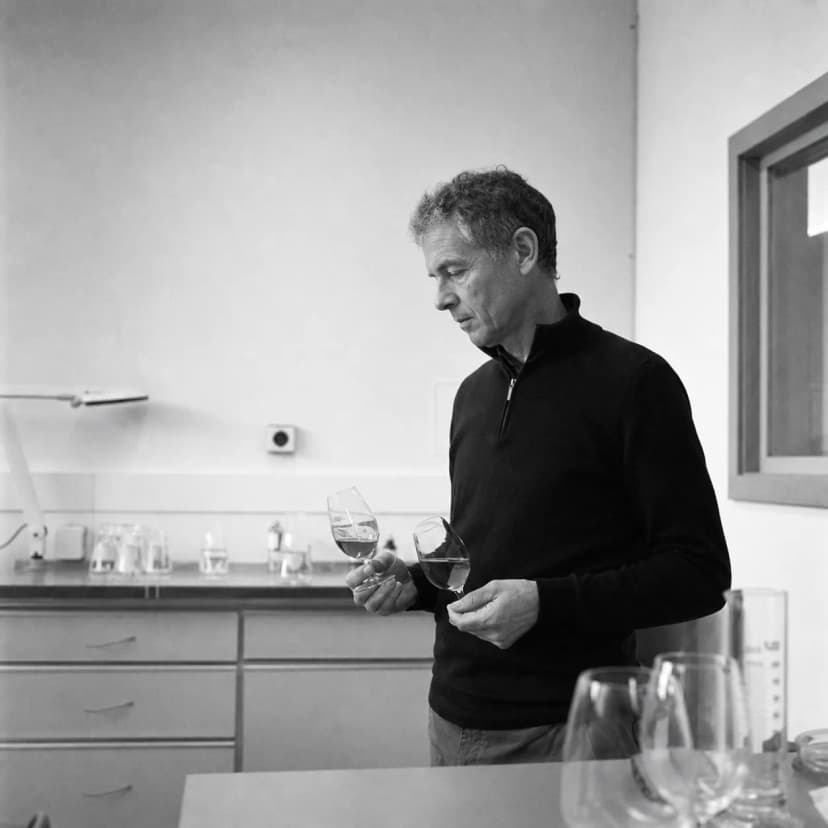
Gil Morrot is a sensory scientist at the Centre INRA de Montpellier and the first author of the study almost everyone credits to somebody else. Morrot, Brochet and Dubourdieu (2001), published in Brain and Language, took a white wine, dyed it red with an odourless dye, and found that a panel of 54 tasters then reached for red-wine vocabulary to describe what they were smelling. The paper is the sensory leg of the context effect on this site. It is routinely attributed to Frédéric Brochet, who is second author.
Who they are
Morrot is a sensory scientist at the Centre INRA de Montpellier. His name on this site is attached to one paper, "The Color of Odors," published in Brain and Language in 2001 with Frédéric Brochet and Denis Dubourdieu.
The design is simple enough to survive being retold, which is part of why it has been retold so often and so loosely. A white wine was coloured red with an odourless dye and presented to a panel of 54 tasters, who described its odour. Their descriptions shifted towards the vocabulary that belongs to red wine. The eyes supplied the category, and the language followed the category rather than the liquid.
State the finding carefully, because the popular version overstates it. The sample is small, and the design is a within-subjects analysis of the words tasters chose rather than a forced-choice discrimination test. What it demonstrates is that colour reshapes how tasters describe a wine. It is not, on its own, evidence that colour reshapes perception itself. That distinction gets lost every time the study is retold as proof that experts cannot tell red from white, which is not what was measured.
The attribution problem is worth stating plainly. This paper is Morrot's, with Brochet second and Dubourdieu third, and it is the paper most often cited alongside the dyed-wine anecdote. Brochet is the name that travels, partly because his 2001 doctoral thesis at the Faculty of Oenology, University of Bordeaux II, contains a related dyed-wine demonstration of his own, and partly because the two documents have been merged in most retellings into a single famous experiment with a single famous author. They are not the same study and the first author of the peer-reviewed one is Morrot.
On the strength of the evidence, this page treats Morrot's result as the lighter of two legs. The heavier one is Hilke Plassmann and colleagues' 2008 fMRI work, which found that believing a wine was expensive raised both rated pleasantness and activity in the medial orbitofrontal cortex. Plassmann shows a frame reaching into the neural signature of the experience. Morrot shows a frame reaching into the words. Both matter, and only one of them supports the strong claim.
Key papers
One paper of his is sourced on this site. The two Brochet documents are listed alongside it because the three are persistently confused with one another.
Morrot, G., Brochet, F., & Dubourdieu, D. (2001), "The Color of Odors," Brain and Language, 79(2), 309-320. N = 54. A white wine dyed red with an odourless dye was described in red-wine terms. Morrot is first author.
Frequently confused with:
Brochet, F. (2001), "Aspects cognitifs de la dégustation" (doctoral thesis), Faculty of Oenology, University of Bordeaux II. Contains Brochet's own dyed-white-wine demonstration. Never published as a standalone peer-reviewed paper.
Brochet, F., & Dubourdieu, D. (2001), "Wine descriptive language supports cognitive specificity of chemical senses," Brain and Language, 77, 187-196.
Key ideas
Colour supplies a category, and the descriptive vocabulary follows the category rather than the liquid in the glass.
Trained tasters were not protected by their training. Expertise gave them a richer vocabulary to apply to the wrong wine.
What the study supports is a claim about description, not about perception. The design is a lexical analysis, not a discrimination test, and the panel was 54 people.
Morrot is first author. The study is habitually credited to Brochet, and a citation correction is not finished until it reaches the entity layer.
Concepts on this site
The context effect, the sensory-perception case, alongside Plassmann's neural one
Sources
- Morrot, G., Brochet, F., & Dubourdieu, D. (2001), "The Color of Odors," Brain and Language, 79(2), 309-320.
- Brochet, F. (2001), "Aspects cognitifs de la dégustation" (doctoral thesis), Faculty of Oenology, University of Bordeaux II.
- Brochet, F., & Dubourdieu, D. (2001), "Wine descriptive language supports cognitive specificity of chemical senses," Brain and Language, 77, 187-196.
- Plassmann, H., O'Doherty, J., Shiv, B., & Rangel, A. (2008), "Marketing actions can modulate neural representations of experienced pleasantness," Proceedings of the National Academy of Sciences, 105(3), 1050-1054.