Herbert Simon
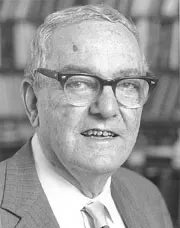
Herbert A. Simon (1916 to 2001) was an American economist and social scientist at Carnegie Mellon University who received the 1978 Nobel Memorial Prize in Economic Sciences for his research into decision-making inside economic organisations. For this site he is the source of the scarcity argument behind the attention economy. In a 1971 chapter on designing organisations for an information-rich world he argued that abundant information uses up the attention of its recipients, so attention has to be allocated among competing sources.
Who they are
Simon was born in Milwaukee, Wisconsin, on 15 June 1916 and died in Pittsburgh, Pennsylvania, on 9 February 2001. His mother was a pianist and his father an electrical engineer who had emigrated from Germany. An uncle who was an economist drew him towards the social sciences. He studied at the University of Chicago, where he took a doctorate in political science in 1943, and then worked at the University of California, Berkeley, and the Illinois Institute of Technology in Chicago before joining Carnegie Mellon University in 1949.
The Nobel committee made him the sole laureate in economic sciences in 1978, for his pioneering research into the decision-making process within economic organisations. The prize record describes his work as blending several academic disciplines. It records that he challenged the prevailing view that firms and entrepreneurs always act with perfect rationality and aim solely at maximum profit, argued that people generally choose in ways that depart from strict rationality, and described companies as adaptive systems made up of physical, personal and social components. His name is closely associated with the concepts of bounded rationality and satisficing, both of which have notes elsewhere in the vault.
The attention argument comes from a different part of his career, the study of how organisations should be designed when information is plentiful. He wrote it for a volume on computers and communications and the public interest, which brought together contributions on the social effects of the new information technologies of its time.
Key papers
Simon, H. A. (1971). Designing organizations for an information-rich world. In M. Greenberger (Ed.), Computers, Communications, and the Public Interest. Baltimore: Johns Hopkins Press. The chapter in which he states that a wealth of information creates a shortage of whatever the information consumes, which is the attention of its recipients.
The chapter makes several connected points. Attention must be allocated among the many sources that might consume it, so treating more information as always better is a mistake. The cost of a message includes the time and attention spent receiving it, which can exceed the cost of producing and sending it. An information system helps an organisation only if it takes in more than it sends on, so that good systems reduce the demands on a manager's attention. He compared the problem to a fixed supply of food shared among a growing population of rabbits. He also suggested that habits formed when printed material was scarce, such as saving and reading everything, fit badly with broadcast media and copying machines, and that people have long coped with overload by practical means such as postponing a judgement of a persuasive speaker until later.
Key ideas
Attention is the scarce resource of an information-rich world, and the useful question about any information system is how much attention it spares its users rather than how much information it delivers.
Information has a cost that falls on the receiver as well as the sender, because receiving takes time.
The chapter concerns organisations and managers. It does not use the phrase attention economy, and the sources used for this site do not show that Simon applied the argument to media or consumers. The later attention economy builds on the premise he stated: if information is abundant and attention is fixed, attention has to go somewhere.
Sources
- Nobel Prize Outreach. Herbert A. Simon, facts. Sveriges Riksbank Prize in Economic Sciences in Memory of Alfred Nobel, 1978. nobelprize.org.
- Simon, H. A. (1971). Designing organizations for an information-rich world. In M. Greenberger (Ed.), Computers, Communications, and the Public Interest. Baltimore: Johns Hopkins Press.
Articles that cite Herbert Simon
- Why Good Enough Often Makes Us Happier
Searching for the best tends to win on an outside measure and lose on how the result feels. Research that separates a high standard from a habit of endless search shows where the feeling is lost.
- What is the attention economy?
The attention economy treats human attention as a scarce resource that publishers and advertisers compete for. Its sources run from a 1971 chapter to a 1997 paper, a history of the newspaper trade…
Concepts on this site
- Attention Economy
The attention economy is the idea that, when information is abundant, attention becomes the scarce resource that publishers, producers and advertisers compete for and trade. Herbert Simon described…
- Automatic vs Controlled Attention
There are two kinds of attention: the reflexive kind that is seized involuntarily by movement, colour or noise, and the deliberate kind a person chooses to direct. The distinction is one of the most…
- Chunking
Grouping material into small units so that working memory can hold it.
- Cognitive Load
Cognitive load theory is John Sweller's account of why learning breaks down: working memory can only handle a small amount at once, so how material is presented changes how much of it is learned…
- Heuristic Versus Active Processing
This is the reversal L. J. Shrum, James E. Burroughs and Aric Rindfleisch reported in 2005, and it is the reason there is no single tidy story about how television gets into a head. Attention during…
- Heuristics
This is the reversal L. J. Shrum, James E. Burroughs and Aric Rindfleisch reported in 2005, and it is the reason there is no single tidy story about how television gets into a head. Attention during…
- Maximisers and Satisficers
Maximisers seek the best available option; satisficers take the first that clears their standard.
- Switch Cost
Switch cost is what moving attention between tasks charges you, and the charge is not the interruption's length but the reorientation on either side of it. The evidence our notes rest on is Foerde…
- Working Memory
Working memory is the small, temporary store that holds whatever you are currently thinking about, and everything that reaches long-term memory passes through it first. That makes its size the…