Jere Brophy
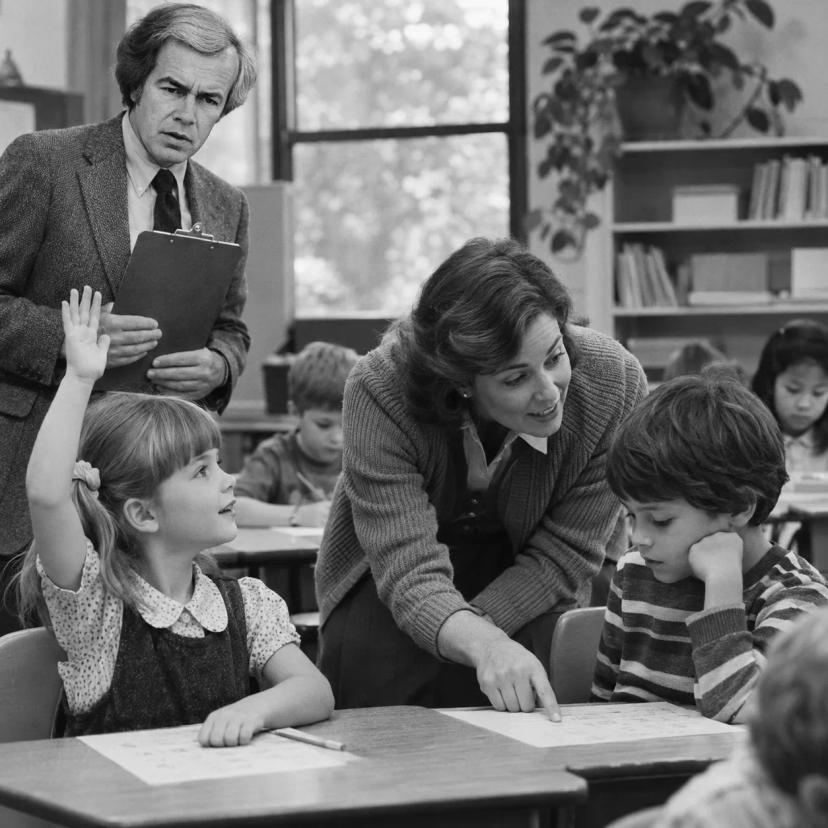
Jere Brophy is the first author, with Thomas Good, of a 1970 paper in the Journal of Educational Psychology titled Teachers' communication of differential expectations for children's classroom performance: Some behavioral data. The paper reports direct observation of four first-grade classrooms, comparing how teachers responded to pupils they had ranked high in achievement with how they responded to pupils they had ranked low.
Who they are
Brophy appears in this vault through that one paper, and this page describes the paper and nothing beyond it. The study took place in four first-grade classes in a small school district. In each class the teacher ranked the pupils by achievement. Observers then followed three boys and three girls from the top of the list and three boys and three girls from the bottom, forty-eight children in all. Each class was observed on four days, covering a full morning or afternoon, and the teachers did not know which individual children were being watched.
Key papers
Brophy, J. E., & Good, T. L. (1970). Teachers' communication of differential expectations for children's classroom performance: Some behavioral data. Journal of Educational Psychology, 61(5), 365-374. https://doi.org/10.1037/h0029908
Key ideas
The paper looked at the quality of the exchanges between teacher and pupil, and found differences in how teachers handled the two groups. When a pupil ranked high did not answer or answered wrongly, the teacher was more likely to repeat the question, rephrase it or offer a hint, giving the child another chance. With pupils ranked low, teachers more often supplied the answer themselves or turned to another child. Teachers also praised correct answers from pupils ranked high more often, and pupils ranked high more often raised their hands and started work-related contacts with the teacher. The direction of the pattern was the same in all four classes, although the size of the gap varied from class to class.
The study recorded behaviour. It did not follow the children's achievement forward, so it shows how a teacher's expectation could be communicated and leaves open how much it changed what pupils later achieved. The authors framed the findings as consistent with the idea that teacher expectations can become self-fulfilling prophecies.
Rosenthal and Jacobson's Oak School study showed that induced expectations could accompany higher test scores. Brophy and Good looked inside lessons for the everyday behaviours through which an expectation might reach a child.
Sources
- Brophy, J. E., & Good, T. L. (1970). Journal of Educational Psychology, 61(5), 365-374. https://doi.org/10.1037/h0029908
Studies on this site by Brophy
- Teachers' communication of differential expectations for children's classroom performance: Some behavioral data
Brophy (1970) · Journal of Educational Psychology
Articles that cite Jere Brophy
- What is the Pygmalion effect?
A label given to a rat, a pupil or a platoon changed how people treated it. The studies show where the effect appears, how it travels and how large it turns out to be.
Concepts on this site
- The Pygmalion Effect
The Pygmalion effect is the claim that a teacher's or a manager's expectations change how well the person they are expecting things from actually performs, rather than only changing how that…