Jerker Denrell
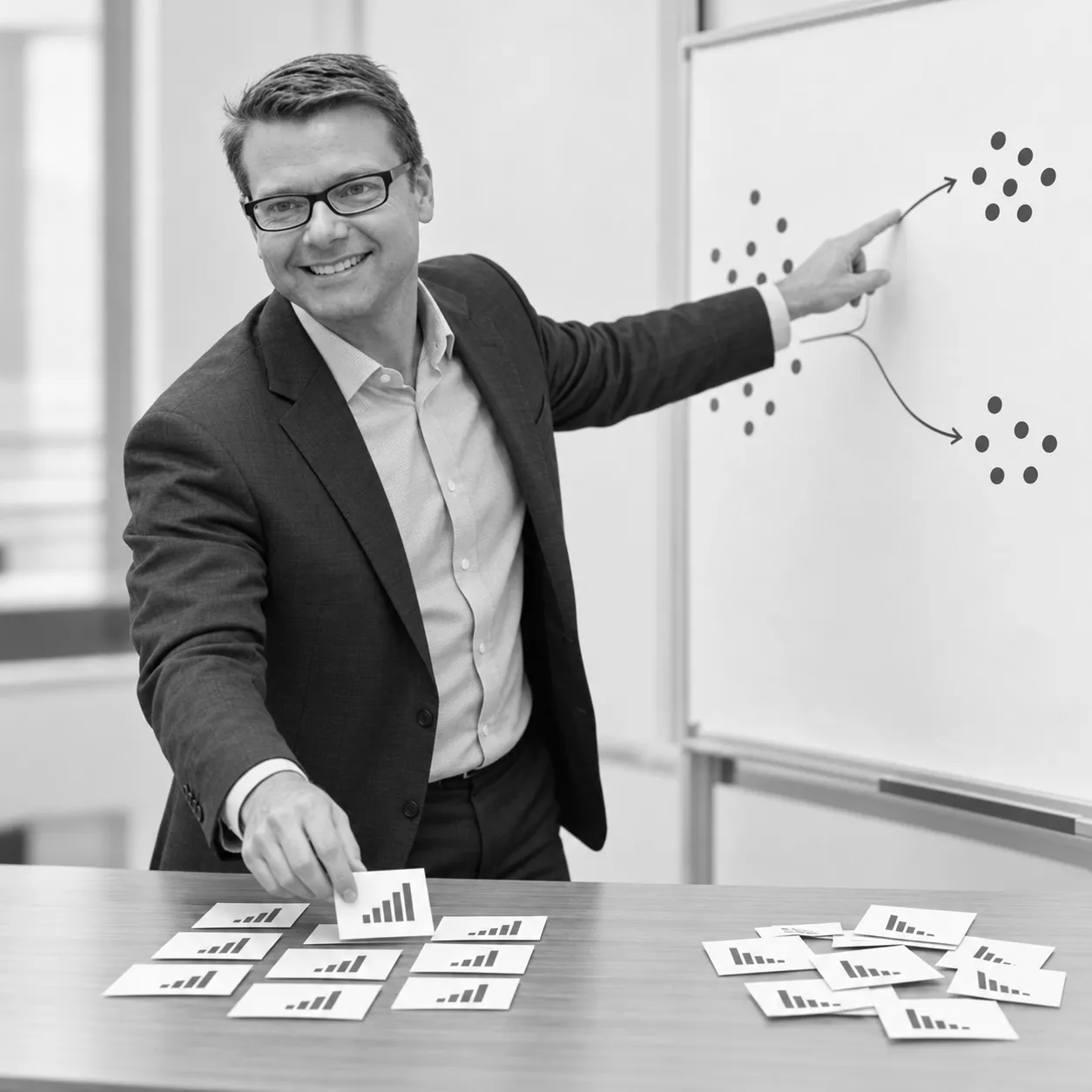
Jerker Denrell is Professor of Behavioural Science at Warwick Business School and the author of 'Vicarious Learning, Undersampling of Failure, and the Myths of Management' (Organization Science, 2003). The paper argues that organisations learn from the firms they can observe, that those firms are mostly survivors, and that risky practices can therefore look beneficial among survivors even when they make no difference across the whole population.
Who they are
Denrell's university profile lists him as Professor of Behavioural Science in the Behavioural Sciences Group at Warwick Business School, which he joined in 2012. His earlier posts were Professor of Strategy and Decision Making at the University of Oxford and Associate Professor of Organizational Behavior at Stanford Graduate School of Business.
He studied philosophy, economics and management at Lund University and mathematics at Stockholm University, and took his PhD at the Stockholm School of Economics in 1998. His research covers how learning and decision-making shape strategy, which the profile describes as behavioural strategy, and organisation theory. The topics it names include persistence of performance, organisational learning and risk-taking.
The profile lists publications in Psychological Review, Science, PNAS, Management Science, Organization Science, the Strategic Management Journal and Administrative Science Quarterly. It also records a teaching award for outstanding contributions to the master's programmes, received four years running.
Key papers
Denrell, J. (2003). 'Vicarious Learning, Undersampling of Failure, and the Myths of Management.' Organization Science, 14(3), 227 to 243. doi:10.1287/orsc.14.2.227.15164. Sole author. Abstract read.
Key ideas
The 2003 paper starts from an ordinary habit. Organisations improve by watching other organisations, and the sensible-seeming strategy is to copy the best performers. Denrell's point is about what the observer can see. The firms available for study are mostly survivors, and failures are undersampled. An observer who looks only at the visible firms can form false beliefs about what drives performance.
His conclusion is that risky practices can look beneficial among survivors even when they have no effect across the full population, and that observation alone can produce convincing but misleading evidence for several common management practices. The remedy follows from the diagnosis: the evidence that would test the practice sits with the firms that tried it and did not last.
The mechanism is easy to state. Suppose two strategies have the same average return, but one scatters outcomes widely. The widely scattered strategy then supplies both the biggest successes and the worst failures. Studying only the top of the ranking finds its practitioners overrepresented there, and the conclusion that it pays follows from the selection and not from the strategy. This is the arithmetic Survivorship Bias in Success Stories uses to explain why success stories mislead.
The abstract spells out what this does to practice. Where the observed sample underrepresents failure, managers' theories can be systematically biased, and the bias can make unreliable practices and concentrated allocation of resources appear superior to reliable practices and diversified allocation. The paper appeared in Organization Science in June 2003 and has a single author.
The article uses the paper for one narrow purpose. The firms a manager can observe are a filtered sample, and the filter can create a link between risk and success that the whole population does not contain. Nothing in the article relies on the paper for how large the effect is in practice.
The paper is a theoretical argument about learning from observation. It does not measure how often managers actually make this mistake, and this page claims no more for it than that.
Sources
- Denrell, J. (2003). 'Vicarious Learning, Undersampling of Failure, and the Myths of Management.' Organization Science, 14(3), 227 to 243. Abstract read.
- Warwick Business School, staff profile for Professor Jerker Denrell. Read for position, education and research areas.
Studies on this site by Denrell
- Vicarious Learning, Undersampling of Failure, and the Myths of Management
Denrell (2003) · Organization Science
Articles that cite Jerker Denrell
- Survivorship Bias in Success Stories
Success stories are chosen because the outcome was good, so whatever the winners share looks like a cause. Abraham Wald's returning bombers, a database of 2,071 US equity funds and a fighter pilot's…
Concepts on this site
- Survivorship Bias
Survivorship bias is reasoning from the cases that made it, because those are the only ones still visible. The failures left no trace, so the pattern found among the winners looks like a cause when…