Joseph Juran
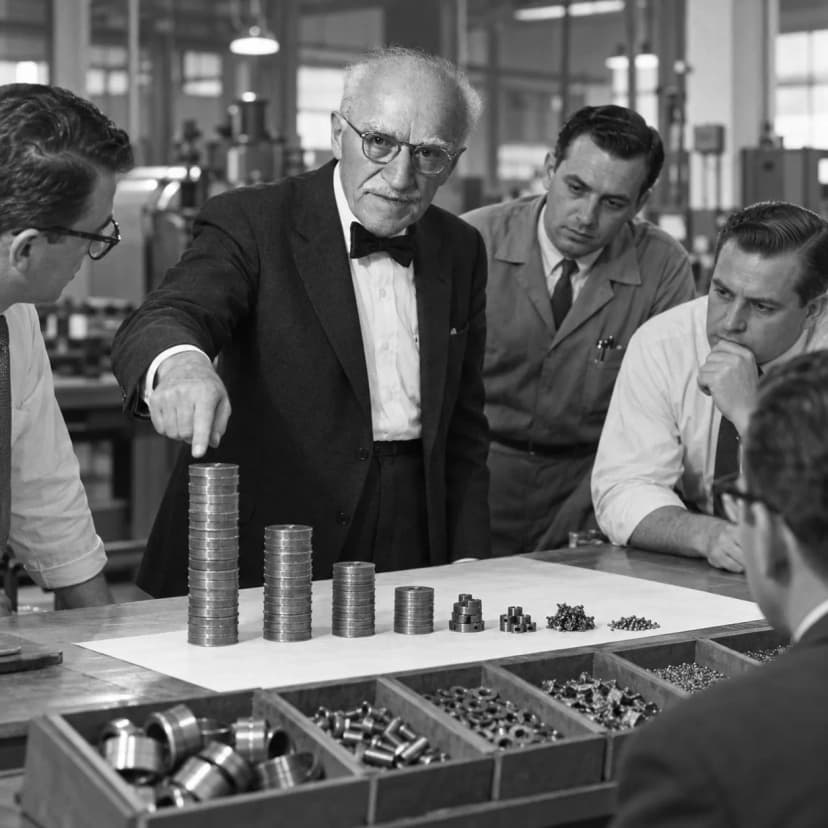
Joseph Juran (1904 to 2008) was a quality-management engineer and writer, and the editor of the Quality Control Handbook. He named the Pareto principle after Vilfredo Pareto and popularised the phrase the vital few and the trivial many. In a 1974 paper titled "The Non-Pareto Principle; Mea Culpa" he wrote that the principle as a universal was not original with Pareto, and that Pareto's models were not intended to be applied to other fields.
Who they are
According to the Juran Institute, Juran was born in Romania in 1904, and his family moved to Minnesota in 1912. He graduated in electrical engineering in 1924 and was hired by Western Electric's Hawthorne Works, where, the Institute says, he began developing what he called universal principles, starting with the Pareto principle. After the Second World War he became a professor of industrial engineering at New York University, teaching quality management. He first visited Japan in 1954 and made nine more visits to teach quality management. He founded the Juran Institute in 1979, retired at 90 and died in 2008 at the age of 103.
His own account of how he came to Pareto's work is in the 1974 paper. He says he met it in the late 1930s through an executive who presided over the executive salary programme at General Motors, who compared the company's salary pattern with one of Pareto's models. Juran notes that Pareto "had made extensive studies of the unequal distribution of wealth", and that the first exposition of the principle as a universal was, to his knowledge, his own.
Two features of the sources are worth stating. The biographical details above come from the website of the organisation he founded, and the account of the paper comes from the paper itself, which is a recollection written decades after the events it describes. This page uses both as statements of what Juran and his institute say, and does not treat either as independent confirmation.
Key papers
Juran, J. M. (1974). "The Non-Pareto Principle; Mea Culpa." Juran Institute archive. The paper's own reference list also cites a 1950 article, "Pareto, Lorenz, Cournot, Bernoulli, Juran and Others", in Industrial Quality Control, and the first edition of the Quality Control Handbook (McGraw-Hill, 1951).
Juran, J. M. (1954). "Universals in Management Planning and Controlling." The Management Review, November 1954. In the 1974 paper Juran calls this "likely" the first published use of the phrase the vital few and the trivial many.
Juran, J. M. (1964). Managerial Breakthrough. The Juran Institute describes it as the first book to lay out a step-by-step sequence for breakthrough improvement.
Key ideas
The vital few and the trivial many. Juran wrote that he contributed to the spread of the principle by coining and popularising this phrase. A footnote to the 1974 paper records that he later changed it to the useful many.
The name was shorthand. Juran wrote that he had "no qualms about Pareto's name", and also that, had he been structured along different lines, he would assuredly have called it the Juran principle.
The retraction. The paper's title carries the apology. Juran wrote that the Pareto principle as a universal was not original with Pareto, and that Pareto's work had been in the economic sphere and his models were not intended to be applied to other fields. The text of the paper does not state the 80 or the 20, which is worth knowing for anyone who meets the 80/20 rule in marketing and assumes it came from him in that form.
See Law of the Vital Few for how the idea has been measured on customer data since.
Sources
- Juran Institute. "Dr. Joseph M. Juran." https://www.juran.com/about-us/dr-jurans-history
- Juran, J. M. (1974). "The Non-Pareto Principle; Mea Culpa." Juran Institute archive. https://www.juran.com/wp-content/uploads/2021/03/The-Non-Pareto-Principle-1974.pdf