Kalina Christoff
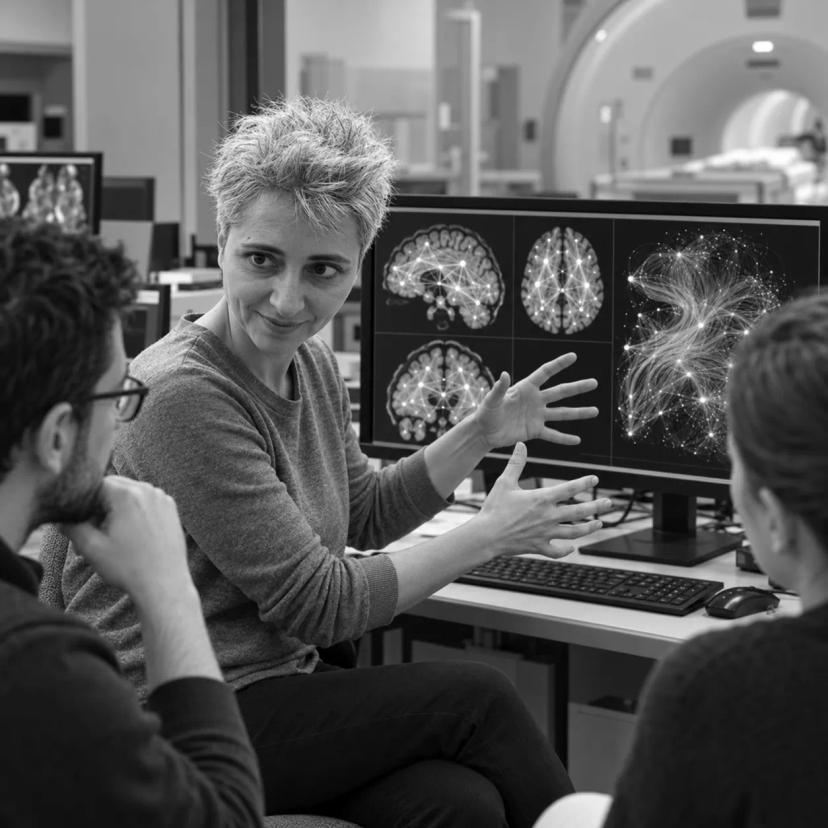
Kalina Christoff is first author of the 2009 study in the Proceedings of the National Academy of Sciences that sampled people's experience during functional MRI. It found that default network regions were active during mind-wandering, and that executive regions, usually thought of as the network's opponent, were recruited as well.
Who they are
The paper's author list is Christoff, Gordon, Smallwood, Smith and Schooler. Two of the co-authors, Jonathan Smallwood and Jonathan Schooler, have their own notes in this vault. Nothing further about her career or affiliation has been verified for this page.
Key papers
Christoff, K., Gordon, A. M., Smallwood, J., Smith, R., & Schooler, J. W. (2009). Experience sampling during fMRI reveals default network and executive system contributions to mind wandering. Proceedings of the National Academy of Sciences, 106(21), 8719-8724.
The study tracked mind-wandering during a concurrent task, using experience sampling and fMRI together. Analyses of the moments before each probe showed default network regions active during mind-wandering. Medial prefrontal default regions were active both when participants reported mind-wandering and when they made more performance errors. Executive network regions were also recruited, and activity in both networks was strongest when people were unaware they were mind-wandering. The authors proposed that the two networks, usually considered opposing, may work together during mind-wandering.
Key ideas
Mind-wandering recruits both the default network and executive regions. The usual picture of the two as rivals may be too simple.
Activity was strongest when people were unaware that their minds had wandered, which suggests that the process is most pronounced without meta-awareness.
The design pairs self-reports with online brain measures, and the authors argue that this pairing is valuable for studying subjective experience.
Sources
- Christoff et al. (2009), PNAS 106(21), 8719-8724. Abstract read.
Studies on this site by Christoff
- Experience sampling during fMRI reveals default network and executive system contributions to mind wandering
Christoff (2009) · Proceedings of the National Academy of Sciences
Articles that cite Kalina Christoff
- What the Default Mode Network Does
The brain spends about a fifth of the body's energy whatever it is asked to do. The default mode network is the pattern found inside that expense, and the evidence supports it as an organised…
Concepts on this site
- Experience Sampling Method
The experience sampling method signals people at intervals during ordinary life and asks what they are doing and how it feels right now, rather than trusting them to remember later. Mihaly…
- Mind-Wandering
Mind-wandering is thinking about something other than what you are currently doing. Matthew Killingsworth and Daniel Gilbert measured it in 2010 by pinging 2,250 adults on their iPhones at random…
- The Default Mode Network
The default mode network is the set of brain regions that become more active when a person appears to be doing nothing. The name and the finding are Marcus Raichle's, published in 2001, and the…