Ladislao Salmeron
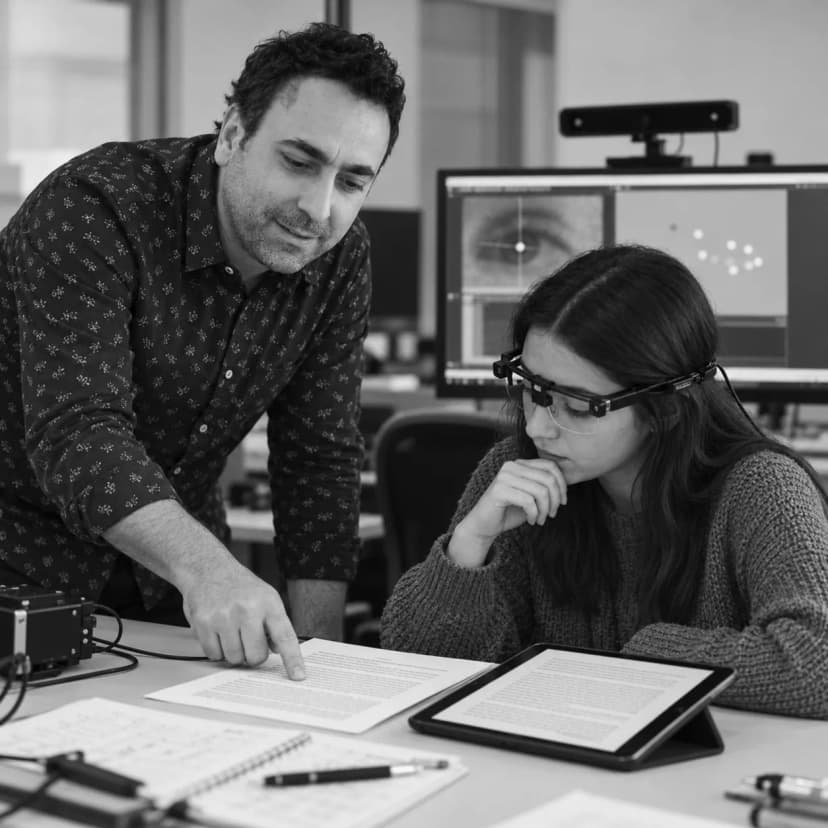
Ladislao Salmerón is a researcher in reading and digital literacy whose work is hosted on the University of Valencia's research portal. He is the last author of the 2018 meta-analysis that found a small paper advantage in reading comprehension across 54 studies and 171,055 readers, and the first author of the 2024 meta-analysis that asked the same question of tablets and e-readers and found roughly half that margin.
Who they are
Salmerón's work asks when the medium matters for comprehension and when it does not. Two meta-analyses carry most of that weight on this site.
The first is Delgado, Vargas, Ackerman and Salmerón (2018). It pooled 54 studies and 171,055 participants and found a small paper advantage with the same size in between-participants and within-participants designs. Three moderators were significant: the advantage was larger under time constraints than in self-paced reading, it held for informational texts or mixtures of informational and narrative texts but not for narrative-only studies, and it grew across the publication years covered, 2000 to 2017.
The second is Salmerón, Altamura, Delgado, Karagiorgi and Vargas (2024), in the Journal of Educational Psychology, a narrative review and meta-analysis of reading on handheld devices, mostly tablets with some e-readers. It found a small paper advantage in both designs. The between-participants analysis covered 29 studies and the within-participants analysis 18, and the advantage was roughly half the 2018 figure. It was larger for undergraduates than for primary and secondary students, and appeared in individual sessions but not in group sessions. Text genre, device type, time limits, text length, page navigation and publication year were not significant moderators, so the pattern of moderators from 2018 did not carry over. The between-participants studies varied widely, with heterogeneity of about 94 per cent, and the authors conclude that print reading should continue in schools and that handheld devices need effective integration.
A third paper, by Altamura, Vargas and Salmerón (2023), published by the American Educational Research Association, examined leisure digital reading and comprehension. It pooled 40 effect sizes covering 469,564 participants from studies published between 2000 and 2022. The average relationship was small but positive, negative for primary and middle school readers and positive for high school and university students, and the authors conclude that leisure digital reading pays off less than print reading for comprehension.
Across these papers the consistent feature is restraint. The headline is a small difference, the moderators are reported even when they shift between analyses, and the later work narrows the earlier estimate instead of defending it.
Key papers
Delgado, Vargas, Ackerman and Salmerón (2018). "Don't throw away your printed books: A meta-analysis on the effects of reading media on reading comprehension," Educational Research Review 25, 23-38.
Altamura, Vargas and Salmerón (2023). A meta-analysis of leisure digital reading and text comprehension, 40 effect sizes, 469,564 participants. DOI 10.3102/00346543231216463.
Salmerón, Altamura, Delgado, Karagiorgi and Vargas (2024). "Reading comprehension on handheld devices versus on paper: A narrative review and meta-analysis of the medium effect and its moderators," Journal of Educational Psychology 116(2), 153-172.
Key ideas
- The paper advantage in reading comprehension is small, and smaller for tablets than in the 2018 pooled estimate.
- Moderators that mattered in one meta-analysis, such as time limits and genre, did not predict the gap in the next.
- The advantage was larger for undergraduates and in individual sessions in the 2024 data.
- Heterogeneity between studies is high, so a single average says less than it seems to.
Sources
- Delgado, P., Vargas, C., Ackerman, R., & Salmerón, L. (2018). Educational Research Review, 25, 23-38. doi:10.1016/j.edurev.2018.09.003
- Altamura, L., Vargas, C., & Salmerón, L. (2023). doi:10.3102/00346543231216463
- Salmerón, L., Altamura, L., Delgado, P., Karagiorgi, A., & Vargas, C. (2024). Journal of Educational Psychology, 116(2), 153-172. doi:10.1037/edu0000830