Marcel Duchamp
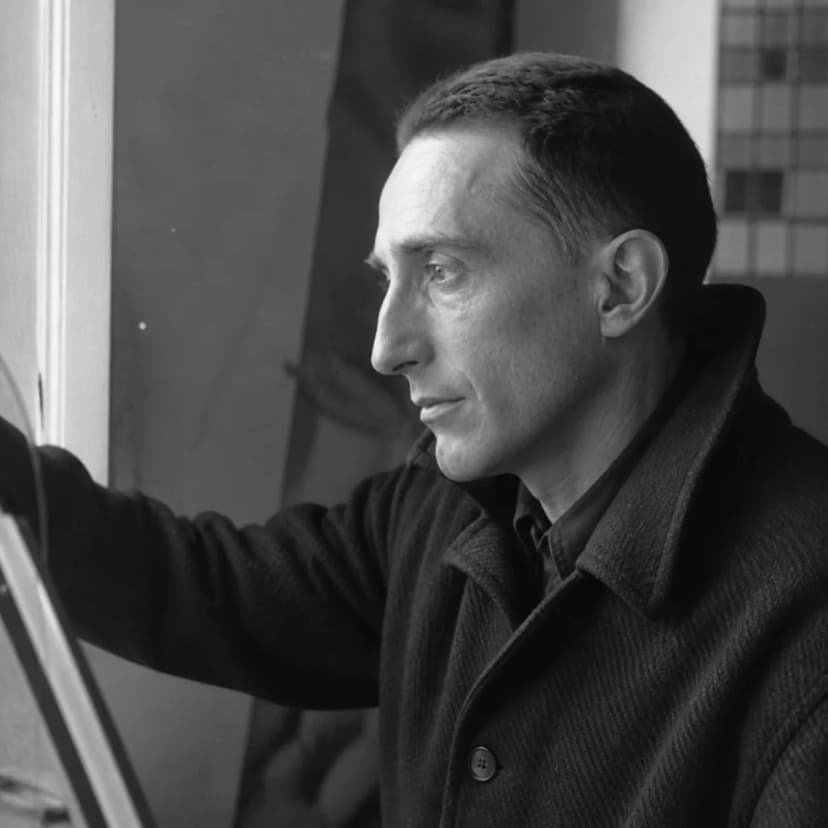
Marcel Duchamp was a French-American artist, central to Dada and later to conceptual art. In 1917 he submitted a mass-produced urinal, signed "R. Mutt," to an exhibition as a sculpture titled Fountain. The object never changed; only its context did, which makes Fountain the founding demonstration behind this site's whole context-effect argument. Duchamp is not a conventional author. What survives of his writing is notes, interviews and essays that outside editors collected, some after his death, not books he wrote and published himself.
Who they are
Marcel Duchamp was a French-American artist, born in 1887, who became one of the central figures of Dada and, later, of conceptual art. He died in 1968. His most consequential act as an artist was minimal by design: in 1917 he bought a mass-produced urinal, signed it "R. Mutt," and submitted it to the Society of Independent Artists exhibition as a sculpture titled Fountain. Nothing about the object was altered. What changed was the context it was placed in, and the willingness of a gallery setting to present it as art rather than as plumbing. That single move, later named the readymade, became the demonstration that value can be assigned by frame rather than by the object itself, an argument this site's context-effect thread traces back to him.
Duchamp is not a conventional author, and his page here is built around that distinction rather than around it. He did not write and publish books in the ordinary sense. What exists instead is a body of notes, essays and interview material that outside editors gathered, translated and arranged into collections, several of them after his death. Michel Sanouillet compiled the first French-language collection in 1958; Sanouillet and Elmer Peterson produced the standard English edition in 1973; Paul Matisse edited a facsimile edition of Duchamp's working notes in 1980, twelve years after Duchamp died. Every title listed below is an edited or posthumous collection, not a book Duchamp sat down to write.
Books
Duchamp did not write books in the ordinary sense. Every title below is a collection of his notes, essays or interviews, assembled, translated and published by other people, two of the three after his death.
Key papers
None. Duchamp was an artist, not a researcher, and he produced no papers. He did not write books in the ordinary sense either. What exists under his name is notes, essays and interview material that outside editors gathered, translated and arranged, two of the three principal collections after his death: Michel Sanouillet's French compilation in 1958, the standard English edition edited and translated by Sanouillet and Elmer Peterson in 1973, and Paul Matisse's facsimile edition of the working notes in 1980, twelve years after Duchamp died. Each is an edited or posthumous collection rather than a book he wrote.
What this site cites him for is an act rather than a text. Fountain, submitted to the Society of Independent Artists in 1917 as a sculpture and signed "R. Mutt", changed nothing about the object and everything about its setting. The modern psychological work on context and framing is by other people and arrived much later; it is not attributed to him here.
Key ideas
Duchamp's contribution to this site is not a text but an act: Fountain is the demonstration that an object's value can be entirely a function of where it is placed and how it is framed, not of anything in the object itself. The readymade, an ordinary manufactured object designated as art by the artist's choice alone, ran this experiment a century before neuroscience did it with a price tag and a scanner. He supplied no theory to go with the demonstration. Brian O'Doherty named the room Duchamp was exploiting fifty years later, and Virgil Abloh restated the same claim again from fashion, decades after that.
Concepts on this site
The white cube, the readymade only works inside the gallery's status-conferring room
Find them elsewhere
Lifespan: 1887 to 1968. No social accounts, and none are claimed on their behalf.
Deceased, so no social accounts. Reference is the Tate artist page, which gives the same dates and a collection biography
Checked 2026-09-10. Handles and affiliations go out of date, so treat this block as a snapshot rather than a standing fact.
Sources
- Duchamp, M. Fountain (1917).
- Sanouillet, M. (ed.) (1958). Marchand du Sel: Écrits de Marcel Duchamp.
- Sanouillet, M. and Peterson, E. (eds. and trans.) (1973). Salt Seller: The Writings of Marcel Duchamp. Oxford University Press.
- Matisse, P. (ed. and trans.) (1980). Marcel Duchamp, Notes. Centre Georges Pompidou. Preface by Pontus Hulten.