Maria Hartwig
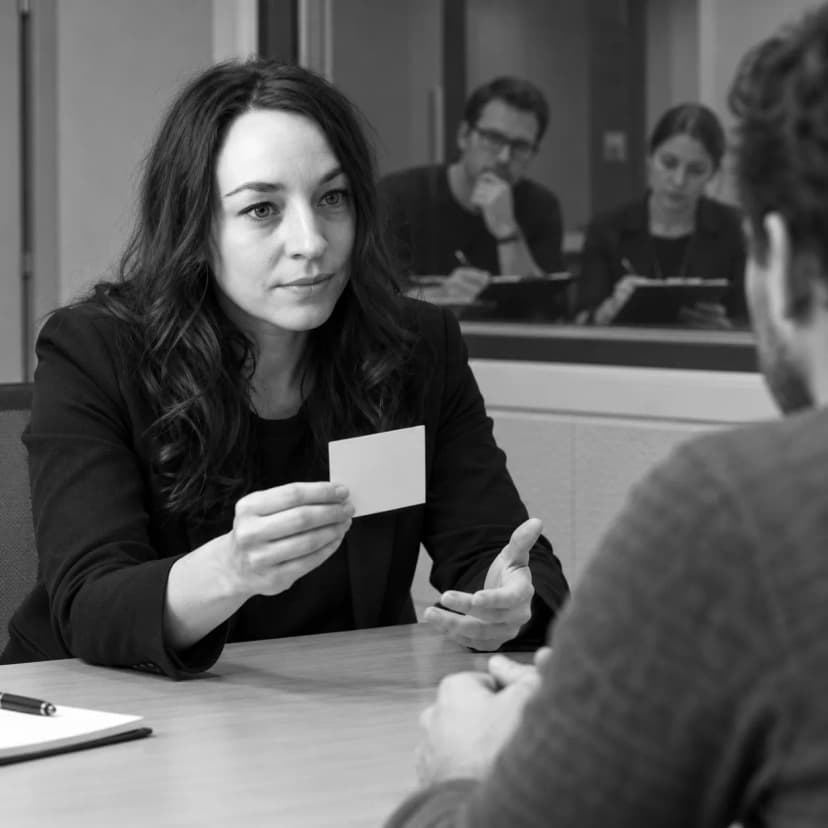
Maria Hartwig is a psychologist who studies lying detection and investigative interviewing. With Charles Bond she wrote the 2011 lens-model meta-analysis of human lie judgments, which found that people rarely rely on the wrong cues when judging lying and that accuracy is limited by how weakly behaviour signals lying. Their conclusion is that the best way to improve lie detection is to increase behavioural differences between liars and truth-tellers, not to train observers in valid cues.
Who they are
Hartwig works on how lying is detected and how investigative interviews are conducted. On the 2011 paper her affiliation is given as John Jay College of Criminal Justice, City University of New York. This site does not assert a current post, because none was retrieved for this page.
Her contribution to this site is a correction to a common story. The popular account of failed lie detection says people watch the wrong things: they look for shifty eyes and fidgeting when they should look elsewhere, so better training should fix them. Hartwig and Bond tested that account directly, and the data did not support it. The people were not looking in the wrong place. The place they were looking had little to show.
Key papers
Hartwig, M., & Bond, C. F., Jr. (2011). "Why do lie-catchers fail? A lens model meta-analysis of human lie judgments." Psychological Bulletin, 137(4), 643-659. The authors used Brunswik's lens model, a conceptual framework for studying human predictions of criteria that are probabilistically related to cues, in four meta-analyses. The first covered 153 independent sender samples from 128 documents and 66 cues. A within-study analysis drew on 25 sender samples. The fourth examined 59 predictions of deception and 30 predictions of perceived deception from multiple cues.
The central finding was that the cues people rely on match the cues that actually occur. The correlation was .59 across studies, and .72 within studies, with a 95 per cent confidence interval of .70 to .74. A lens model matching index of .93 indicated that behaviour-based predictions of lying closely matched behaviour-based predictions of lying judgments. Pooled multiple-cue validity for lying was about .35. People's perceptions of lying are generally linked to valid behavioural cues, so they seldom rely on the wrong ones. Their intuitive judgements were more accurate than their explicit beliefs.
Hartwig, M., & Bond, C. F., Jr. (2014). "Lie detection from multiple cues: A meta-analysis." Applied Cognitive Psychology, 28(5), 661-676.
Key ideas
The signal is the bottleneck. Accuracy is limited mainly by how weakly behaviours signal lying, so a judge with perfect habits of attention would still be held back.
Gaze is not the answer. The authors wrote that gaze aversion is not a valid indicator of lying, and that many signs of nervousness, such as fidgeting, blushing or speech disturbances, are not systematically linked to it.
Experience in the role does not help. They wrote that presumed lie experts who routinely assess credibility in their professional life do not perform better than lay judges do.
Change the conversation. The best way to improve judgment achievement, they concluded, is to increase behavioural differences between liars and truth-tellers, not to train perceivers in objective cues to lying. For an interviewer, that points at the design of the questions and away from the observation of the face.
Where the work sits
The 2011 paper is the reason this site separates two claims that are often run together: that people are poor at detecting lies, and that people are looking at the wrong things. The first is well supported by the pooled accuracy figures on the Lie Detection Accuracy page. The second is not, and the Cues to Deception page sets out why. The recommendation to increase behavioural differences is a conclusion about where improvement could come from. It names no technique, and whether a given interview method achieves it is a separate empirical question that this page does not settle.
Sources
- Hartwig, M., & Bond, C. F., Jr. (2011). "Why do lie-catchers fail? A lens model meta-analysis of human lie judgments." Psychological Bulletin, 137(4), 643-659. doi:10.1037/a0023589
- Hartwig, M., & Bond, C. F., Jr. (2014). "Lie detection from multiple cues: A meta-analysis." Applied Cognitive Psychology, 28(5), 661-676. doi:10.1002/acp.3052
- Bond, C. F., Jr., & DePaulo, B. M. (2006). "Accuracy of deception judgments." Personality and Social Psychology Review, 10(3), 214-234. doi:10.1207/s15327957pspr1003_2
- Vault note: [[Maria Hartwig]].