Mark Granovetter
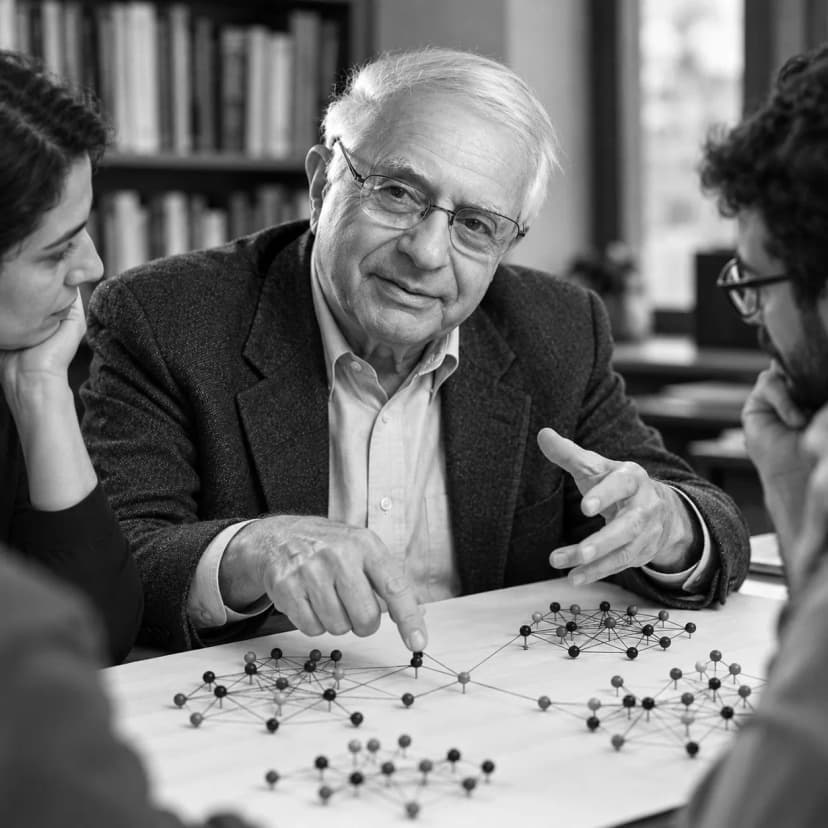
Mark Granovetter is an American sociologist at Stanford whose 1973 paper The Strength of Weak Ties gave the social sciences the phrase weak ties. His argument was structural: acquaintances bridge social circles that close friends do not, so they carry information a person's own circle lacks. Job-finding was his main illustration. He is easily confused with the wellbeing literature on casual interactions, which uses his phrase and belongs to other authors.
Who they are
Granovetter is a sociologist, based at Stanford University. This page is deliberately narrow, because what the site knows about him is the argument of one paper and the work that has since tested it.
The paper appeared in the American Journal of Sociology in 1973, volume 78, issue 6, 1360-1380. Its abstract stresses the cohesive power of weak ties, and notes that most network models implicitly focus on strong ties, which limits them to small, well-defined groups. One further point of sourcing, recorded on this site's weak ties page: Zelana Montminy's Finding Focus puts the phrase in quotation marks and credits nobody, so a reader of that book would not learn that it is his.
Key papers
Granovetter, M. S. (1973). The Strength of Weak Ties. American Journal of Sociology, 78(6), 1360-1380.
The paper defines the strength of a tie as a combination of the amount of time, the emotional intensity, the intimacy and the reciprocal services that characterise it. It defines a bridge as a tie that provides the only path between two points in a network, and concludes that all bridges are weak ties.
It also describes the triad he considered least likely to occur: person A strongly tied to both B and C, with no tie between B and C. He notes that the empirical evidence for the absence of that triad is limited.
For job-finding, the paper reports data on people who found work through a contact. In a sample of 54, 16.7 per cent saw the contact often, 55.6 per cent occasionally and 27.8 per cent rarely. He concludes that the pattern suggests the primacy of structure over motivation, which acknowledges that people with strong ties are more motivated to help while arguing that structure counts for more.
Key ideas
Bridges are weak ties. Strongly tied people tend to know each other's friends, so close circles recirculate the same information. A weak tie is the usual route between circles, and that is why an acquaintance can carry news a close friend cannot.
Structure over motivation. Strong ties are more motivated to help, and he said so. His claim was that this advantage matters less than whether the helper knows something the seeker does not.
Later tests. Two large studies have since examined the claim for job-finding. Gee, Jones and Burke (2017), using data on about six million Facebook users, found that most people were helped through one of their many weak ties but that a single stronger tie was significantly more valuable at the margin. Rajkumar and colleagues (2022) ran randomised experiments on LinkedIn across more than 20 million members, and reported that moderately weak ties, with around ten mutual connections, raised job transmission the most, that the answer depended on how strength was measured and that weak ties helped more in digital industries. Neither overturns the mechanism, and neither supports the idea in its simplest popular form.
What is not his. The wellbeing claim, that brief exchanges with acquaintances improve mood and belonging, is the work of Gillian Sandstrom and Elizabeth Dunn (2014). Nothing in the 1973 paper is about how weak ties make people feel.
Sources
- Granovetter, M. S. (1973). "The Strength of Weak Ties." American Journal of Sociology, 78(6), 1360-1380. doi:10.1086/225469
- Gee, L. K., Jones, J., & Burke, M. (2017). "Social Networks and Labor Markets: How Strong Ties Relate to Job Finding on Facebook's Social Network." Journal of Labor Economics, 35(2), 485-518. doi:10.1086/686225
- Rajkumar, K., Saint-Jacques, G., Bojinov, I., Brynjolfsson, E., & Aral, S. (2022). "A causal test of the strength of weak ties." Science, 377(6612), 1304-1310. doi:10.1126/science.abl4476