Matthew Rabin
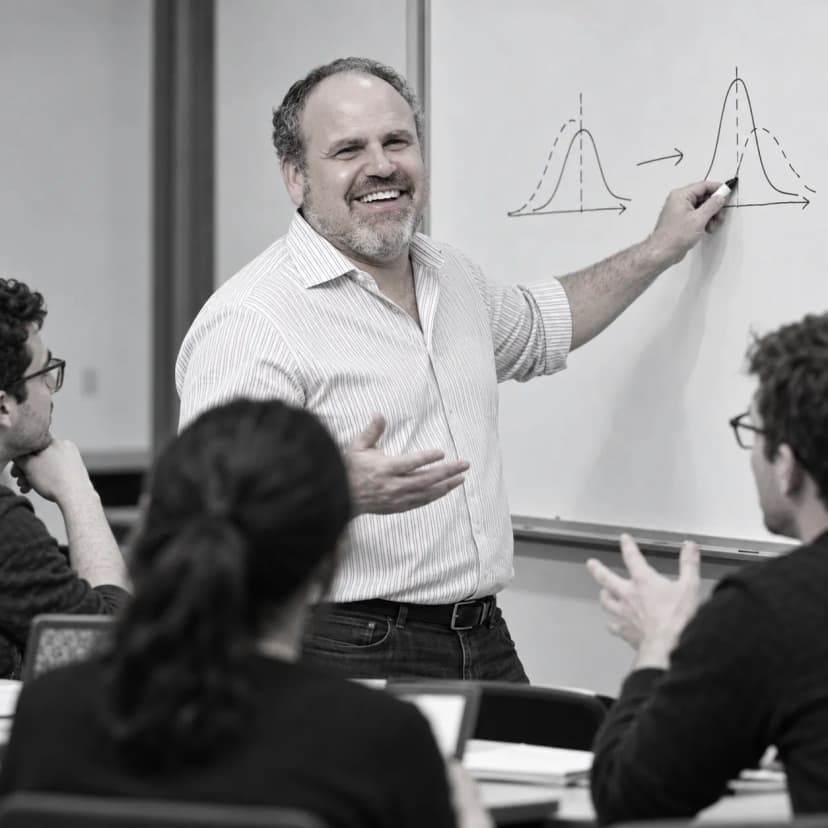
Matthew Rabin is an economist who appears in three places in the narrow framing literature: as co-author of the 1999 choice-bracketing paper, as co-author of the 2009 test of narrow bracketing with Georg Weizsäcker, and, in Thinking, Fast and Slow, as the person who with Richard Thaler pointed out the oddity in Paul Samuelson's coin-toss argument.
Who they are
Matthew Rabin is the Pershing Square Professor of Behavioral Economics at Harvard, in the Economics Department and Harvard Business School. He spent 25 years in the Economics Department at the University of California, Berkeley, after taking his PhD at MIT in 1989 and joining the Berkeley faculty that year as an assistant professor.
His research puts more psychologically realistic assumptions into formal economic theory. It covers errors in statistical reasoning and the evolution of beliefs, how choice context affects expressed preferences, reference-dependent preferences, and errors in inference in market and learning settings. His honours include a MacArthur Fellowship, the American Economic Association's John Bates Clark Medal, a Sloan Research Fellowship, and fellowship of the Econometric Society and of the American Academy of Arts and Sciences.
He is distinct from Michael Rabin, who has his own note in the vault.
Key papers
Read, D., Loewenstein, G., & Rabin, M. (1999). Choice bracketing. Journal of Risk and Uncertainty, 19(1 to 3), 171 to 197. doi:10.1023/A:1007879411489.
Rabin, M., & Weizsäcker, G. (2009). Narrow bracketing and dominated choices. American Economic Review, 99(4), 1508 to 1543. doi:10.1257/aer.99.4.1508.
Key ideas
The 2009 paper shows that a person who evaluates decisions separately will sometimes choose a dominated option unless their risk preferences are of one particular kind, and reports that 28 per cent of participants did so in a real-stakes replication of Tversky and Kahneman's 1981 pair of decisions. The authors estimate that 89 per cent of people bracket narrowly, a figure from their model of average preferences. The 1999 paper supplies the vocabulary of narrow and broad bracketing.
Sources
- Rabin, M., & Weizsäcker, G. (2009). American Economic Review, 99(4), 1508 to 1543. doi:10.1257/aer.99.4.1508.
- Read, D., Loewenstein, G., & Rabin, M. (1999). Journal of Risk and Uncertainty, 19(1 to 3), 171 to 197. doi:10.1023/A:1007879411489.
- Kahneman, D. (2011). Thinking, Fast and Slow.
- Harvard University Department of Economics, faculty profile of Matthew Rabin.