Maurice Allais
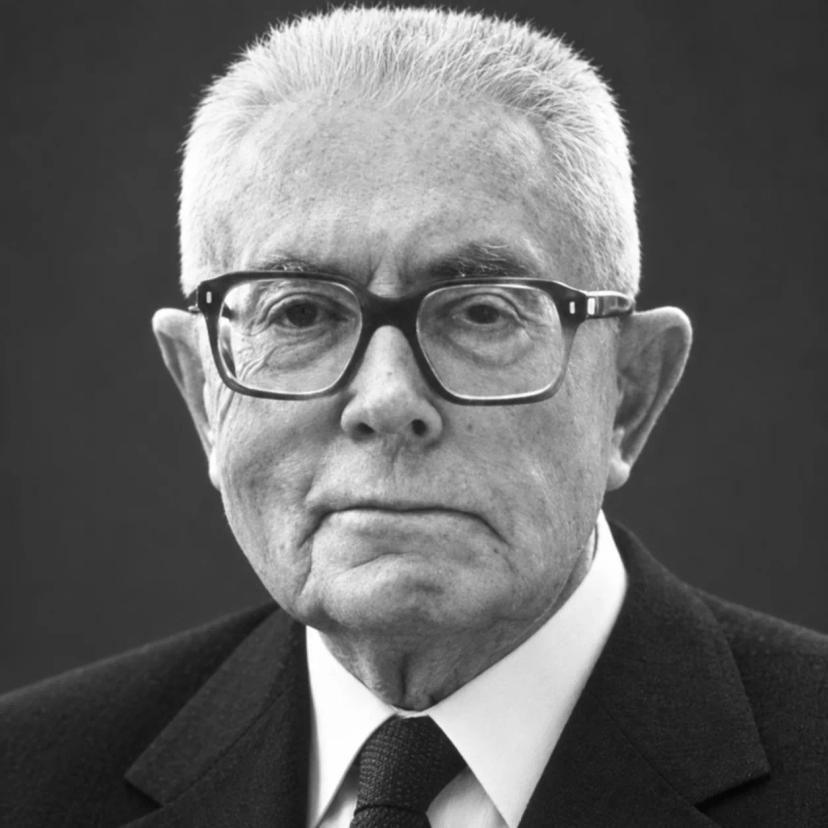
Maurice Allais (1911 to 2010) was a French economist who received the Nobel Memorial Prize in Economic Sciences in 1988. In decision theory he is known for a pair of choice problems, put to leading theorists, whose answers violated expected utility theory. Kahneman reports that his and Amos Tversky's first goal in building prospect theory was a satisfactory psychological account of what is now called the Allais paradox. On this site it stands behind the certainty effect.
Who they are
Allais was born in Paris on 31 May 1911. He took baccalaureates in Latin and science in 1928 and in mathematics and philosophy in 1929, entered the École Polytechnique in 1931 and graduated first in his class in 1933. After military service he studied for two years at the École Nationale Supérieure des Mines in Paris.
He joined the state mining service, the Corps National des Mines, as an engineer in October 1936, and in 1937 became head of the Nantes Mines and Quarries Service. He was recalled to the Alpine Army in 1939 and 1940 and retired to Nantes after the armistice. From October 1943 to April 1948 he directed the Bureau of Mines Documentation and Statistics in Paris. In 1944 he became professor of economic analysis at the École Nationale Supérieure des Mines, and in 1946 he took charge of a research unit at the CNRS, the French national research centre.
His teaching posts followed. He taught at the Institute of Statistics of the University of Paris from 1947 to 1968, at the Thomas Jefferson Center of the University of Virginia in 1958 and 1959, at the Graduate Institute of International Studies in Geneva from 1967 to 1970, and at the University of Paris-X from 1970 to 1985. He retired from the civil service on 31 May 1980. From 1959 to 1962 he was the founder and general delegate of the Movement for a Free Society. He died on 9 October 2010.
His honours were many. He received the Lanchester Prize in 1958 for his mining research paper and the Galabert Prize of the French Astronautical Society in 1959. The CNRS awarded him its Gold Medal in 1978 for lifetime work, and he was the first economist to receive it. The Nobel Foundation's 1988 volume lists fourteen scientific prizes between 1933 and 1987, before the Nobel Prize in Economic Sciences itself.
Key papers
This site holds Allais's decision-theory work only through Kahneman's description of it in Thinking, Fast and Slow, chapter 29. It records no paper, year or page for the choice problems and does not assign one. The Nobel Foundation's biography lists these books, with dates as it gives them.
Économie pure et rendement social (1945). Prolégomènes à la reconstruction économique du monde (1945). Abondance ou misère (1946). Économie et intérêt (1947). À la recherche d'une discipline économique, written from 1941 to 1948. A mining research memoir of 1952, published in English in 1957. Essor et déclin des civilisations: facteurs économiques, first drafted from 1961 to 1968 and revised over the following decades.
The list shows how wide his work was. The problems that carry his name in psychology are a small part of it.
Key ideas
The problems as Kahneman reports them are two choices. In the first, a 61 per cent chance of $520,000 stands against a 63 per cent chance of $500,000. In the second, a 98 per cent chance of $520,000 stands against a certain $500,000. In Kahneman's retelling, Allais put the problems to some of the leading decision theorists in the world and then revealed that their preferences across the two violated the expected utility theory they worked with. Kahneman writes that Allais had intended the announcement to be a bombshell.
The difference between the options is the same two points of probability in each case. Kahneman and Tversky's reading was that the two points are not worth the same: the step from 98 per cent to certainty is far more impressive than the step from 61 to 63. That is the certainty effect. The book says that their initial goal was a satisfactory psychological account of the paradox, and the account became prospect theory. Kahneman and Tversky accepted the paradox as a real feature of choice and described it, instead of defending the axioms as a description of behaviour.
Using the weighting function in Tversky and Kahneman's 1992 paper at its median gain parameter of 0.61, we calculated that the step from 61 to 63 per cent adds 1.1 points of decision weight and the step from 98 per cent to certainty adds 12.9. That calculation is ours, made from the published formula, and it is an illustration of the shape Allais's problems exposed, not a measurement of the theorists he tested.
His name is still attached to the field. The Max Planck Institute for Human Development lists the Maurice Allais Memorial Prize, awarded by the Maurice Allais Foundation, among the 2026 honours of the psychologist Ralph Hertwig, whose work on risky choice learned by experience is described on this site.
Sources
- Nobel Foundation. "Maurice Allais, Biographical." Nobel Prize in Economic Sciences 1988, nobelprize.org. Dates, positions, prizes and works.
- Kahneman, D. (2011). Thinking, Fast and Slow. Farrar, Straus and Giroux. Chapter 29, for the two problems and the account of the announcement, as recorded in the vault's digests.
- Tversky, A., & Kahneman, D. (1992). "Advances in prospect theory: Cumulative representation of uncertainty." Journal of Risk and Uncertainty, 5(4), 297-323. doi:10.1007/BF00122574.
- Max Planck Institute for Human Development, staff page for Ralph Hertwig, for the 2026 Maurice Allais Memorial Prize.
Articles that cite Maurice Allais
- Why a 1 Per Cent Chance Feels Bigger
In the best-known estimates a 1 per cent chance carries a decision weight of about 5.5. The weight shifts with how vivid the outcome is, and in some experiments it reverses when people learn the…
Concepts on this site
- Certainty Effect
The certainty effect is the finding that outcomes which are almost certain get less weight in a choice than their probability justifies, so removing the last of the risk is worth far more than its…
- Prospect Theory
Prospect theory is Daniel Kahneman and Amos Tversky's 1979 description of how people actually choose between risky options, and it is the parent of loss aversion rather than a consequence of it. Its…