Morris Goldsmith
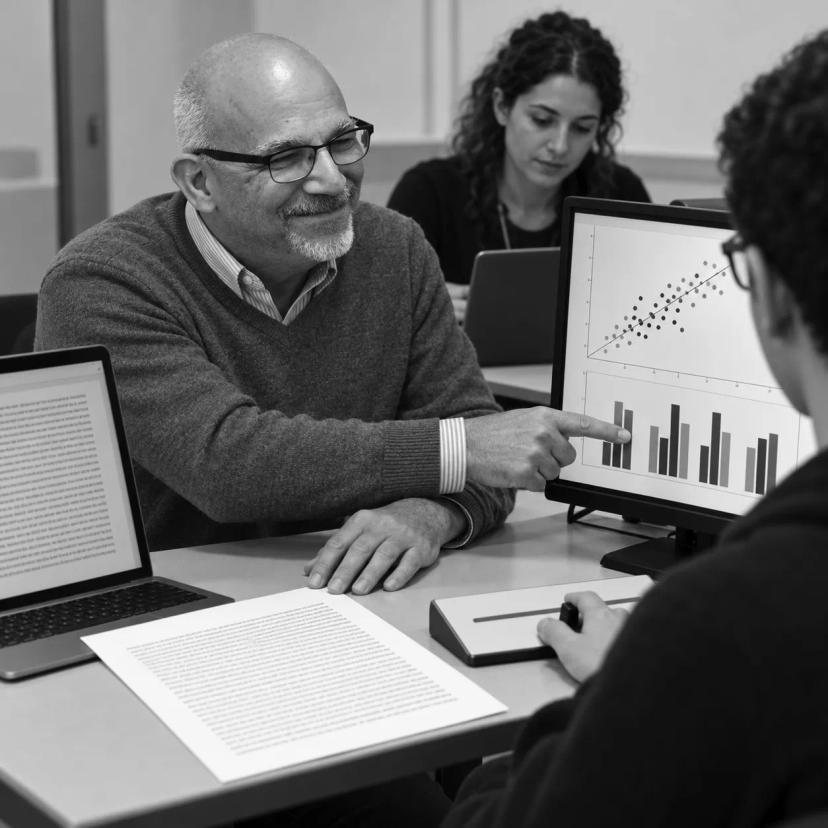
Morris Goldsmith is a psychologist whose published work concerns how people monitor and control what they report from memory. On this site he appears as the second author of the 2011 experiments with Rakefet Ackerman in which readers on screen predicted their test scores less accurately than readers on paper. The University of Haifa research portal lists his work under its Department of Psychology.
Who they are
Much of Goldsmith's published work is with Asher Koriat, and it asks a question that sits close to the one in the screen-reading experiments: how do people decide what to say, and how sure do they need to be before they say it. Koriat and Goldsmith (1996), in Psychological Review, proposed a framework in which people can make their memory reports considerably more accurate by choosing whether to volunteer an answer, with monitoring and control processes driving that choice. Greater accuracy usually comes with fewer items reported, and both depend on the incentive placed on accuracy and on how well people monitor their own memory. The paper also proposed a method for measuring both accuracy and quantity.
A 1999 chapter with Koriat, in Attention and Performance XVII, extended the framework to two forms of control: deciding whether to volunteer or withhold information on the basis of confidence, and choosing the level of generality, or grain size, of an answer. A 2002 paper in the Journal of Experimental Psychology: General, with Koriat and Amit Weinberg-Eliezer, showed that people adjust how fine-grained their answers are to balance accuracy against informativeness.
The 2011 paper with Ackerman applied that monitoring-and-control tradition to learning from text. Participants read expository texts of 1,000 to 1,200 words on screen or on paper and predicted their performance on a multiple-choice test. With fixed study time, scores did not differ, 61.0 per cent on screen and 60.7 per cent on paper, while screen readers predicted 71.0 per cent against 65.6. With self-paced study, screen readers scored 63.2 per cent against 72.3 per cent on paper, overestimated their scores by more, and regulated their study time more erratically. The authors attribute the gap mainly to metacognition rather than cognition. The paper also introduced the Metacognitive Learning Regulation Profile, a method for identifying where such differences arise.
For the argument on this site the useful point is the framing. The cost of reading on screen shows up in the experiment as a mismatch between what readers expect and what they achieve. That is a more specific claim than the idea that screens make readers shallow, and the experiments support it only under the conditions tested: one text length, one test format, and participants who set their own pace in the second experiment.
Key papers
Koriat and Goldsmith (1996). "Monitoring and control processes in the strategic regulation of memory accuracy," Psychological Review 103(3), 490-517.
Goldsmith and Koriat (1999). "The strategic regulation of memory reporting: Mechanisms and performance consequences," in Attention and Performance XVII, Oxford University Press, 372-400.
Goldsmith, Koriat and Weinberg-Eliezer (2002). "Strategic regulation of grain size in memory reporting," Journal of Experimental Psychology: General 131(1), 73-95.
Ackerman and Goldsmith (2011). "Metacognitive regulation of text learning: On screen versus on paper," Journal of Experimental Psychology: Applied 17(1), 18-32.
This page covers the work the site has verified. It is not a full bibliography.
Key ideas
- People regulate what they report by monitoring how sure they are, which makes reports more accurate and usually shorter.
- Accuracy and informativeness trade off, and people adjust the grain size of an answer to balance them.
- In the 2011 reading experiments, screen readers monitored their own comprehension less accurately than paper readers.
- With fixed study time the scores matched, so the cost in those experiments depended on self-regulation.
Sources
- Koriat, A., & Goldsmith, M. (1996). Psychological Review, 103(3), 490-517. doi:10.1037/0033-295X.103.3.490
- Goldsmith, M., & Koriat, A. (1999). Attention and Performance XVII, 372-400. Oxford University Press.
- Goldsmith, M., Koriat, A., & Weinberg-Eliezer, A. (2002). Journal of Experimental Psychology: General, 131(1), 73-95. doi:10.1037/0096-3445.131.1.73
- Ackerman, R., & Goldsmith, M. (2011). Journal of Experimental Psychology: Applied, 17(1), 18-32. doi:10.1037/a0022086