Neil Postman
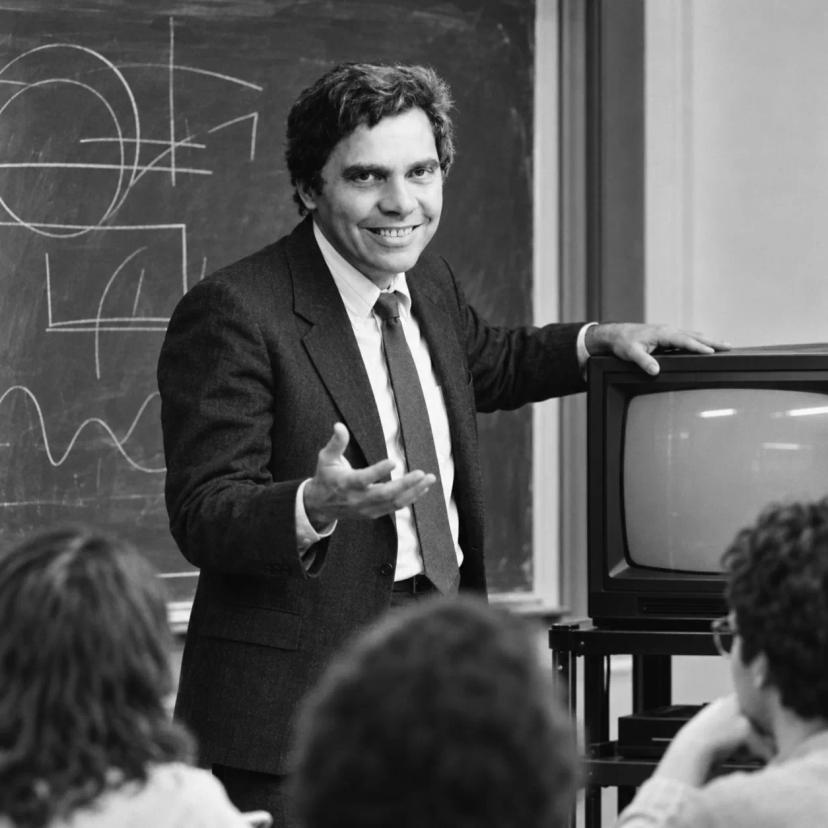
Neil Postman, who died in 2003, was a media theorist at New York University, where he held a University Professorship and the Paulette Goddard Chair of Media Ecology. His 1985 book Amusing Ourselves to Death argued that television turns public discourse, news included, into entertainment. For this site he is the claim under test. Thomas Patterson, Markus Prior, Matthew Baum and Tim Wu each bear on a different part of it, and the cause he named, the form of the medium, is the part the evidence supports least.
Who they are
Neil Postman was a professor at New York University, where his positions included University Professor, the Paulette Goddard Chair of Media Ecology and chair of the Department of Media, Culture, and Communication. Before that he worked as an elementary and secondary school teacher, which began a long interest in education that runs through several of his titles. He died in 2003. His publisher's author page says he wrote 20 books.
He is best known for Amusing Ourselves to Death: Public Discourse in the Age of Show Business, published in 1985 by Viking Penguin. The book began as a 1984 talk at the Frankfurt Book Fair on Orwell's 1984, and it sets Huxley against Orwell: the danger to public life is not coercion but amusement. A twentieth-anniversary edition appeared in 2005, edited by his son Andrew.
Postman wrote as a critic and teacher, not as an experimenter. His method is argument from the form of a medium to its effects on thought, and he built it on an adaptation of Marshall McLuhan's phrase, the medium is the metaphor. That is the right register in which to read him. His claims about television are claims about what a form makes possible, and they are not findings from a study. On this site they are cited as arguments, and they are held up against studies that measure things he could only describe.
His readers have also taken a second theme from his later work. Technopoly names a culture that takes high technology as self-evidently good, so that alternatives become invisible. The vault holds it through Cal Newport's use of it in Deep Work, as an argument and not as evidence.
Books
The titles below are those listed on his publisher's author page. The page gives no publication years for them, and the only year verified for this page is that of Amusing Ourselves to Death, so years are omitted rather than guessed.
This page does not summarise the books other than Amusing Ourselves to Death and Technopoly, which it knows only as the vault records it.
Key ideas
The medium is the metaphor. The form of a medium shapes what can be said through it. See The Medium Is the Metaphor.
All subject matter presented as entertaining. In summary: Postman's complaint is that the trouble lies less in television offering entertaining subject matter than in all subject matter being presented as entertainment.
The news show as entertainment. A news broadcast, he held, is a vehicle for entertainment rather than for education or reflection.
Huxley over Orwell. People give up their rights to amusement instead of being coerced.
An earlier break at the telegraph. On study-guide summaries of his fifth chapter, Postman placed an earlier change at the telegraph, which brought irrelevance, impotence and incoherence into American discourse. That would make television the extension of a change, not its start.
How the evidence treats his claim
Postman's claim has three testable parts, and the evidence handles them differently. News did soften: Thomas Patterson's analysis of 5,331 stories found the soft share rising from under 35 per cent to about 50 per cent, across television, newspapers and newsmagazines, and tied it to competition from cable and entertainment. The audience did split: Markus Prior found that as media choice grew, entertainment-minded viewers left the news and became less informed and less likely to vote. Neither study isolates the form of television as the cause, and Matthew Baum found that foreign crises shown in soft news reached politically uninvolved Americans. The print age as the sober standard is the weakest part: Tim Wu's history has the penny Sun selling a moon hoax to a record circulation in 1835. Wu's account of Edward R. Murrow adds a counter-case on television itself. The article Was Amusing Ourselves to Death Right sets out the reading.
This page has Postman's book only through summaries and a reproduced excerpt. Nothing here depends on a page number.
Sources
- Postman, N. (1985). Amusing Ourselves to Death: Public Discourse in the Age of Show Business. Viking Penguin. Two quotations from a reproduced excerpt (anthologialitt.com); publication details and thesis from the reference summary.
- Penguin Random House author page for Neil Postman: positions at New York University, the count of 20 books, the list of eight titles, death in 2003. https://www.penguinrandomhouse.com/authors/24351
- LitCharts study guide to Amusing Ourselves to Death, on the telegraph. https://litcharts.com/lit/amusing-ourselves-to-death/chapter-5-the-peek-a-boo-world
- Patterson, T. E. (2000). Doing Well and Doing Good. Shorenstein Center, Harvard Kennedy School.
- Prior, M. (2005). American Journal of Political Science, 49(3), 577-592.
- Baum, M. A. (2002). American Political Science Review, 96(1), 91-109.
- Wu, T. (2016). The Attention Merchants. Knopf.
Articles that cite Neil Postman
- Was Amusing Ourselves to Death Right
Neil Postman argued in 1985 that television turns all subject matter, news included, into entertainment. The evidence confirms that news softened and that entertainment-minded viewers drifted away…
Concepts on this site
- Soft News
Soft news is news about routine crime, accidents, disasters and celebrities rather than public affairs. Thomas Patterson's 2000 analysis of 5,331 news stories counted its share of coverage rising…
- The Medium Is the Metaphor
The medium is the metaphor is Neil Postman's adaptation of Marshall McLuhan's phrase. It holds that the form of a medium shapes what can be said through it, so that the dominant medium of a culture…