Nikolaas Tinbergen
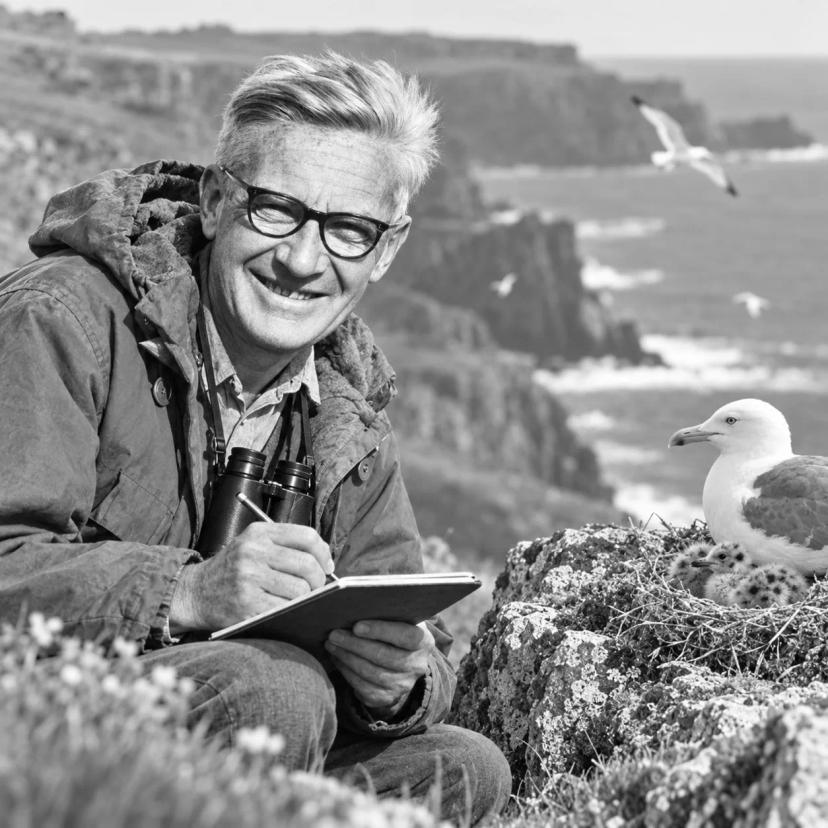
Nikolaas Tinbergen was a Dutch ethologist who spent most of his career at Oxford and shared the 1973 Nobel Prize in Physiology or Medicine with Karl von Frisch and Konrad Lorenz. For this site he is the source of the supernormal stimulus, the term for an artificial cue that draws an instinctive response harder than the natural object it imitates. The founding case is a set of experiments on newly hatched herring gull chicks, run with A. C. Perdeck and published in the journal Behaviour.
Who they are
Tinbergen was born in The Hague on 15 April 1907 and died on 21 December 1988. He studied biology at Leiden University and later worked there as an instructor. In 1935 he was asked to teach comparative anatomy and to set up an animal behaviour course for undergraduates. He later settled at Oxford at the invitation of Sir Alister Hardy, where he built a research and teaching centre in animal behaviour. The Nobel Foundation's biography adds that he helped found the journal Behaviour, in which the gull chick paper appeared, and that he was involved in the Oxford School of Human Sciences.
His interest in gulls began early. The Nobel biography says he became interested in them through an early encounter with a herring gull colony near The Hague, and his book The Herring Gull's World, published in 1953, covers that work. The Study of Instinct, published by the Clarendon Press at Oxford in 1951, grew out of lectures he gave in the United States. The Nobel Foundation records the 1973 prize as shared equally by three laureates, each with a one-third share, for their discoveries concerning organization and elicitation of individual and social behaviour patterns.
What the gull chicks did is simple to state. A newly hatched herring gull chick begs by pecking at a red spot near the tip of the parent's yellow bill, and the parent then brings up a meal. Tinbergen and Perdeck used cardboard models in place of the bird to find out which features of the parent the chick actually answers. A newspaper account of the work reports that the chicks responded to a single detail, a red mark on a long, thin, yellow shape, whatever the rest of the model looked like. It adds that a stick longer than the real bill, carrying a higher-contrast red patch, drew harder pecking than the bill itself, and that Tinbergen called this a supernormal stimulus.
Key papers
Tinbergen, N., & Perdeck, A. C. On the stimulus situation releasing the begging response in the newly hatched herring gull chick (Larus argentatus argentatus Pont.). Behaviour, 3(1), 1-39. doi:10.1163/156853951X00197. The publisher's record dates the issue 1951, and the paper is often cited as 1950. This site therefore gives no year for it in running prose.
Tinbergen, N. (1951). The Study of Instinct. Oxford: Clarendon Press. The book from his American lectures, cited here for its date and place of publication.
Tinbergen, N. (1953). The Herring Gull's World. Named in the Nobel Foundation's biography as the book that covers his early gull work.
Key ideas
A supernormal stimulus is defined by a comparison. The artificial cue is set against the natural one, and the artificial one wins. The comparison is made in an experiment, and the gull chicks and, in a separate field case, jewel beetles that tried to mate with beer bottles are the two instances this site uses.
The red rod is the version most often retold. In the retelling the winning model is a thin red rod with three white bands, a shape no gull has. That detail comes from secondary accounts of the experiment, and the paper itself was not opened for this page, so it should be checked against the original before it is quoted.
The idea has since travelled from birds to people. Deirdre Barrett carried the concept to human urges in her 2010 book, and Nicholas Carr applies it to the phone in the 2020 afterword to The Shallows. Tinbergen's own finding is solid ethology. The extension to phones is an analogy, and the studies Carr pairs with it, the brain drain results, did not hold up in a 2022 replication or a 2024 meta-analysis. The article on this site treats the label as testable only if a designer names the cue being exaggerated and the natural alternative it outdoes.
Sources
- Nobel Foundation, biographical note on Nikolaas Tinbergen, Nobel Prize in Physiology or Medicine 1973, and the prize summary page, which gives the laureates and the citation. Tinbergen and Perdeck's paper in Behaviour, 3(1), 1-39, record checked through Crossref. The newspaper account of the gull chick experiments is the Irish Times piece on beak spots and gulls. The paper's full text was not read for this page.