Paul MacLean
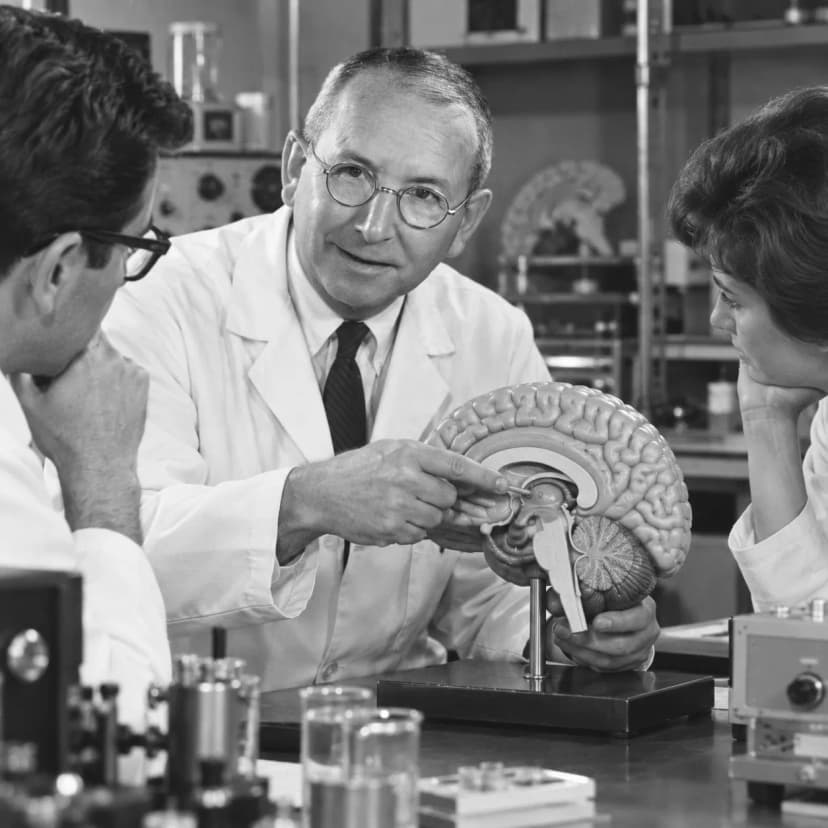
Paul D. MacLean, 1913 to 2007, was an American physician and neuroscientist who proposed the triune brain through the 1960s and set it out in full in The Triune Brain in Evolution (Plenum, 1990). He also coined the term "limbic system", which remains in use. His layered model, with a reptilian complex beneath a limbic system and a neocortex, is the source of the "lizard brain". It has been rejected by researchers who study nervous-system evolution, and this page keeps the verdict on the model apart from any verdict on the man.
Who they are
MacLean worked at the National Institute of Mental Health in the United States. He is recorded here for the model that carries his name, and for the term "limbic system", which he introduced in 1952 by folding Pierre Paul Broca's limbic lobe together with subcortical nuclei into one proposed system for emotion. The term outlived the model it was built into, and it is still used as shorthand in textbooks and clinical writing, though the grouping is disputed as a functional unit.
The triune brain was a serious synthesis of the comparative anatomy available to him. It put emotion inside the biology of the brain at a time when that was not assumed, and it gave a generation of clinicians and writers a vocabulary. Being superseded is the ordinary fate of a good scientist's model, and nothing here impugns his practice. Max Bennett, in a 2023 endnote recorded in this site's vault, remarks that most of the issues with the model lie in its popular success and that MacLean's own work readily acknowledges many of the framework's challenges.
The model's reach came through popularisers. Carl Sagan took it to general readers in The Dragons of Eden in 1977, and Lisa Feldman Barrett records in How Emotions Are Made (2017) that Sagan and others carried it into wide circulation. From there it entered management and marketing writing as the lizard brain and the old brain.
Key papers
MacLean, P. D. (1990). The Triune Brain in Evolution: Role in Paleocerebral Functions. New York: Plenum Press. The full statement of the model: three layers acquired in evolutionary succession, a reptilian complex for instinct and survival, a limbic system for emotion and a neocortex for reason, each able to act semi-independently.
MacLean, P. D. (1952). The paper in which "limbic system" was coined, as recorded in this site's vault note on the limbic system after an external verification pass; it was not reopened for this page.
Key ideas
Three layers acquired in succession. The model holds that brains grew by adding structures on top of older ones, so that a human carries a reptilian core beneath newer mammalian and human layers.
The limbic system as the emotional layer. MacLean grouped the amygdala, hippocampus and related structures as the substrate of emotion. Critics including Joseph LeDoux argue that the regions lack consistent structural and functional criteria as a single system.
What the evidence says now. Joseph Cesario and colleagues reported in 2020 that neurobiologists have long rejected the view that newer brain structures were added over older ones and that it conflicts with agreement among researchers who study nervous-system evolution. A 2022 study in Science compared a bearded dragon brain atlas with mouse data and found that some neuron types are conserved and others diverged, so the brain cannot be cleanly divided into ancestral and novel areas. A 2019 review found shared, integrated vertebrate systems linking the midbrain, hypothalamus, thalamus, basal ganglia and amygdala. Barrett calls the layered model one of the most successful misconceptions in human biology.
The distinction to keep. The verdict applies to the model and to the popular vocabulary built on it. It is not a verdict on a researcher who proposed a reasonable synthesis of the evidence of his day. Any use of the model on this site is historical, attributed to MacLean, and marked as superseded.
Sources
- MacLean, P. D. (1990). The Triune Brain in Evolution: Role in Paleocerebral Functions. New York: Plenum Press. Cited as recorded in the vault note on the triune brain; not opened for this page.
- Barrett, L. F. (2017). How Emotions Are Made: The Secret Life of the Brain. Boston: Houghton Mifflin Harcourt. Pp. 81 to 82, as recorded in the vault digest of the book.
- Cesario, J., Johnson, D. J., and Eisthen, H. L. (2020). "Your Brain Is Not an Onion With a Tiny Reptile Inside." Current Directions in Psychological Science, 29(3), 255-260. doi:10.1177/0963721420917687. Hain, D., et al. (2022). Science, 377(6610), eabp8202. Pessoa, L., Medina, L., Hof, P. R., and Desfilis, E. (2019). Neuroscience and Biobehavioral Reviews, 107, 296-312. Each read at the level of the abstract.
- Bennett, M. (2023). A Brief History of Intelligence, endnote on the triune brain, as recorded in the vault hub for the book.
- Vault note: [[Paul MacLean]].