Paul Samuelson
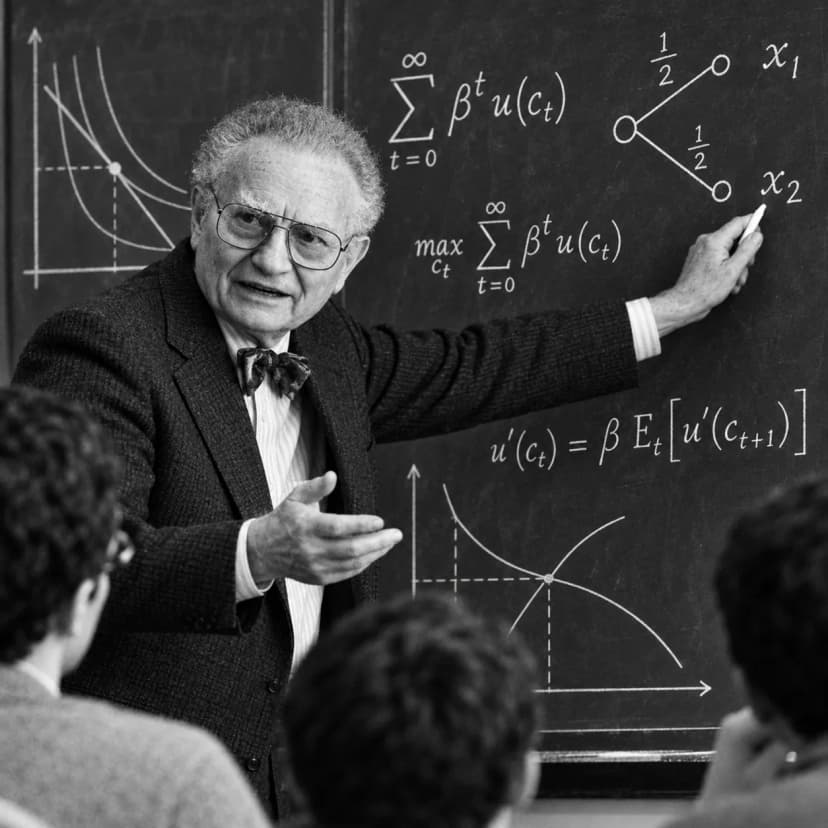
Paul Samuelson is the economist whose coin-toss problem opens the account of broad framing in Thinking, Fast and Slow. In the book's telling, a friend would not accept a single bet to lose $100 or win $200, but would accept a hundred of them. Samuelson proved that a person who maximises expected utility and rejects one such gamble should reject the offer of many.
Who they are
Paul Samuelson was born in Gary, Indiana, in 1915 and died in Belmont, Massachusetts, in 2009. He became an economics professor at the Massachusetts Institute of Technology in 1940 and received the Nobel Prize in Economic Sciences in 1970 for his fundamental contributions to nearly all branches of economic theory. His best-known works include Foundations of Economic Analysis (1947) and the introductory textbook Economics (1948).
He is distinct from William F. Samuelson, the co-author of the winner's curse paper with Max Bazerman, who has his own note.
Key papers
Kahneman and Lovallo's 1993 paper in Management Science cites Samuelson's (1963) observation that people who refuse one play of a favourable gamble will accept a run of them. Thinking, Fast and Slow gives the coin-toss version without a citation in the passage on narrow framing.
Key ideas
The book reports that Matthew Rabin and Richard Thaler later pointed out how odd the conclusion is: a hundred such bets have an expected return of $5,000, a 1 in 2,300 chance of losing any money and a 1 in 62,000 chance of losing more than $1,000. Kahneman uses the case to show the difference between narrow and broad framing.
Sources
- Kahneman, D. (2011). Thinking, Fast and Slow. New York: Farrar, Straus and Giroux.
- Kahneman, D., & Lovallo, D. (1993). Timid choices and bold forecasts: A cognitive perspective on risk taking. Management Science, 39(1), 17-31.
- Encyclopaedia Britannica, entry on Paul A. Samuelson.