Ryan Holiday
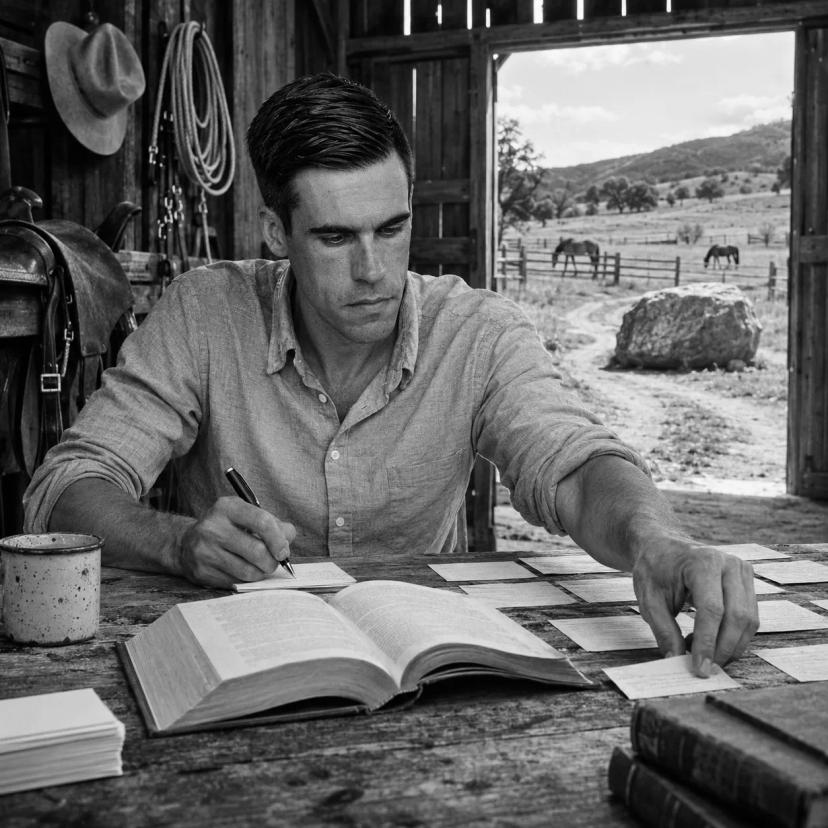
Ryan Holiday is the American author of The Obstacle Is the Way, published in 2014 and subtitled The Ancient Art of Turning Adversity to Advantage. The book draws on Stoic philosophy and is built around three disciplines: perception, action and will. This site treats it as a popular philosophy book, a statement of a position, and not as a research report.
Who they are
Ryan Holiday is an American writer whose author note in The Obstacle Is the Way describes a background in media strategy and marketing. The note says he left college at nineteen, advised authors and musicians, and served as Director of Marketing at American Apparel. It names his first book, Trust Me, I'm Lying, as a Wall Street Journal bestseller. The Acknowledgments of the book record that he was introduced to Stoicism while he was a student. His later titles include Ego Is the Enemy, The Daily Stoic, Conspiracy and Stillness Is the Key, which continue the same Stoic theme.
The book was first published in 2014, by Portfolio, an imprint of Penguin, in the United States and by Profile Books in the United Kingdom. The Profile Books paperback edition appeared in 2015 and carries a cover note on sales of more than one million copies. That figure comes from the publisher's cover note.
This page is a neutral profile. It records who he is, what he published and what the book proposes. It does not judge motives, and it does not assess how the book's claims compare with research. Where a claim in the book is compared with evidence, the comparison sits on the book and concept pages and concerns the claim.
Key papers
Holiday is an author of books and not of research papers, so there are no journal articles to list. The work this site draws on is The Obstacle Is the Way, a book of thirty-two chapters in three parts. Part one, which has eleven chapters, concerns perception, part two action and part three will. A postscript, acknowledgments and a note on further reading follow the main text. The book also carries a selected bibliography of ninety-nine entries and a reading list of Stoic authors for readers who want the originals.
The author states plainly in the book that it is not an academic study or history of Stoicism, and he directs readers to the Stoic writers themselves for the primary material. The site reports that statement as the author's own account of the book's purpose.
Key ideas
The organising idea is that an obstacle can be turned to advantage by the way a person responds to it. The book gives this a three-part shape. Perception is how a person sees an event and what they decide it means, with the aim of separating the event from the story told about it. Action is directed action, which the book describes as creative, persistent and iterative. Will is the discipline of enduring and accepting what cannot be changed, and the book defines it more through surrender and humility than through force.
The author separates his claim from positive thinking. The book says the aim is to see how a difficult situation can be made good, and it does not say the situation is not so bad. It rests on historical examples, drawn from the lives of public figures, to show the approach in use.
The first part of the book is closest to what psychologists study as cognitive reappraisal, the deliberate change of what a situation is taken to mean so that the feeling it produces changes. The book does not use that term. The article What is cognitive reappraisal? sets the book's emphasis on separating what is up to a person from what is not beside a 2013 study of 170 people, which reported that the link between reappraisal ability and how people were faring depended on whether the stressor could be controlled. The book and the study meet at the same dividing line, one as a philosophical position and the other as a research result.
The concepts linked from this page are Stoicism, the dichotomy of control, amor fati, survivorship bias, the practitioner playbook evidence classes and the unfalsifiable frame, which the vault uses to read the book's historical cases.
Sources
- Holiday, R. (2014). The Obstacle Is the Way: The Ancient Art of Turning Adversity to Advantage. Portfolio, New York; Profile Books, London (paperback 2015).
- Troy, A. S., Shallcross, A. J., & Mauss, I. B. (2013). A person-by-situation approach to emotion regulation: Cognitive reappraisal can either help or hurt, depending on the context. Psychological Science. https://doi.org/10.1177/0956797613496434
Articles that cite Ryan Holiday
- Why are we so afraid of failing?
How psychology came to measure the fear of failing, from a 1957 model to a five-part scale, and why the room matters as much as the person.
- What is cognitive reappraisal?
In a meta-analysis of 306 comparisons, the family of strategies that holds cognitive reappraisal beat the other two. A 2013 study adds a condition: whether the problem can be fixed.
Concepts on this site
- Stoicism
An ancient philosophical tradition whose writers Ryan Holiday draws on to treat obstacles as material for action.
- Survivorship Bias
Survivorship bias is reasoning from the cases that made it, because those are the only ones still visible. The failures left no trace, so the pattern found among the winners looks like a cause when…
- The Unfalsifiable Frame
The unfalsifiable frame is the failure in which a theory is built so that almost nothing could refute it, because a denial is absorbed as further evidence for it. Agreement confirms the theory…