Solomon Asch
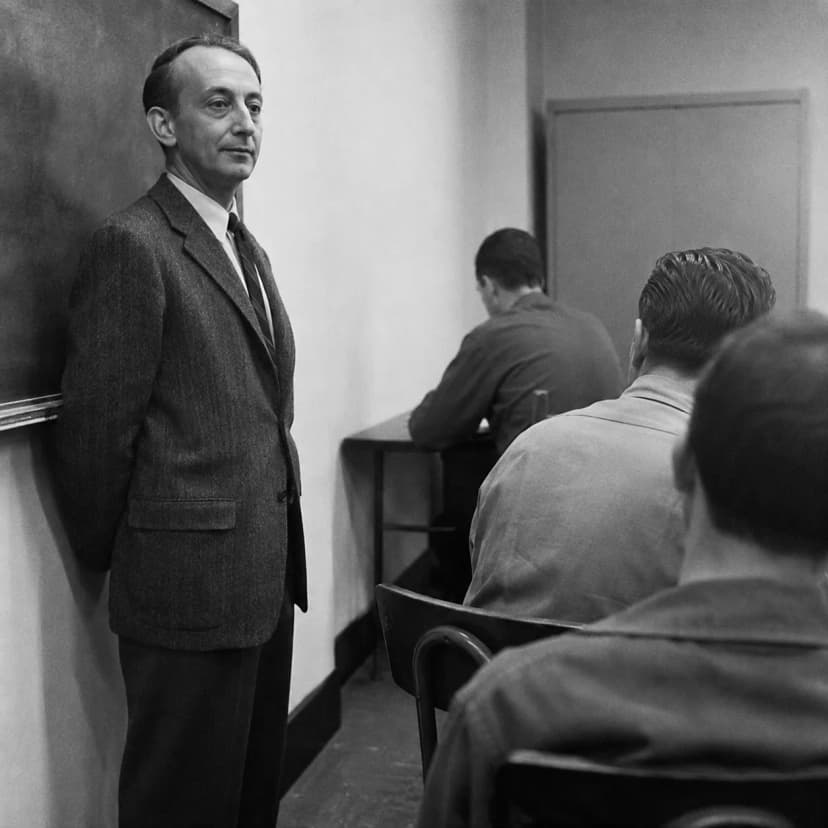
Solomon Asch ran the line-judgment studies of the early 1950s, the standard demonstration of conformity in every introductory course since. He designed them to demonstrate independence, and read his own data as showing more of it than of conformity. Around two thirds of responses were independent. The textbooks kept the other third and taught it as a lesson in how easily people fold, which tells you what the discipline found interesting rather than what it found.
Who they are
Solomon Asch was born in Warsaw in 1907 and emigrated to the United States with his family when he was thirteen. He took his bachelor's degree at the City College of New York in 1928 and his master's and doctorate at Columbia. At Brooklyn College he met Max Wertheimer, one of the founders of Gestalt psychology, who became the major intellectual influence on his work. In 1947 he moved to Swarthmore College, where he spent twenty years in daily contact with Wolfgang Köhler and Hans Wallach. He died in 1996.
He was a Gestalt psychologist before he was a social psychologist, and it shows in the design of everything he did. The commitment is that a whole is not the sum of its parts and that the parts change meaning inside it, which is why his conformity work is about a judgment made in a room rather than a response extracted from an individual.
The line-judgment procedure was almost insultingly simple. He put 123 American male students in a room with confederates who confidently gave the wrong answer about which of three comparison lines matched a reference line. The task was not ambiguous. Working alone, people were right almost every time. In the group, participants gave the wrong answer on 37 per cent of critical trials, 75 per cent went along at least once, and 5 per cent went along every time. What the interviews afterwards established is the part that matters: many of them knew the answer, could see the lines, and said the wrong thing anyway, reporting that they did it so as not to stand out. That makes it a transaction rather than a mistake.
The reading Asch himself gave was the opposite of the one that survived. Roughly two thirds of responses were independent. Most people, most of the time, said what they saw and absorbed the cost of dissent. His 1956 monograph is titled "Studies of Independence and Conformity", in that order, and independence was the finding he had gone looking for. Cite the 37 per cent and the two thirds together or not at all.
His other major contribution is to impression formation. In 1946 he showed that early information about a person carries more weight than later information in shaping the overall judgment, the primacy effect, and that some traits function as central and reorganise the meaning of everything around them while others are peripheral.
Key papers
Asch, S. E. (1946), "Forming Impressions of Personality," Journal of Abnormal and Social Psychology, 41, 258-290. The foundational study of impression formation, the primacy effect, and the distinction between central and peripheral traits.
Asch, S. E. (1952), Social Psychology, Prentice-Hall. His textbook, 646 pages, which carried the Gestalt reading of social life to a generation of students.
Asch, S. E. (1956), "Studies of Independence and Conformity: I. A Minority of One Against a Unanimous Majority," Psychological Monographs: General and Applied, 70(9), 1-70. The full report of the line-judgment studies, under a title that puts independence first.
Key ideas
In a group giving a confident wrong answer, participants gave the wrong answer on 37 per cent of critical trials, 75 per cent conformed at least once, and 5 per cent conformed every time.
Around two thirds of responses were independent, and Asch read this as the finding. The discipline kept the inverse.
Participants who conformed largely knew the right answer and reported going along so as not to stand out, which makes conformity a price paid rather than a perceptual error.
Impression formation runs on a primacy effect: what is learned first weights what is learned later.
Some personality traits are central and reorganise the meaning of the rest.
Concepts on this site
Find them elsewhere
Lifespan: 1907 to 1996. No social accounts, and none are claimed on their behalf.
Deceased, so no social accounts. Reference is the Swarthmore College history page on his conformity experiments, which gives the same dates
Checked 2026-09-10. Handles and affiliations go out of date, so treat this block as a snapshot rather than a standing fact.
Sources
- Asch, S. E. (1946), "Forming Impressions of Personality," Journal of Abnormal and Social Psychology, 41, 258-290.
- Asch, S. E. (1952), Social Psychology, Prentice-Hall.
- Asch, S. E. (1956), "Studies of Independence and Conformity: I. A Minority of One Against a Unanimous Majority," Psychological Monographs: General and Applied, 70(9), 1-70.
- Bond, R., & Smith, P. B. (1996), "Culture and Conformity: A Meta-Analysis of Studies Using Asch's (1952b, 1956) Line Judgment Task," Psychological Bulletin. (For how the rate moves across time and culture.)