Sungeun Cho
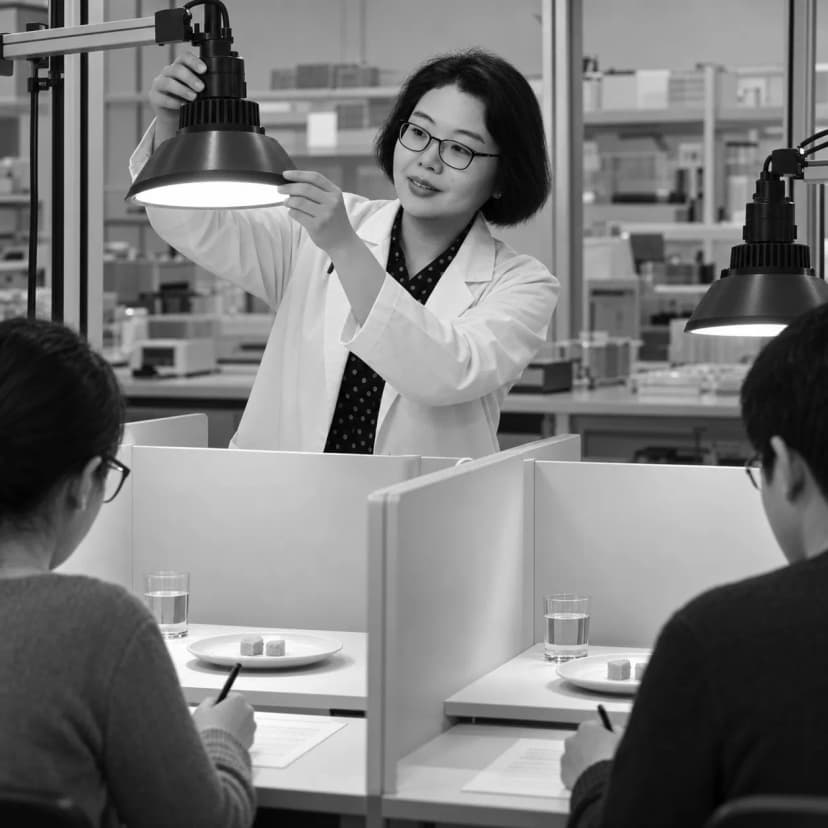
Sungeun Cho is the first author of a 2015 paper in Appetite titled 'Blue lighting decreases the amount of food consumed in men, but not in women', with Han-Seok Seo as last author. It is the one study cited on this site about appetite and coloured light that includes yellow among its conditions, and the reported reduction in eating was under blue.
Who they are
The facts about Sungeun Cho that this site has verified are narrow. The bibliographic record lists her first on a 2015 Appetite paper with seven co-authors and Han-Seok Seo last. The PubMed record places all eight authors in the Department of Food Science at the University of Arkansas, Fayetteville, with Seo as corresponding author. This page does not describe her wider career or any other publication, and it does not read more into the author order than the record shows.
Key papers
Cho, S., Han, A., Taylor, M. H., Huck, A. C., Mishler, A. M., Mattal, K. L., Barker, C. A., & Seo, H.-S. (2015). 'Blue lighting decreases the amount of food consumed in men, but not in women.' Appetite, 85, 111-117. doi:10.1016/j.appet.2014.11.020.
The design below comes from the paper's abstract. It describes 112 participants, 62 men and 50 women, who ate a breakfast of omelettes and mini pancakes under one of three lighting colours: white, yellow or blue. The measures were the hedonic impression of the food's appearance, willingness to eat, overall flavour intensity, overall impression of the food and meal size, meaning the amount eaten.
The abstract reports that blue lighting decreased the hedonic impression of the food's appearance, but not willingness to eat, compared with yellow and white. Blue lighting significantly decreased the amount eaten by men, but not by women, compared with yellow and white. Overall flavour intensity and overall impression did not differ among the three colours. The authors conclude that the colour of lighting can modulate meal size and that blue lighting can decrease the amount eaten by men without reducing their acceptability of the food. The abstract gives no separate result for yellow, and the full text and tables were not read for this page.
Key ideas
A lighting condition that includes yellow. Most colour and appetite experiments change the food or a backdrop. This one changed the light in the room, and yellow was one of the three lights.
A difference by sex. The title itself states that the reduction was seen in men and not in women. The abstract reports the result without testing a reason for the difference, and this page offers none.
Where it sits. The Graz experiment of Schlintl and Schienle, which cites this study, describes findings on blue as decreasing appetite, within a literature it calls inconsistent. See Colour-Appetite Claim.
Sources
- Cho, S., Han, A., Taylor, M. H., Huck, A. C., Mishler, A. M., Mattal, K. L., Barker, C. A., & Seo, H.-S. (2015). Appetite, 85, 111-117. doi:10.1016/j.appet.2014.11.020. Bibliographic record read.
- PubMed record and abstract, PMID 25447013, read for the design and results.
- Schlintl, C., & Schienle, A. (2020). Frontiers in Psychology, 11, 589826, for the description of the study in its introduction.