The Buddha
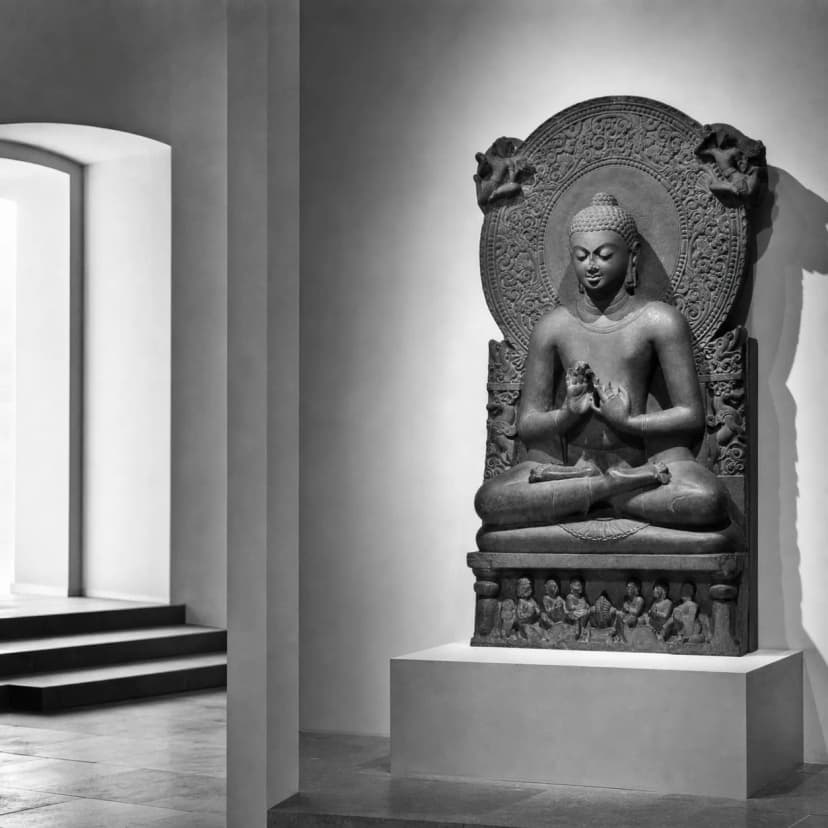
The Buddha is the founder of Buddhism and the author, by tradition, of the oldest psychological hypothesis still in continuous clinical use: that suffering has a specific cause, and that the cause is craving. His first sermon, the Dhammacakkappavattana Sutta, names the origin of dukkha as taṇhā, thirst, and does not mention thinking at all. That distinction matters, because the modern wellness version of the doctrine blames the wandering mind rather than the wanting one, and in doing so replaces the load-bearing claim with a secondary one. His dates are genuinely disputed, and this page does not pretend otherwise.
Who they are
The Buddha, Siddhattha Gotama in Pali and Siddhārtha Gautama in Sanskrit, was a teacher in the Ganges basin of northern India whose teaching became Buddhism. The traditional dates, roughly 563 to 483 BCE, are not an ancient given. They were reconstructed in the nineteenth century by working backwards from the coronation of the Mauryan king Ashoka, and modern scholarship has moved them substantially later. Heinz Bechert's collaborative reappraisal placed the death somewhere between about 400 and 350 BCE. Other specialists have proposed other windows, including 463 to 383 BCE and 502 or 479 to 422 or 399 BCE. There is no settled consensus. The honest statement is that he lived in the fifth or sixth century BCE and died in the fifth or fourth, and that anyone who gives you a firm year is quoting one tradition rather than reporting a finding.
The transmission problem is larger than the dating one, and it changes how the man can be cited. The Pali discourses were carried orally for roughly four centuries before they were written down, probably in Sri Lanka in the first century BCE. What survives is therefore a canon, not a manuscript, and no line in it can be traced to a specific afternoon in a particular year. This site cites the sutta and names it, rather than attributing sentences to the man.
His relevance to modern psychology rests on two texts that say different things. The Dhammacakkappavattana Sutta (SN 56.11), the sermon given in the deer park at Isipatana near Varanasi, sets out the Four Noble Truths, and the second of them identifies the origin of suffering as taṇhā in three varieties: thirst for sensual pleasure, thirst for existence and thirst for non-existence. It is a causal claim, and a testable one. The Madhupiṇḍika Sutta (MN 18) describes something else, papañca, the process by which what a person conceives they differentiate and what they differentiate then multiplies back on them. That is much closer to the sentence people now repeat about the untrained mind, and it is the junior doctrine of the two: the commentarial tradition ties papañca back to craving, conceit and false view rather than treating it as the root.
The popular version fuses the two and promotes the junior one, which is why the doctrine is so often defended on the wrong ground. It also means the modern neuroscience aimed at this tradition is aimed exactly at the load-bearing wall. Kent Berridge's dissociation between wanting and liking describes wanting as a pull with nothing necessarily painful behind it. If that generalises, the Second Noble Truth is describing a subset of human wanting while claiming the whole of it.
Key texts
The Buddha wrote nothing, and no text in the canon was recorded in his lifetime. The two discourses below are the ones this site cites, both from the Pali Canon, both reaching us through centuries of oral transmission before they were committed to writing.
Key papers
There are no papers here, and there is no book he wrote. He wrote nothing, and no text in the canon was recorded in his lifetime. What this site cites are two discourses from the Pali Canon, both carried orally for roughly four centuries before they were committed to writing, probably in Sri Lanka in the first century BCE. The convention followed on this page is to cite the sutta and name it rather than to attribute sentences to the man.
Dhammacakkappavattana Sutta, Saṃyutta Nikāya 56.11. The first sermon, given by tradition in the deer park at Isipatana near Varanasi. It sets out the Four Noble Truths, and the second of them identifies the origin of dukkha as taṇhā in three varieties: thirst for sensual pleasure, thirst for existence and thirst for non-existence.
Madhupiṇḍika Sutta, Majjhima Nikāya 18. The discourse on papañca, the process by which what a person conceives they differentiate and what they differentiate then multiplies back on them. The commentarial tradition ties papañca back to craving, conceit and false view rather than treating it as the root.
Ñāṇananda, Bhikkhu (1971), Concept and Reality in Early Buddhist Thought: An Essay on Papañca and Papañca-saññā-saṅkhā, Buddhist Publication Society. Modern scholarship rather than canon, and the source of the standard English rendering of papañca as conceptual proliferation.
Bechert, H. (ed.) (1991-1997), The Dating of the Historical Buddha / Die Datierung des historischen Buddha, Vandenhoeck & Ruprecht, Göttingen. The collaborative reappraisal that moved the consensus later. Cited here for the existence of the dispute, not for a single answer.
Key ideas
Craving is the diagnosis, not thinking. The Second Noble Truth names taṇhā as the origin of suffering. Every popular restatement that blames mental chatter has quietly changed the claim.
Wanting is defined as unpleasant. Taṇhā means thirst, and a thirst is a discomfort by construction. That definitional move is what makes the doctrine vulnerable to evidence that some wanting is a neutral or positive pull.
Papañca is a different and later-weighted idea. See papanca. Useful, but not the root of the system, and not interchangeable with the Second Noble Truth.
Attribution is a real constraint here. Four centuries of oral transmission mean claims belong to named suttas rather than to a biography. Anyone who quotes "the Buddha said" without a reference is not citing anything.
Concepts on this site
Find them elsewhere
Lifespan: dates disputed, traditionally c. 563 to 483 BCE, now often placed a century later. No social accounts, and none are claimed on their behalf.
Deceased, so no social accounts. Reference is the Stanford Encyclopedia of Philosophy entry, which dates him only as flourishing circa 450 BCE, so the dispute is preserved rather than resolved
Checked 2026-09-10. Handles and affiliations go out of date, so treat this block as a snapshot rather than a standing fact.
Sources
- Dhammacakkappavattana Sutta, Saṃyutta Nikāya 56.11. The first sermon; the Second Noble Truth names the origin of dukkha as taṇhā in three varieties.
- Madhupiṇḍika Sutta, Majjhima Nikāya 18. The discourse on papañca.
- Ñāṇananda, Bhikkhu (1971), Concept and Reality in Early Buddhist Thought: An Essay on Papañca and Papañca-saññā-saṅkhā, Buddhist Publication Society. Source of the standard English rendering of papañca as conceptual proliferation.
- Bechert, H. (ed.) (1991-1997), The Dating of the Historical Buddha / Die Datierung des historischen Buddha, Vandenhoeck & Ruprecht, Göttingen. The collaborative reappraisal that moved the consensus later. Cited here for the existence of the dispute, not for a single answer.
- On the written fixing of the canon: the Pali discourses were transmitted orally and first committed to writing in Sri Lanka, probably in the first century BCE.