Timothy Bates
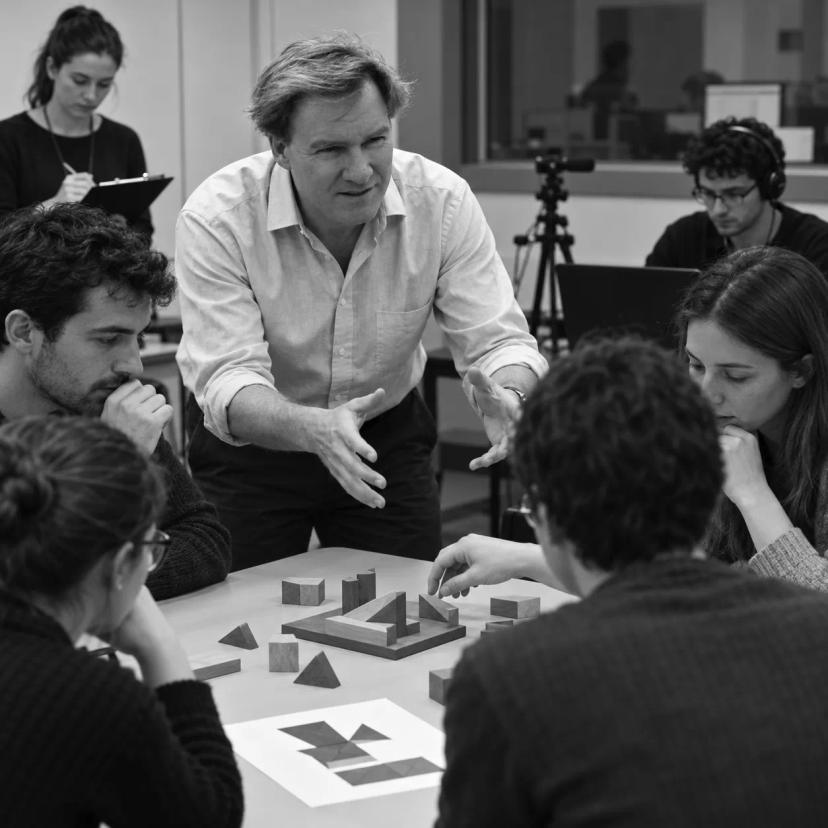
Psychologist at the University of Edinburgh and, with Shivani Gupta, author of 'Smart groups of smart people: Evidence for IQ as the origin of collective intelligence in the performance of human groups', published in the journal Intelligence. Three studies with 312 people found that individual intelligence accounted for about 80 per cent of the differences between groups, and gave no support to the turn-taking and proportion-of-women predictions of the 2010 collective intelligence paper.
Who they are
Bates is at the University of Edinburgh, which is where the first and third of his three studies were run. The second was run with teams in Chennai, India. He is a psychologist whose published work in this vault runs in one direction: testing whether striking claims survive a second look. He is also second author, with Y. Li, of a paper reporting three failures to replicate an effect of mindset on children's ability, school achievement and response to challenge, which this site uses in its piece on growth mindset.
That description is the site's, drawn from the two papers it uses. Nothing else about his career is asserted here, because nothing else was verified for the article that cites him.
Key papers
Bates, T. C., & Gupta, S. (2017). 'Smart groups of smart people: Evidence for IQ as the origin of collective intelligence in the performance of human groups.' Intelligence. doi:10.1016/j.intell.2016.11.004. Published online in 2016 and in print in 2017. Read at the author-hosted copy; the volume and page numbers were not in the text read.
The paper tests a specific claim from Anita Woolley and colleagues' 2010 paper in Science: that group intelligence is largely independent of the intelligence of the individuals in the group, and is instead linked to the members' social sensitivity, the evenness of their turn-taking and the proportion of women. Bates and Gupta ran three studies with 312 people in total. Study 1 had 72 students in 26 groups of two to four at Edinburgh. Study 2 had 40 teams of three in Chennai. Study 3 had 40 teams of three at Edinburgh again.
Key ideas
The central result is that individual intelligence accounted for about 80 per cent of group-level differences. In the authors' structural model, individual intelligence fully determined the latent group factor, to the point where the two are described as effectively identical. The Reading the Mind in the Eyes test, the 2010 paper's measure of social sensitivity, had no effect on the group factor once individual intelligence was in the model.
The two other predictors fared no better. The hypothesised link between turn-taking and group performance was not supported, and the authors argue that the original finding was probably a false positive. The proportion of women in a group did not predict group performance: all-male, all-female and mixed groups performed about equally well.
The paper is a direct challenge by an independent team, and it needs to be read alongside what followed. In 2021 Christoph Riedl and colleagues, including two of the 2010 authors, pooled 22 studies covering 5,279 individuals in 1,356 groups and found that the collective intelligence factor held up, that it predicted performance on out-of-sample tasks, and that the proportion of women remained a significant predictor mediated by social perceptiveness. In that pooled analysis collaboration process was the strongest predictor of the factor, followed by individual skill and then group composition. The two bodies of work do not simply cancel. One shows that a measured group factor can be traced largely to the members' individual intelligence in three small samples; the other shows that the factor is stable across many studies and is better predicted by how groups work than by who is in them.
A second dispute runs beneath both. The social sensitivity measure is the Reading the Mind in the Eyes test, and a 2024 scoping review in Clinical Psychology Review found that most studies using it reported no validity evidence on key dimensions. That is a problem for a large literature and not a charge against any one paper, but it bears on how much weight the social sensitivity finding of 2010 can carry, and it is part of why this site describes the general group factor as contested rather than refuted.
For readers who want the one-line version: Bates and Gupta are the reason this site does not repeat the claim that group intelligence has little to do with the intelligence of members without also saying that an independent team tried to reproduce it and reached a different answer.
Sources
- Bates, T. C., & Gupta, S. (2017). Intelligence. doi:10.1016/j.intell.2016.11.004. Abstract, studies, sample sizes and findings read at the author-hosted copy. Riedl, C., Kim, Y. J., Gupta, P., Malone, T. W., & Woolley, A. W. (2021). Proceedings of the National Academy of Sciences, 118(21), e2005737118. doi:10.1073/pnas.2005737118. Indexed record read.
Studies on this site by Bates
Articles that cite Timothy Bates
- Is Collective Intelligence Real
Galton's crowd guessed an ox to within 0.8 per cent, and the result has been read as proof that groups are smarter than people ever since. The later record is narrower: averaging works while guesses…
Concepts on this site
- Collective Intelligence
Collective intelligence is a general factor in group performance, analogous to general intelligence in individuals: a group that does well on one kind of task tends to do well on others, and that…