Vilfredo Pareto
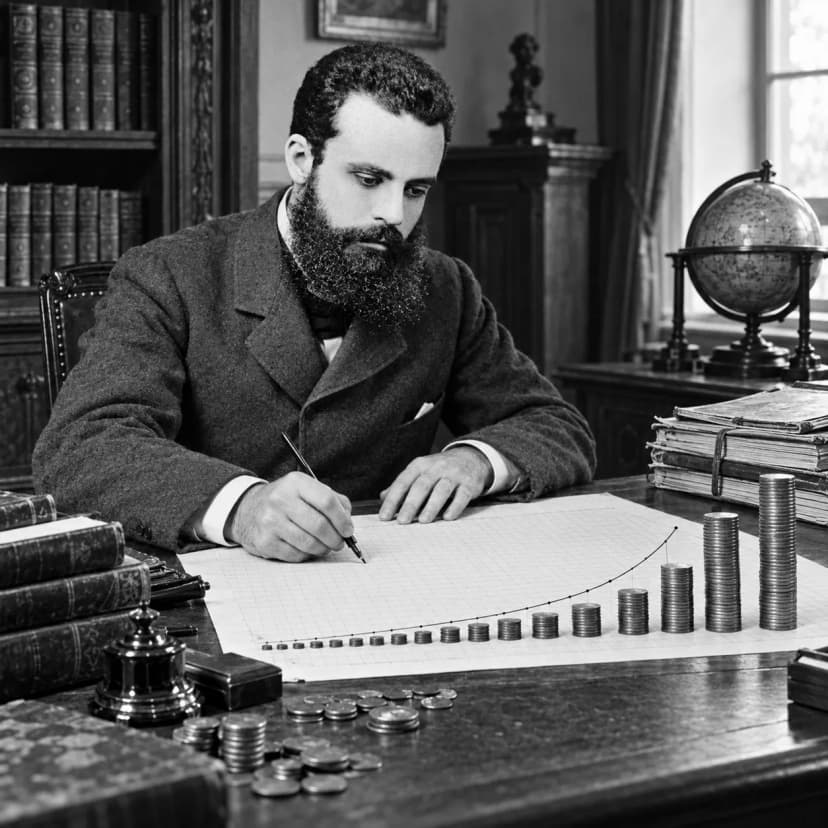
Vilfredo Pareto (1848 to 1923) was an economist and sociologist who held the chair of economics at the University of Lausanne. He is known for an income law and for the idea of Pareto optimality. The Pareto principle, the 80/20 rule, was named after him by Joseph Juran, who wrote that Pareto's models were not intended to be applied to other fields. A standard biography of Pareto does not mention an 80/20 split.
Who they are
According to the Library of Economics and Liberty, Pareto was born in Paris in 1848 to Italian exiles and moved to Italy for his education in mathematics and literature, and graduated from the Polytechnic Institute in Turin in 1869. He worked as a railway engineer and did not study economics seriously until about the age of 42. In 1893 he succeeded his mentor Leon Walras as the chair of economics at the University of Lausanne. His first book, the Cours d'economie politique, appeared in 1896 to 1897, when he was 49, and the Manual of Political Economy followed in 1906. He died in 1923 and is buried in Celigny.
In his later years he turned towards sociology, holding that people act non-logically while pretending to act logically. In 1923 he was nominated to a senate seat in Mussolini's government and refused to be a ratified member.
What he is known for in economics is two things. The first is Pareto optimality: an allocation of resources is Pareto-optimal when no one can be made better off without making someone else worse off. The second is the income law, which the Library of Economics and Liberty describes as derived from British income data and showing a linear relationship between income levels and the number of people earning more than that amount, with similar results for Prussia, Saxony, Paris and some Italian cities. Pareto said it could be provisionally accepted as universal and recognised exceptions.
Key papers
Pareto, V. (1896 to 1897). Cours d'economie politique. The Library of Economics and Liberty gives this as his first book.
Pareto, V. (1906). Manual of Political Economy.
Key ideas
Pareto optimality. No one can be made better off without making someone else worse off.
The income law. A regular relationship between an income level and the number of people earning more than it, observed in several countries and held open to exceptions.
Non-logical action. In his sociology, the claim that people act non-logically while pretending to act logically.
What he did not say. The 80/20 rule carries his name because Joseph Juran gave it to the principle. Juran wrote in 1974 that the principle as a universal was not original with Pareto and that Pareto's work had been in the economic sphere, with models not intended for other fields. The biography used for this page does not mention an 80/20 split. See Law of the Vital Few and Joseph Juran.
Sources
- Library of Economics and Liberty. "Vilfredo Pareto." https://www.econlib.org/library/Enc/bios/Pareto.html
- Juran, J. M. (1974). "The Non-Pareto Principle; Mea Culpa." Juran Institute archive. https://www.juran.com/wp-content/uploads/2021/03/The-Non-Pareto-Principle-1974.pdf