Choice Overload
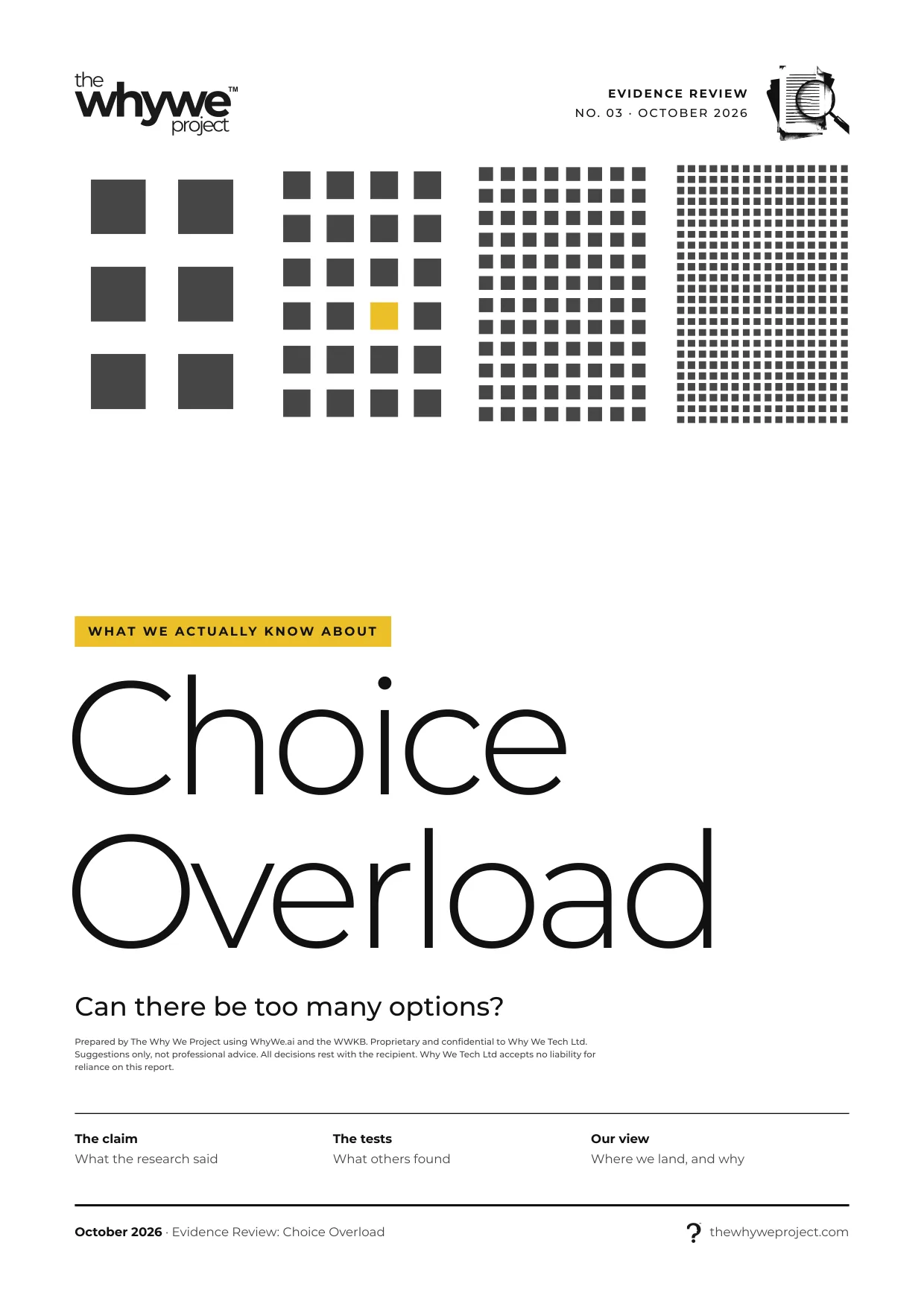
Is choice overload real?
Yes, but only under certain conditions. Across 50 experiments the average effect of more options was close to zero. A second review found overload reliably when options are hard to compare, the decision is difficult, people are unsure what they want, or they want to choose quickly.
What the report found
- The original finding was striking. A stand with 24 jams drew more shoppers than one with 6, but only 3 per cent of those who stopped bought a jar, against 30 per cent at the smaller display.
- Real decisions showed the same pattern. In 401(k) pension plans, participation fell from about 75 per cent with two funds to about 60 per cent with 59, and people offered more funds put less into shares.
- The first large review found almost nothing on average. Across 50 experiments with more than 5,000 people, the average effect of more options was close to zero, with large differences between studies.
- The second found that it depends. Overload appeared reliably when options were hard to compare, the decision was difficult, people did not know what they wanted, or they wanted to choose quickly.
- Our view: real, but conditional. More choice is not bad in general. It is bad for people who lack a clear preference, facing options they cannot easily compare. The useful question is not how many options, but how easy they are to choose between.
What is inside
- The idea and where it came from
- The original studies, explained
- What happened when others tested it
- Where researchers disagree
- What we can say with confidence
Plus a timeline of the research, the four conditions that make overload likely, a graded list of claims and a five-question checklist.
Who it is for
For anyone who has heard that fewer options sell more, and anyone who designs menus, ranges or plans.
How we work
Evidence Reviews follow one idea from its first studies to the latest reviews. Every claim is graded Established, Emerging or Untested. Where researchers disagree, as they do on whether choice overload is real, both sides are set out before we say where we stand.
Cite this report
The Why We Project (2026) Choice Overload: Can there be too many options? Evidence Review No. 03. Dubai: Why We Tech Ltd. Available at: thewhyweproject.com