Present Bias
Is present bias real?
Yes, and it is clearest for effort, food and leisure. Office workers who chose fruit a week ahead mostly switched to treats on the day, and in a careful test people showed clear present bias over work but very little over money. Commitment helps those who choose it: one plan lifted saving rates from 3.5 to 13.6 per cent over 40 months.
What the report found
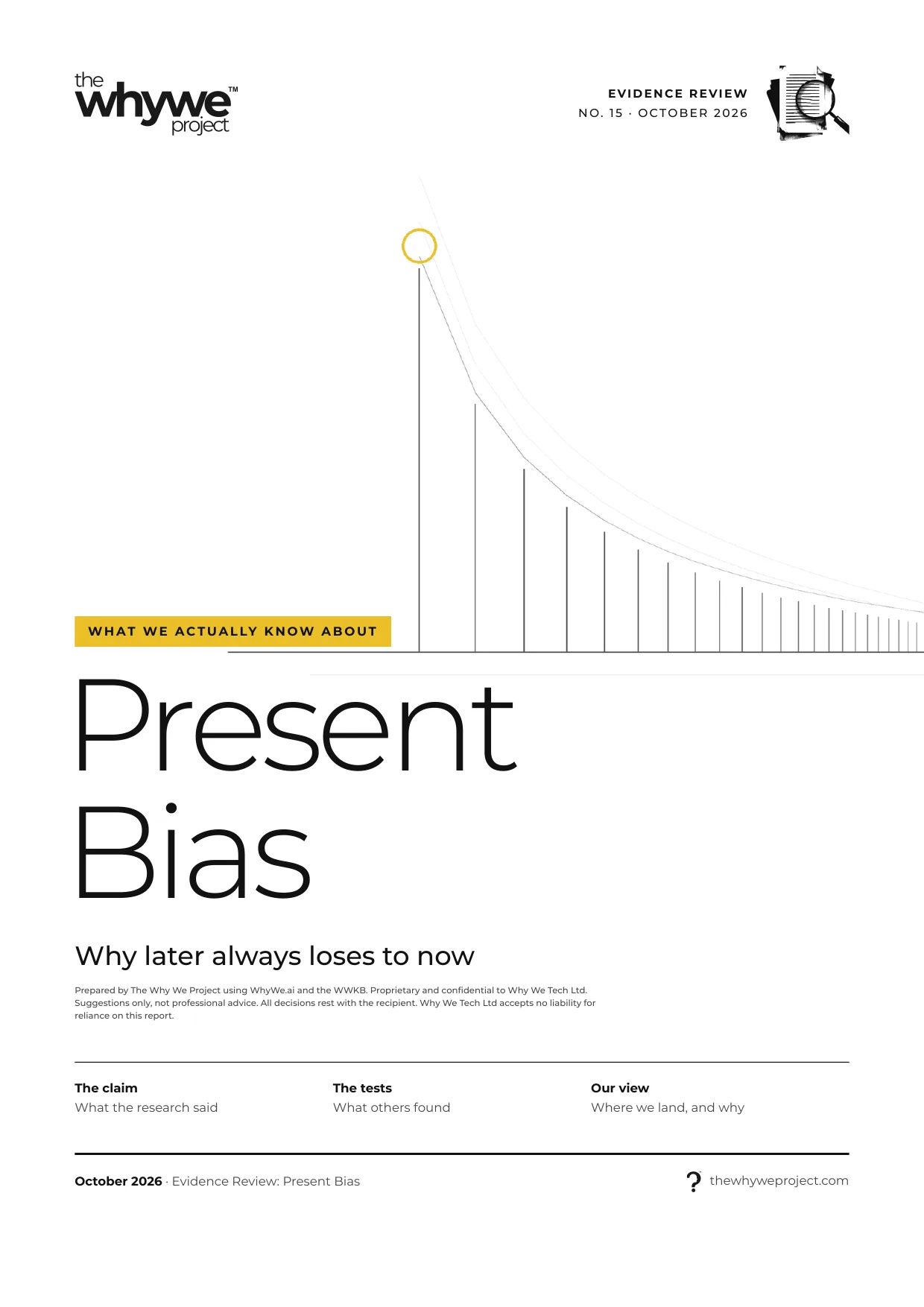
- Impatience is steepest close to now. People asked how much they would need later to give up 15 dollars today asked for rates that implied about 345 per cent a year over one month, and about 19 per cent a year over ten years.
- Plans change when the moment arrives. Office workers who chose fruit for a week ahead mostly switched to chocolate or crisps when the snack was in front of them; 34 of 36 people in another study reversed a choice as both rewards drew near.
- It is clearest in effort and consumption. In a careful test, people showed very little present bias over money but clear present bias over work, and those most biased were the most likely to ask to be held to their plans.
- Commitment helps those who choose it. A locked savings account raised balances, a plan to save from future pay rises lifted saving rates from 3.5 to 13.6 per cent over 40 months, and a quit smoking contract raised the share who passed a test, though take up was often low.
- The effect is real; its size depends on how it is measured. Present bias is well established for food, effort and everyday plans. Over money in the laboratory it is smaller and harder to pin down, and researchers still debate why.
What is inside
- The idea and where it came from
- The original studies, explained
- What happened when others tested it
- Where researchers disagree
- What we can say with confidence
Plus a timeline of the key studies, two debates set out side by side and a table grading each common claim.
Who it is for
For employers, product and pension teams, health and fitness services, teachers, and anyone whose plans for next week keep changing when next week arrives.
How we work
Evidence Reviews follow one well known idea from its origin to today: the original studies, what happened when others tested them, where researchers disagree and what we can say with confidence. Every claim is graded, and both sides of each debate are set out before we say where we stand.
Cite this report
The Why We Project (2026) Present Bias: Why later always loses to now. Evidence Review No. 15. Dubai: Why We Tech Ltd. Available at: thewhyweproject.com