The Spotlight Effect
What is the spotlight effect?
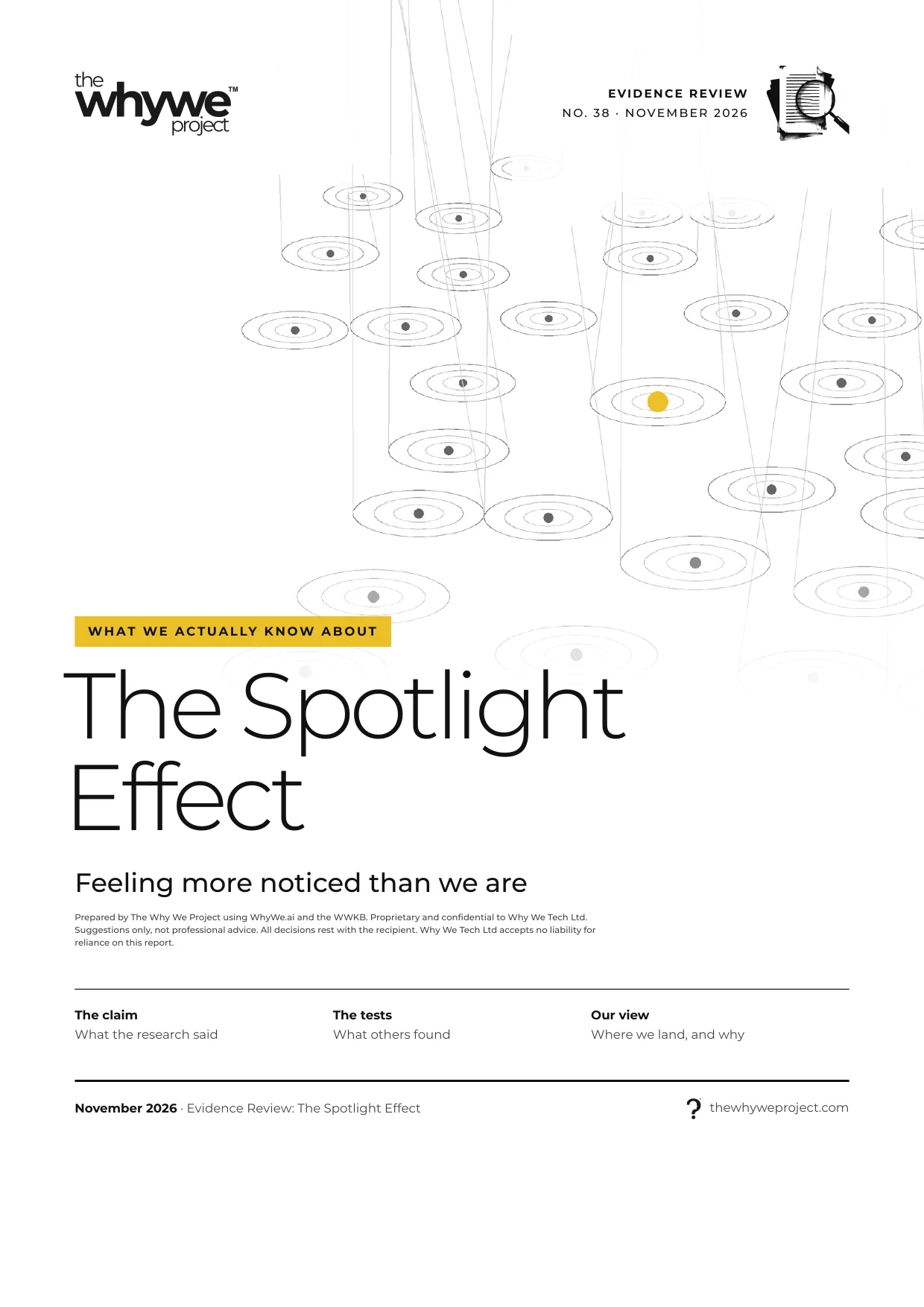
It is the tendency to overestimate how much other people notice our appearance and our actions. People who wore a conspicuous shirt into a room overestimated how many others could recall it, and student speakers rated their own nerves well above the level their audiences saw.
What the report found
- We feel watched more than we are. People who wore a conspicuous shirt into a room, or spoke up in a group discussion, overestimated how much others noticed. The finding has been extended by several teams over more than two decades.
- The cause is a vivid view from the inside. Our own looks, slips and feelings fill our attention. We start from that experience when we guess what others see, and we adjust too little for the fact that they are busy with their own.
- We also expect harsher judgement than we get. People who make a small public blunder tend to think observers will judge them more severely than they do, partly because they forget that observers can imagine being in their shoes.
- The spotlight can run the other way. People underestimated how much others noticed a scent they had stopped sensing themselves, and many believe they watch others more than others watch them. What is vivid to us shapes the guess, in both directions.
- A truer sense of being seen can be learned. Rewarding accuracy and giving people specific information about the bias both reduced these errors in experiments. Embarrassment, when it shows, tends to earn goodwill rather than scorn.
What is inside
- The idea and where it came from
- The original studies, explained
- What happened when others tested it
- Where researchers disagree
- What we can say with confidence
Plus a timeline of the key studies, two charts of reported results, four diagrams, two tables of the early and later studies, three debates set out side by side and a table grading each common claim.
Who it is for
For designers of shops, classrooms, workplaces, events and online spaces, product and research teams, educators, and anyone who has felt that every eye in the room was on them.
How we work
Evidence Reviews follow one well known idea from its origin to today: the original studies, what happened when others tested them, where researchers disagree and what we can say with confidence. Every claim is graded, and both sides of each debate are set out before we say where we stand.
Cite this report
The Why We Project (2026) The Spotlight Effect: Feeling more noticed than we are. Evidence Review No. 38. Dubai: Why We Tech Ltd. Available at: thewhyweproject.com
In these themes
- Biases and Heuristics
The mental shortcuts we rely on, and how well the evidence for each holds up.
- Social Proof and Conformity
Why we look to other people before we decide.