Onboarding
What makes onboarding work?
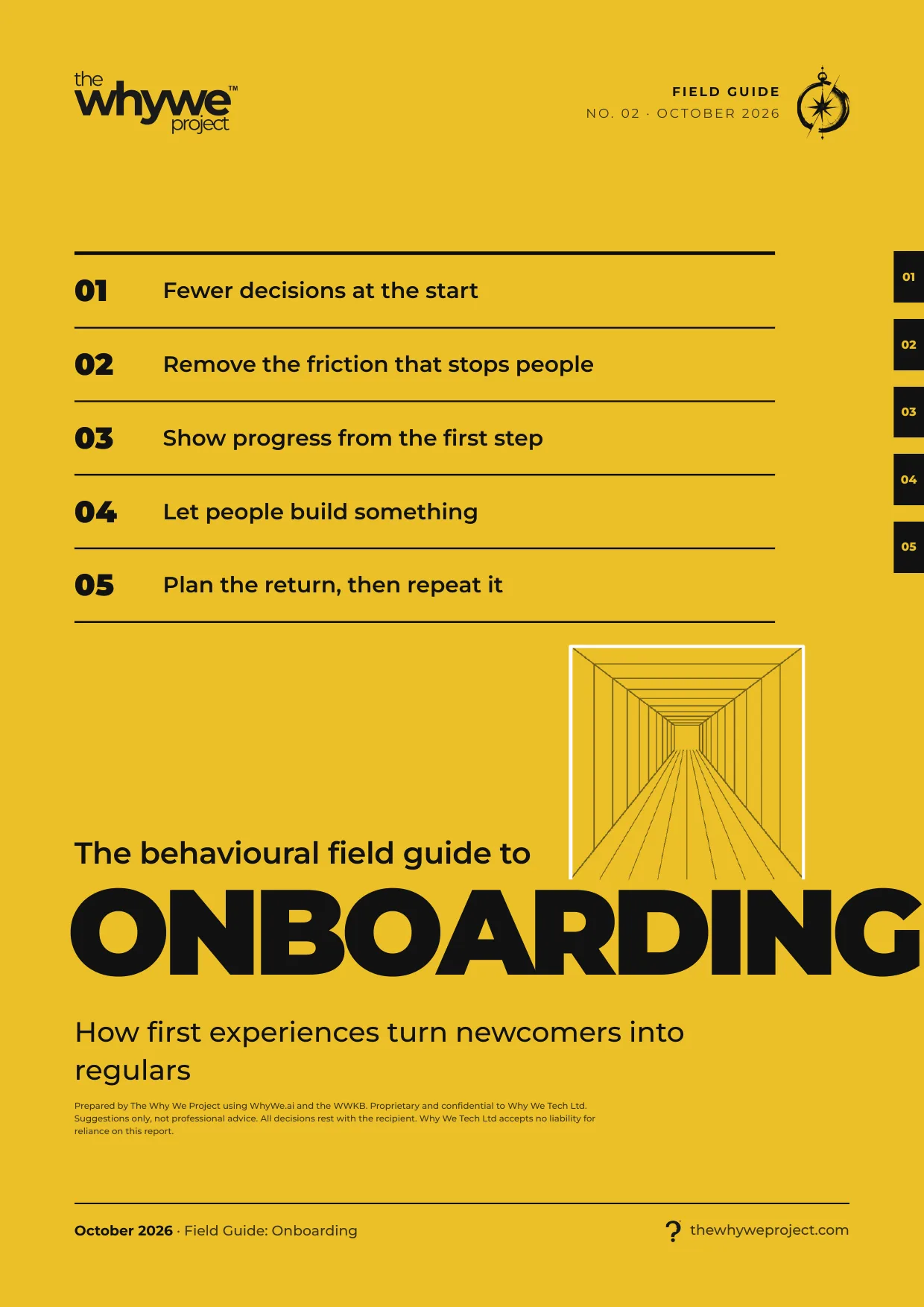
Fewer decisions at the start, help at the step where people stop, visible progress from the first step, a first session that ends with something the user made, and a planned return repeated in the same context until it becomes a habit.
What the report found
- Ask for fewer decisions at the start. A tasting stand with 6 jams sold to 30 per cent of those who stopped; one with 24 sold to 3 per cent. The effect is real only in some conditions, and a good default often does more than a shorter list.
- Remove the friction that stops people, not the effort that commits them. Help filling in a financial aid form raised the share of students completing two years of college from 28 to 36 per cent. Information alone did nothing.
- Show progress from the first step. A loyalty card with two stamps already given was completed by 34 per cent of customers; an equivalent blank card by 19 per cent.
- Let people build something. People valued a toy they had assembled about twice as much as an identical one they had not, but only if they finished it.
- Plan the return, then repeat it in the same place. Asking people to write down a date and time raised flu vaccination by 4 percentage points. Habits took from 18 to 254 days to form, and paying people to visit a gym eight times in a month doubled later visits among those who rarely went.
Who it is for
For anyone who designs a first experience, in an app, a bank, a gym or a public service, and anyone starting something they mean to keep.
How we work
Field Guides turn behavioural science into practical principles. Each principle sets out the idea, the evidence, a worked example, things to try and things to watch out for, and every claim is graded Established, Emerging or Untested.
Cite this report
The Why We Project (2026) Onboarding: How first experiences turn newcomers into regulars. Field Guide No. 02. Dubai: Why We Tech Ltd. Available at: thewhyweproject.com