Research
How do you get honest answers in a survey?
Ask about what people did rather than what they will do, let them answer privately on a screen, use neutral words and answer scales based on real data, keep the survey short with the key questions first, and in interviews ask for specific stories rather than reasons. Then check answers against what people actually do.
What the report found
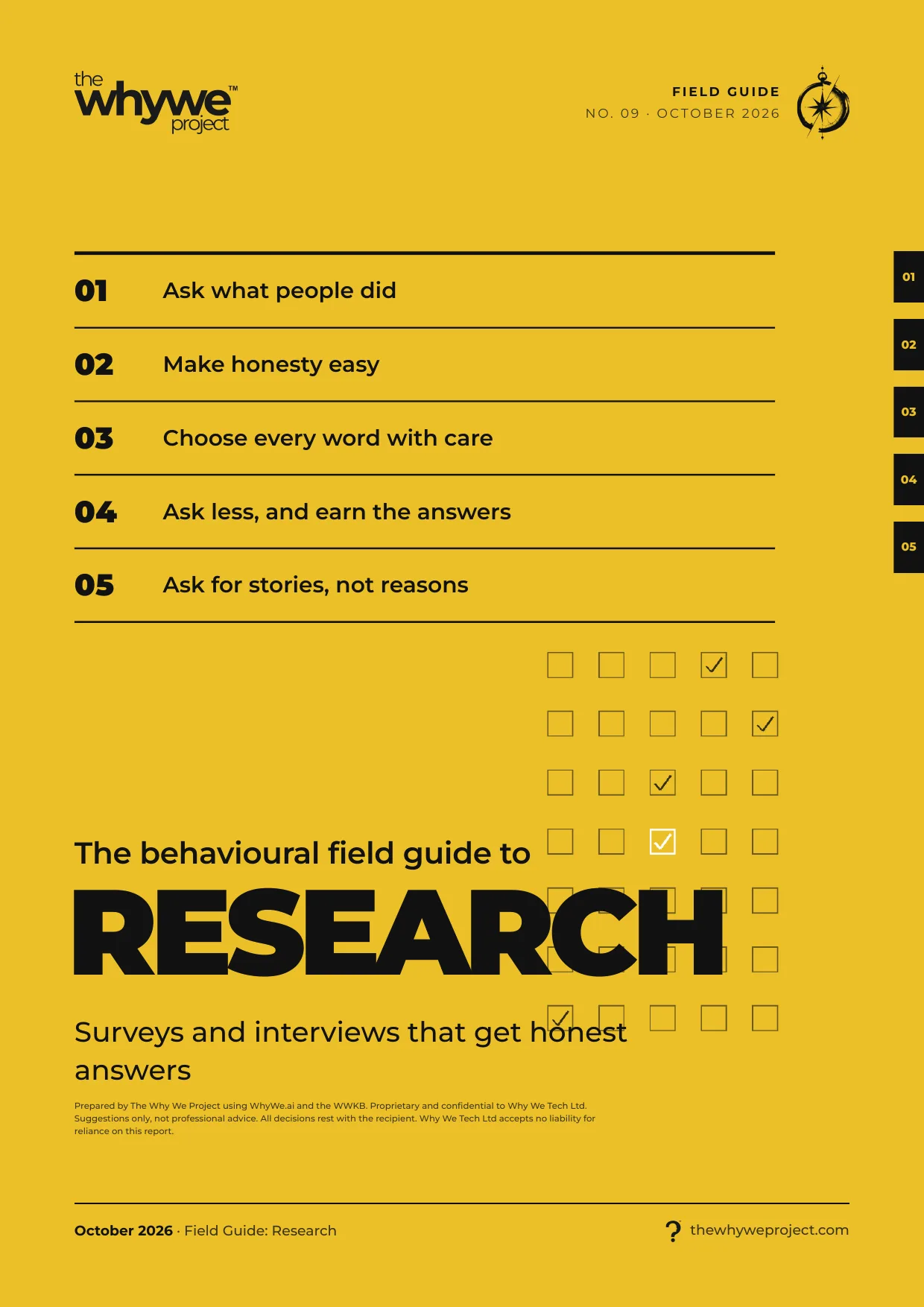
- Ask what people did, not what they will do. Intentions predict behaviour only loosely; many people who say they will act do not.
- Make honesty easy. People report more embarrassing facts, and more accurately, when they answer on a screen rather than to a person.
- Choose every word and scale with care. When the answer options for daily television ran higher, 37.5 per cent reported watching more than two and a half hours, against 16.2 per cent with lower options.
- Ask less, and earn the answers. Longer surveys put people off starting, and questions near the end got quicker, thinner answers.
- In interviews, ask for stories, not reasons. People often cannot say why they chose something, and will give a plausible reason anyway.
Who it is for
For marketers, product teams, founders, researchers, public servants and anyone who writes a survey or interviews customers.
How we work
Field Guides turn behavioural science into practical principles. Every claim is graded Established, Emerging or Untested. Each principle comes with the evidence, a worked example from the UAE and what to try and watch out for, and the guide ends with a worksheet and a checklist.
Cite this report
The Why We Project (2026) Research: Surveys and interviews that get honest answers. Field Guide No. 09. Dubai: Why We Tech Ltd. Available at: thewhyweproject.com