Websites
How do you design a website people can actually use?
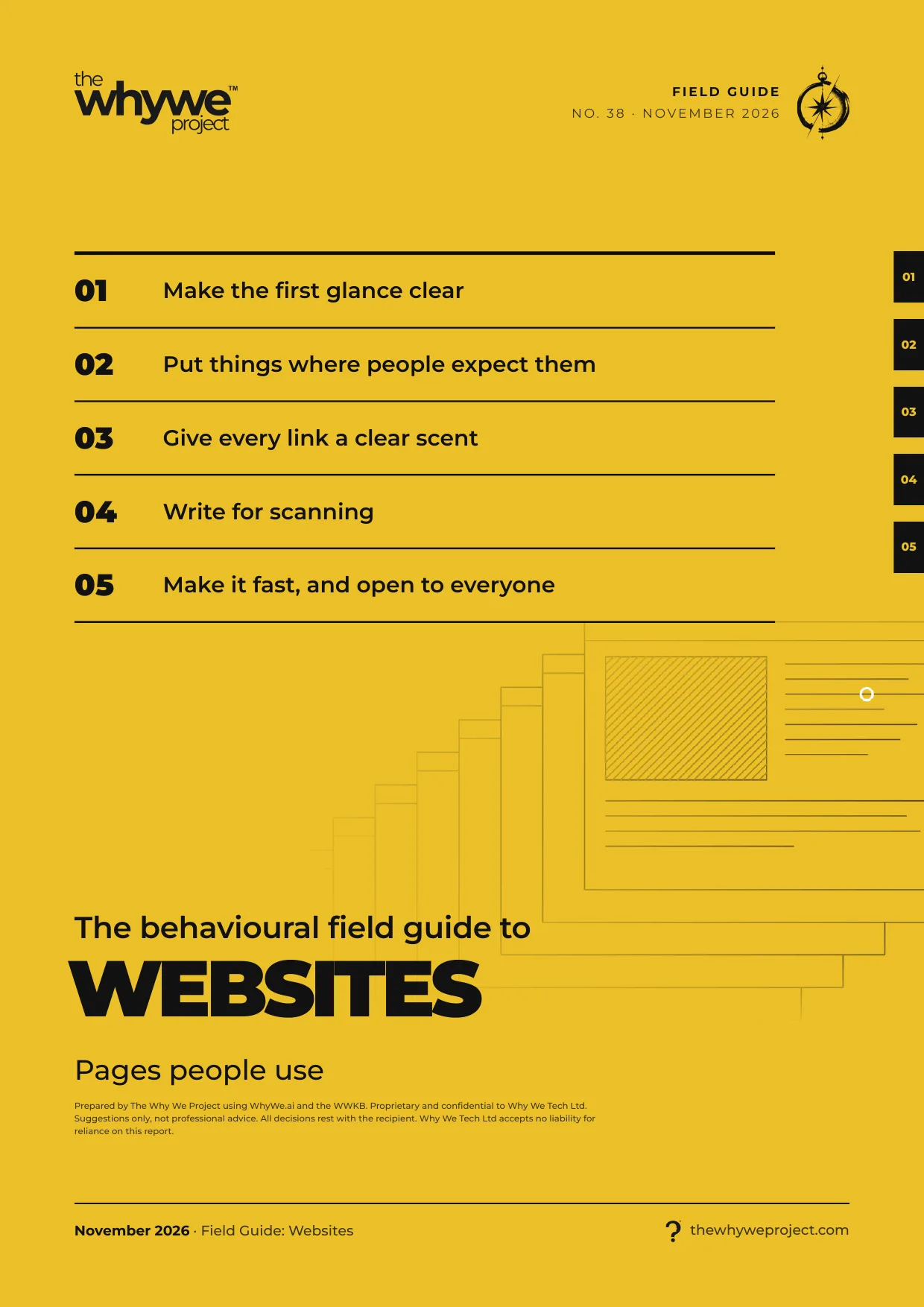
Design for how people really use pages. Keep the first glance simple and true to the kind of site it is, put common objects where visitors expect them, label every link in the visitor's words, put the point first with headings a skimmer can stop at, and make pages fast and accessible from the start.
What the report found
- Make the first glance clear. People judge a page's appeal in a fraction of a second, and that judgement colours what they think of its usability and trustworthiness. Pages that looked simple and familiar were rated most appealing, even after a glance of 17 milliseconds.
- Put things where people expect them. When 516 people built example pages, they agreed on where many common objects belong. A page that broke the usual conventions slowed new visitors down at first, though they adapted over time.
- Give every link a clear scent. People follow the words and cues that best match what they are looking for. A structure of medium depth and breadth beat the broadest, shallowest one, and the best structure depended on how clear the labels were.
- Write for scanning. Readers skim, reading until a passage stops paying off and then skipping ahead. In one study of 104 readers, larger text was easier to read, and understanding was better at 18 and 26 points.
- Make it fast, and open to everyone. About one person in six lives with a significant disability. Pages built to accessibility guidelines helped people with and without visual impairments finish tasks faster, and feedback during a wait made delays easier to bear.
Who it is for
For web designers, content writers, product teams, small business owners and anyone who looks after a website and wants visitors to find what they came for.
How we work
Field Guides turn the evidence into principles, each with the research, a worked example and what to try and watch out for. Every claim is graded, and where researchers disagree, as they do on whether a good looking page also works better, both sides are set out before we say where we stand.
Cite this report
The Why We Project (2026) Websites: Pages people use. Field Guide No. 38. Dubai: Why We Tech Ltd. Available at: thewhyweproject.com
In these themes
- Packaging and Product Design
How a product's form shapes what we expect of it.
- Digital Behaviour and Social Media
What feeds, phones and notifications do to attention, and what the evidence says.