The Commute
How does the daily commute affect the mind?
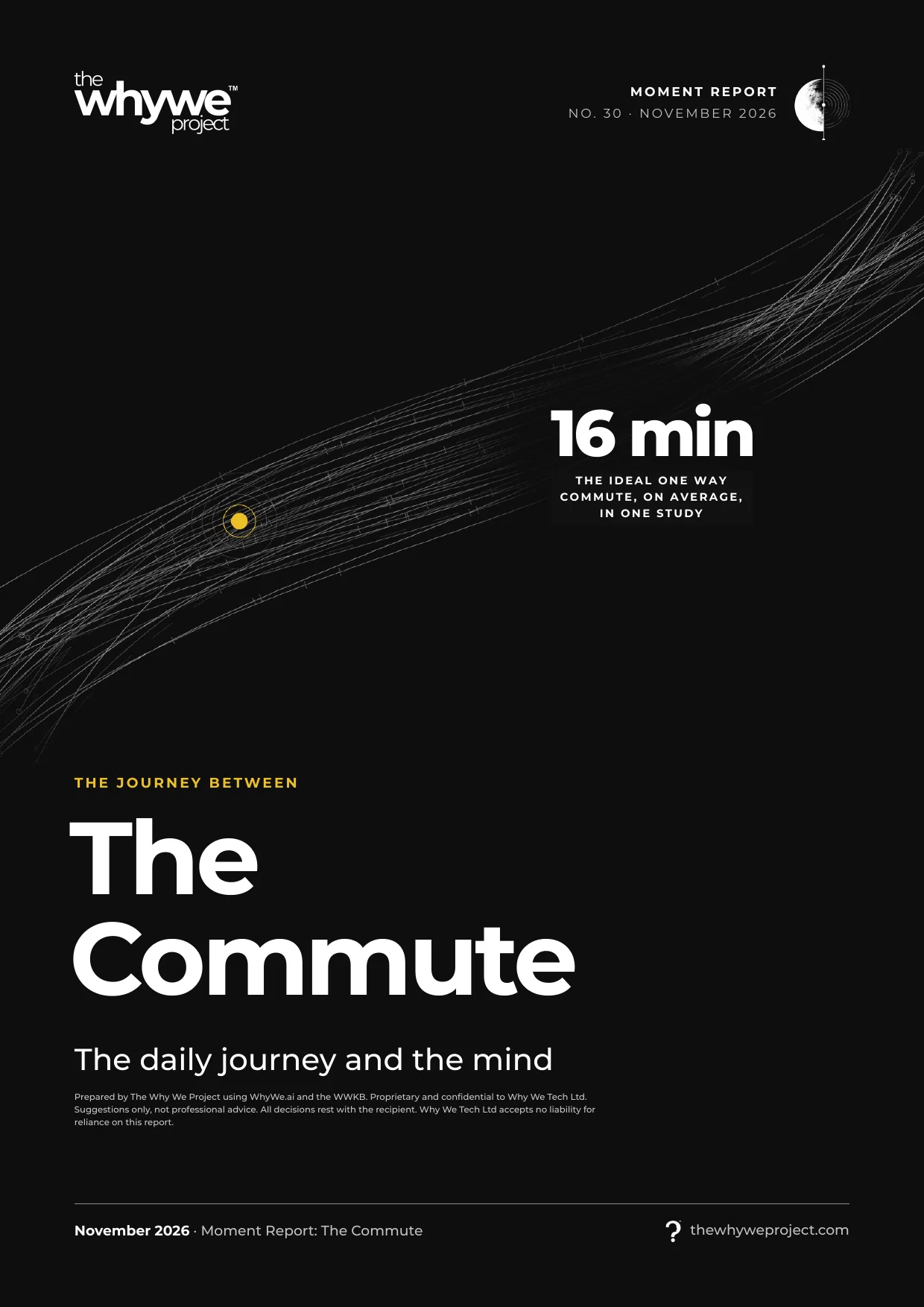
The commute is chosen mostly by habit, and people value a short journey: in one study the average ideal one way commute was about 16 minutes, and very few wanted none. The journey feels better when it is predictable, when it involves walking or cycling and when it is shared, and many commuters put the time to good use, reading or looking out of the window. It gives people room to move between home and work roles. Longer commutes go with lower satisfaction with leisure time, while the link with life satisfaction as a whole is debated.
What the report found
- The commute is short, regular and shared by millions. In one large survey across a group of European countries, six in ten employed people travelled less than 30 minutes each way. Research suggests people travel roughly an hour a day, though how fixed that hour is remains debated.
- Before setting off, habit makes the choice and the ideal is not zero. Strong habits narrow how people choose to travel, and a move of home can open the choice again. In one study the average ideal one way commute was about 16 minutes, and very few wanted none.
- During the journey, mood follows control, movement and company. One study of daily life found the morning commute the least pleasant activity, yet others find feelings during the commute mostly positive or neutral. Predictable journeys are less stressful, walking and cycling the most relaxing, and talking to a stranger more pleasant than expected.
- Travel time is often put to good use. In one national rail survey, eight in ten commuters made some or very worthwhile use of their time, most often reading or looking out of the window. Researchers describe the journey as transition time and time out.
- Arriving is a change of role, and the journey carries over. The commute gives room to move between home and work roles, and how it feels spills into the day. Longer commutes go with lower satisfaction with leisure time; the link with life as a whole is debated, and we set out both sides.
What is inside
- The moment
- Before: setting off
- During: the journey
- After: arriving
- How the moment is lived around the world
- What lasts
Plus a phase map of the commute, charts of commuting times, the ideal and actual commute, how people feel about the journey, mood across the day and how rail commuters use their time, a diagram of the commute as a crossing between roles, an illustrated morning journey, a table of what varies and what is shared around the world and a data panel of sourced figures.
Who it is for
For anyone who travels to work or study, by any means and at any hour, and for the employers, transport providers and services that serve people on the move around the world.
How we work
Moment Reports look at how people think and decide at particular points in the year or in life, and how each moment is lived by people around the world. Every claim is graded Established, Emerging or Untested, and where researchers disagree, both sides are set out before we say where we stand.
Cite this report
The Why We Project (2026) The Commute: The daily journey and the mind. Moment Report No. 30. Dubai: Why We Tech Ltd. Available at: thewhyweproject.com
In these themes
- Habits and Routines
How behaviour becomes automatic, and how it changes.