A Label Moved the Hormone, Not Hunger
A famous milkshake study found a label changed a hunger hormone but not hunger. A 2022 test found the reverse. What labels can and cannot do.
By The Why We Project · Medical review: [REVIEWER: name to be added]
Key takeaways
- In Alia Crum's 2011 study, 46 participants drank the same 380-calorie milkshake labelled indulgent or sensible, and ghrelin fell more steeply after the indulgent label.
- Participants' own hunger ratings showed no significant difference between the labels.
- A 2022 crossover trial led by Sinead Watson found people felt fuller after an indulgent label, with no difference in ghrelin or other gut hormones.
This article is general information about research on food labels, hormones and hunger. It is not medical or dietary advice. If you have concerns about your eating, appetite or weight, speak to your GP or a registered dietitian. Medical review: [REVIEWER: name to be added].
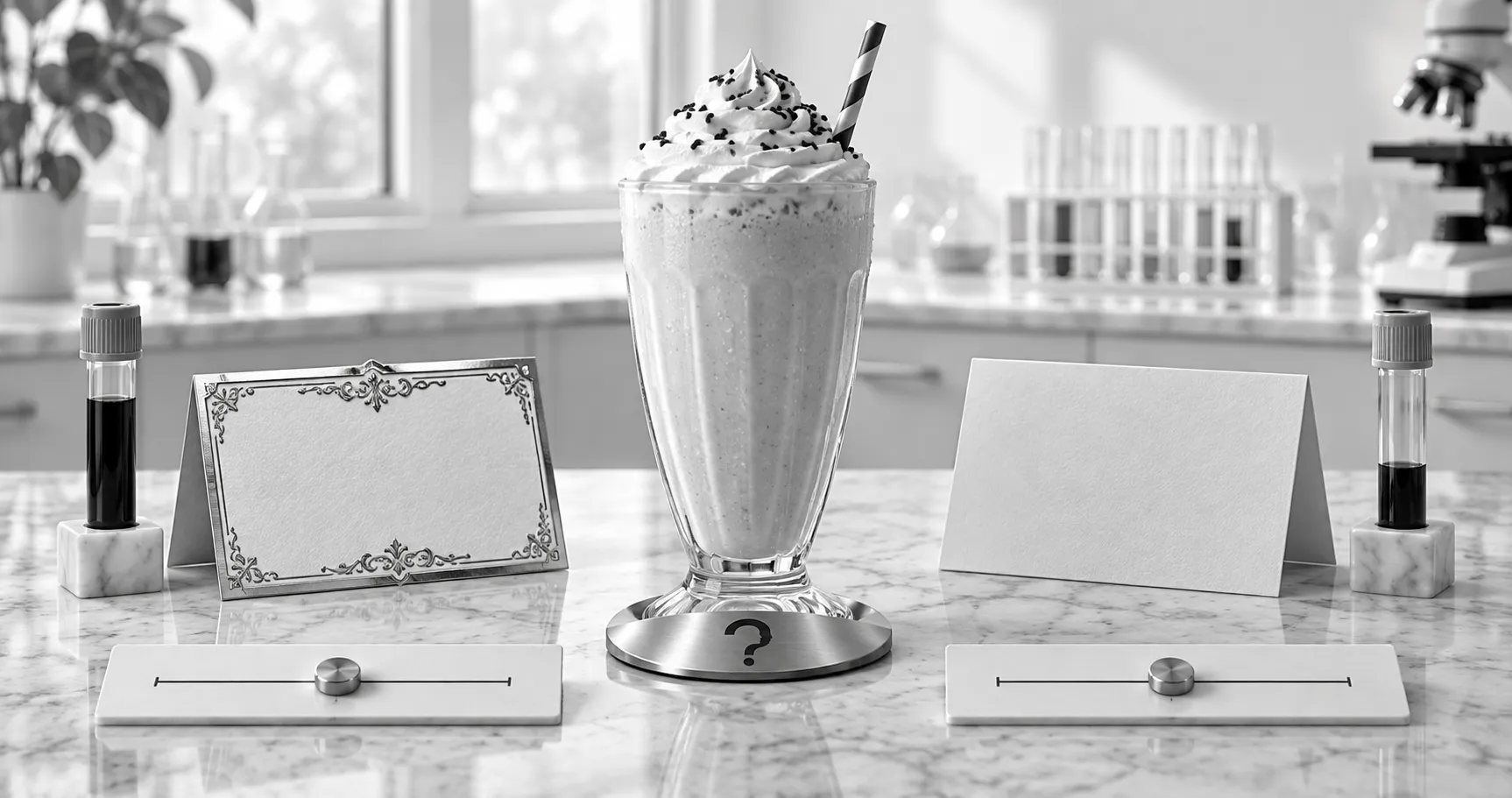
A vanilla milkshake sits on a table with a label beside it. On one visit the label calls it an indulgent treat, rich and high in calories. On another visit the same shake comes with a label calling it a sensible, low-calorie choice. The drink inside is identical. The question a small experiment set out to answer was whether the body could tell the difference, or whether it would believe the label.
One milkshake under two labels
In 2011 Alia Crum published the experiment in Health Psychology with three colleagues. Participants came in on two occasions and drank a 380-calorie milkshake each time. On one visit it was labelled as a 620-calorie indulgent shake. On the other it was labelled as a 140-calorie sensible one. Before and after drinking, the researchers took blood samples and measured ghrelin, a hormone that generally rises before meals and falls after eating, and that is often described as a hunger hormone.
The design is clever.
Because each person drank both versions, any difference between the two visits could not be put down to differences between people. Because the shake itself never changed, any difference could not be put down to the food. Only the label varied.
The idea behind it is one that David Robson's The Expectation Effect builds a whole chapter around: that what we believe about what we are eating can change how the body responds to it. Robson describes the milkshake study at pages 123 to 125, and it is easy to see why it appeals. A hormonal response to a label would be a striking example of the mind reaching into the gut.
The study's own title made the same point more playfully, framing the result as mind over milkshakes. It became a widely retold example in popular writing about expectation and appetite, often summarised as proof that thinking you have eaten a lot makes you feel full.
That summary is where the trouble starts. What the experiment found is narrower, and more interesting, than the version that travelled.
It is also worth noting how small the study was. Forty-six participants were included in the analysis, most of them students. That is a reasonable number for a first test of an idea, and a small number for a result that has been asked to carry as much weight as this one.
The hormone moved, the hunger did not
The headline finding concerned ghrelin. After the shake labelled as indulgent, ghrelin levels fell more steeply than after the shake labelled as sensible, which stayed relatively flat. In other words, the body's hormonal response looked more like the response to a large meal when people believed they were having one. Our own review of the evidence describes the key statistics as marginal by conventional standards, which means the result is suggestive rather than firm.
The part that rarely travels with it concerns hunger itself. Participants also rated how hungry they felt, and on those ratings the study found no significant differences between the two labels. The hormone moved. The feeling, as people reported it, did not.
That matters because the popular version of the finding is about feeling full. The study supports a claim about a hormone in a laboratory, measured at a few time points in a small group. It does not support the claim that a label made people feel less hungry, because the people in the study said it did not.
Robson's account does not give the sample size, and does not mention that the hunger ratings showed no difference, so a reader of the book would reasonably come away believing the label changed how hungry people felt. It is a common pattern in popular science, where a vivid mechanism tends to be reported and a null result beside it tends to be dropped.
Ghrelin is also not the whole story of hunger. Appetite involves several hormones, the stomach, memory of recent meals, habit, and what is in view. A change in one hormone over a short window is a long way from a change in how much someone eats later, which the study did not measure.
None of this makes the experiment worthless. It was an imaginative first test, and it pointed to a possibility worth checking. Checking it is what happened next.
A breakfast that reversed it
In 2022 a team led by Sinead Watson published a second test of the same idea in the journal Nutrients. Fifty people attended the first visit of a randomised crossover trial. On two mornings a week apart they ate the same 380-calorie breakfast of granola and yoghurt, labelled once as a 500-calorie indulgent product and once as a 250-calorie sensible one. They did not know the two breakfasts were identical. Blood samples measured ghrelin and two other gut hormones involved in appetite, and participants rated their hunger and fullness.
The results came out the other way round.
People reported feeling fuller after the breakfast labelled as indulgent. But none of the gut hormones, ghrelin included, differed between the two labels.
So across the two studies, the label moved a hormone and not the feeling in one, and moved the feeling and not the hormone in the other. The authors of the 2022 study concluded that the difference in how full people felt was not driven by the main appetite hormones, and was more likely to be produced in the brain.
The hormone moved. The feeling, as people reported it, did not.
That is a genuine frame shift. The popular story was that a label tricks the gut. The fuller picture is that a label can change how full people say they feel, at least modestly and at least in one well-designed study, and that the hormonal part of the story has not held up when tested again.
The two studies differ in many ways, from food to sample to setting, so neither cancels the other outright. But anyone citing the 2011 hormone result should now cite the 2022 study beside it.
What a label can do
What remains is a modest and useful point. How a food is described can change how satisfying people find it, and the effect seems to run through expectation rather than through the hormones the original study measured. That fits a wider body of research on expected satiety, the fullness people predict from a food before they eat it.
What does not survive is the idea that you can change your body's hunger hormones by telling yourself a meal is bigger than it is. One small study suggested it. A later one, with a similar number of blood samples analysed, did not find it.
For readers, that has a practical shape, offered as our reading rather than as a tested recommendation:
- Treat food labels as part of the meal. A description can change how satisfying food feels, so labels that frame healthy food as meagre may make it less satisfying than it needs to be.
- Be cautious about tricks. Deliberately misleading yourself about a meal is not supported by the evidence on hormones, and it is not a substitute for advice from someone who knows your situation.
- Notice what you expect. If you sit down to a meal expecting it to leave you hungry, that expectation may shape how full you feel afterwards.
A description can change the meal you think you ate, and that is worth knowing, but there is no good evidence yet that it can persuade your gut that a light meal was a heavy one, whatever the menu, the packet or your own good intentions say about it.
Common questions
Can a food label change your hunger hormones?
One 2011 study by Alia Crum found that ghrelin fell more steeply after a milkshake labelled indulgent than after the same shake labelled sensible. A 2022 study found no difference in ghrelin or other gut hormones between labels, so the hormonal effect is unconfirmed.
Did the milkshake study show people felt less hungry?
No. Participants' own hunger ratings showed no significant difference between the two labels. The study's finding concerned the hormone, not how hungry people said they felt.
Can a label make you feel fuller?
In the 2022 study led by Sinead Watson, people reported feeling fuller after a breakfast labelled indulgent than after the same breakfast labelled sensible, without any difference in gut hormones. The authors suggested the effect is produced in the brain.
Should I use labels to eat less?
This article is not dietary advice. The evidence suggests descriptions can change how satisfying food feels, but it does not support tricking yourself about a meal. For advice on eating, speak to a GP or registered dietitian.
Sources
Crum, A. J., Corbin, W. R., Brownell, K. D., & Salovey, P. (2011). 'Mind over milkshakes: mindsets, not just nutrients, determine ghrelin response.' Health Psychology, 30(4), 424-429. doi:10.1037/a0023467. 46 analysed; 380-calorie shake labelled 620 indulgent or 140 sensible; steeper ghrelin decline after the indulgent label; key statistics marginal; hunger ratings showed no significant differences.
Watson, S., and colleagues (2022). 'The power of suggestion: subjective satiety is affected by nutrient and health-focused food labelling with no effect on physiological gut hormone release.' Nutrients, 14(23), 5100. doi:10.3390/nu14235100. Read at the publisher, 2026-10-08: randomised crossover; 50 attended the first visit, 48 analysed for appetite and 38 for acylated ghrelin; 380 kcal breakfast labelled 500 kcal indulgent or 250 kcal sensible; higher fullness change after the indulgent label; no difference in gut hormones; effect judged more likely centrally mediated.
Robson, D. (2022). The Expectation Effect. Canongate. Read in full by this publication, 2026-10-08, with a reliability audit. pp. 123-125, the milkshake study, given without sample size or the null hunger result.
A note on scope: this is general information, not dietary advice. The three suggestions are this publication's reading, not tested recommendations.