Everyone Thinks Everyone Else Wants It
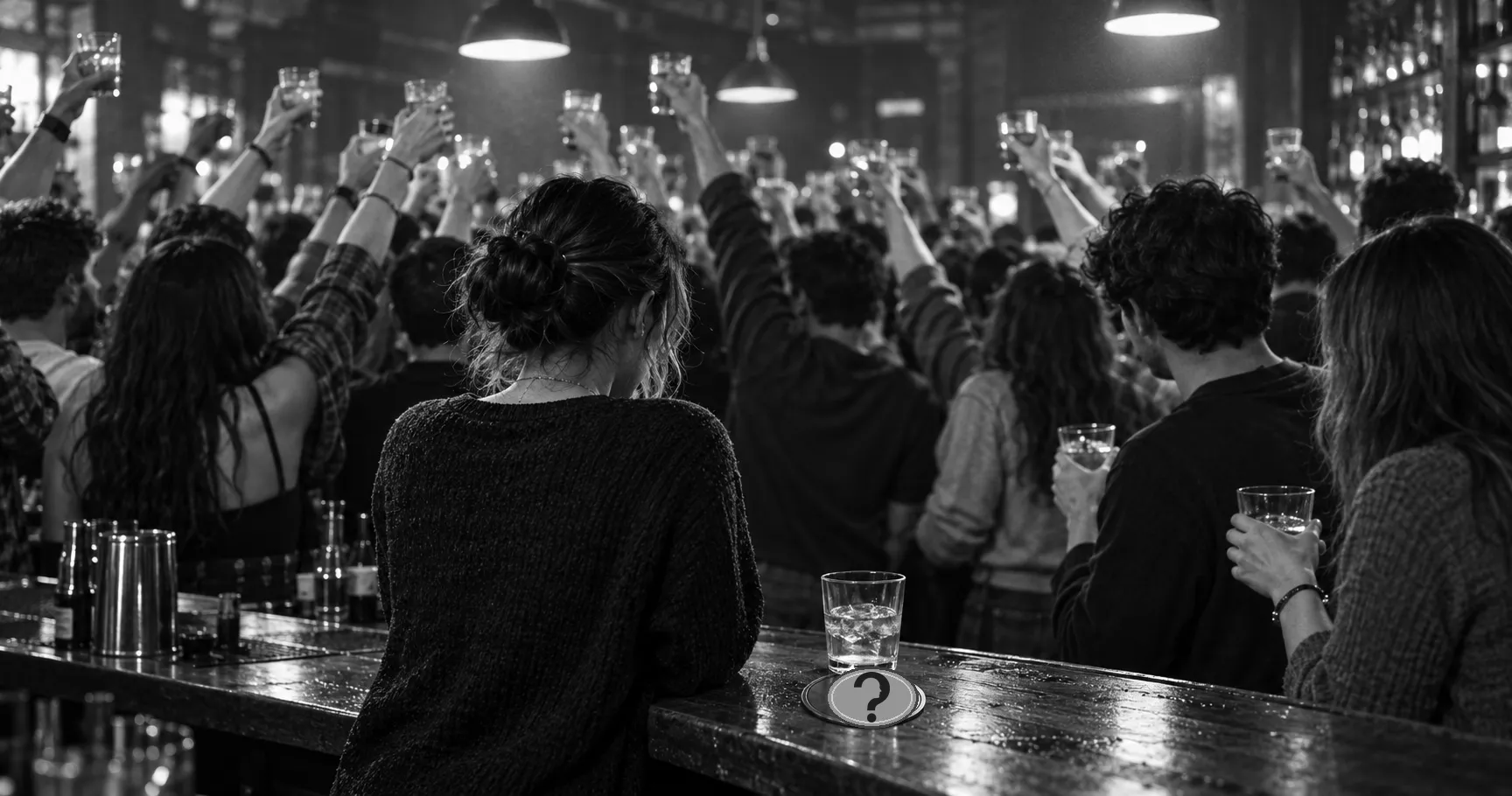
Groups often do what few members want, because each assumes everyone else wants it. The research on dissent suggests one voice can do more than a statistic.
Key takeaways
- In Deborah Prentice and Dale Miller's 1993 studies, students believed they were less comfortable with campus drinking than the average student.
- A 1998 intervention explaining this gap was followed by lower reported drinking months later, in one university.
- A 2015 Cochrane review of 70 studies found social norms messages reduced drinking by amounts too small to matter for practice.
- In Vernon Allen and John Levine's 1968 study, a single dissenter reduced conformity on visual judgements.
Why do so many people go along with things they privately dislike? The usual answer is that they are weak, or that they want to fit in. A better answer, backed by reliable findings in social psychology, is that each of them is wrong about what everyone else thinks. They follow a crowd that, privately, does not want what it is doing either. Todd Rose calls this a collective illusion. In his 2022 book, Collective Illusions, he argues that groups often enact what almost nobody wants. At page xiv he names the established term, pluralistic ignorance, calls it "inadequate and confusing", and replaces it with his own.
A campus that misread itself
The study most often used to show the pattern was published in 1993 in the Journal of Personality and Social Psychology. Deborah Prentice and Dale Miller, then at Princeton, asked students about drinking on campus: how comfortable they personally were with it, and how comfortable they thought the average student was.
Across four studies the answer was the same. Students believed they were less comfortable with campus drinking than the average student. When most people in a group say that, their picture of the average cannot be right. The group was misreading itself.
The same gap appeared when students compared themselves with their own friends, so it was not only a matter of an imagined stranger. And it had consequences. In a study that followed students over a semester, men shifted their own attitudes towards what they wrongly believed the norm to be. Women did not.
The illusion had begun to change real attitudes. In a fourth study, the more out of step students felt, the more alienated they reported feeling from campus life, even though the sense of being out of step was itself mistaken.
That is the core of a collective illusion. Nobody has to be lying. Each person sees others drinking, laughing and apparently at ease, assumes their private reservations are unusual, and keeps them to themselves. Everyone else does the same, and the visible behaviour confirms the false picture.
The pattern travels well beyond student drinking. It is a plausible mechanism behind a dress code nobody likes, a meeting nobody wanted, or a product everyone buys because they assume everyone else rates it. Rose applies it widely, and his examples are a reasonable illustration of how general the idea is. The book's scale claims rest largely on polling the author commissioned, which has not been independently replicated, so we lean on the older laboratory and field work for the evidence.
What the illusion costs, and whether it can be lifted
If a collective illusion rests on a misreading, telling people the truth should help. That was tested directly. In 1998 C. M. Schroeder and Deborah Prentice ran an intervention with 452 first-year students at Princeton. In their first weeks, students attended one-hour discussions in their residential groups. Some discussions explained pluralistic ignorance and the gap between private and perceived comfort with drinking. The others covered individual decision-making in drinking situations.
Four to six months later, 143 students completed a follow-up. Those who had heard about the illusion reported drinking about three drinks a week on average, against about five in the comparison group.
On its face that is a large difference for a single hour, but the details temper it. The proportion who did not drink at all was much the same in both groups. And the gap between students' own comfort and their estimate of the average student's had narrowed over time in both conditions.
Those results are encouraging, but they come from one university and a minority of the students who started. The larger test came later, when this kind of message, telling people what their peers really think and do, became a common way of trying to reduce drinking on campuses.
A 2015 Cochrane review led by D. R. Foxcroft pooled 70 studies with 44,958 participants. Social norms messages did reduce drinking, but by very little. Pooled across studies, the drop in drinking quantity was about 0.9 drinks a week from a baseline of about 13.7, and the reduction in binge drinking amounted to about 2.7 per cent fewer binge drinkers. Marketing campaigns and group sessions showed no effect on how often people drank. The reviewers concluded that the benefits were too small to matter for policy or practice.
What one dissenter does
If correcting the numbers helps only a little, what breaks a collective illusion? The conformity research suggests an answer that Rose's own notes contain and his text does not stress.
Rose describes Solomon Asch's line-judgement studies, in which people went along with a group giving obviously wrong answers. What he leaves in his endnotes is the finding that matters most for anyone trying to resist.
In 1968 Vernon Allen and John Levine reported in Sociometry how conformity changed when one other person broke from the group. On visual judgements, conformity dropped when a single dissenter gave the correct answer. It also dropped when the dissenter gave an answer even more wrong than the group's. On matters of opinion, only a dissenter who agreed with the participant reduced conformity. That is exactly the situation in a collective illusion, where the dissenter says aloud what others privately think.
The lesson is that unanimity, not size, gives a group much of its pull. One visible exception makes it easier for everyone else to say what they think. Rose cites the paper in support of advice about speaking tentatively. Our reading, which goes beyond what the study tested, is that a collective illusion can be broken by one person who goes first.
A statistic about what the average student thinks is easy to doubt and easy to forget. A friend who says it out loud is much harder to dismiss.
That may also help explain why the social norms campaigns had modest effects. A statistic about what the average student thinks is easy to doubt and easy to forget. A friend who says out loud that they would rather not go to the bar is much harder to dismiss.
Breaking a collective illusion in practice
The practical lesson is uncomfortable, because it asks someone to go first. When you suspect a group is doing something most of its members do not want, the research described here points towards saying so, plainly and early, rather than waiting for a survey to settle it, though nobody has tested that advice directly. A single dissenter can loosen a group's hold, and in a collective illusion there are, by definition, many silent dissenters.
For businesses, the illusion shows up in two places. Customers may follow a trend because they assume everyone else values it, which can make popularity partly self-sustaining. And inside organisations, meetings can reach decisions few participants support, because each assumes everyone else does. In both cases, a private poll or an anonymous channel can reveal the gap.
A few signs suggest a collective illusion may be at work. The behaviour is visible but the attitudes behind it are not. People complain about it in private, one at a time, but never in a group. And nobody can quite say who wanted it in the first place. When all three are present, it is worth asking the question out loud, because the answer may be that almost nobody did.
The illusion also has a quieter cost. In Prentice and Miller's fourth study, students who felt out of step reported feeling less connected to the place they lived, even though they were in the majority. Keeping a private reservation to yourself is not free. It can leave a person feeling like an outsider in a group full of people who feel exactly the same way.
Our view is that the research supports the core idea strongly and the remedies weakly. That people misjudge what others privately think is well established. The evidence that correcting it with information changes behaviour much is weak. The most effective correction seems to be a person rather than a number: someone in the room who says first what the others were waiting to say.
Common questions
What is pluralistic ignorance?
It is the pattern in which most members of a group privately reject a belief or practice but each assumes everyone else accepts it, so the group goes along with something few want. Todd Rose calls it a collective illusion.
Do social norms campaigns reduce drinking?
Only slightly. A 2015 Cochrane review of 70 studies with 44,958 participants found reductions so small, such as about 0.9 fewer drinks a week, that the reviewers judged them too small to matter for practice.
How can one person change a group's behaviour?
In Vernon Allen and John Levine's 1968 conformity studies, a single dissenter reduced conformity on visual judgements. Breaking unanimity makes it easier for everyone else to say what they think.
Sources
Prentice, D. A., & Miller, D. T. (1993). 'Pluralistic ignorance and alcohol use on campus: some consequences of misperceiving the social norm.' Journal of Personality and Social Psychology, 64(2), 243-256. doi:10.1037/0022-3514.64.2.243. Four studies; sample sizes not printed because the full text was not read.
Schroeder, C. M., & Prentice, D. A. (1998). 'Exposing pluralistic ignorance to reduce alcohol use among college students.' Journal of Applied Social Psychology, 28(23), 2150-2180. doi:10.1111/j.1559-1816.1998.tb01365.x. 452 first-year students; 143 at follow-up; 3.10 against 5.05 drinks a week.
Foxcroft, D. R., Moreira, M. T., Almeida Santimano, N. M. L., & Smith, L. A. (2015). 'Social norms information for alcohol misuse in university and college students.' Cochrane Database of Systematic Reviews, CD006748. doi:10.1002/14651858.CD006748.pub4. 70 studies, 44,958 participants.
Allen, V. L., & Levine, J. M. (1968). 'Social support, dissent and conformity.' Sociometry, 31(2), 138-149. doi:10.2307/2786454.
Rose, T. (2022). Collective Illusions. Hachette. Read in full by this publication, with a reliability audit. p. xiv; pp. 79-81; ch. 3 note 45.
A note on scope: the signs of a collective illusion are offered as a rule of thumb, not a tested checklist. The book's scale claims rest on commissioned polling and are not relied on here.