How Active You Think You Are Matters
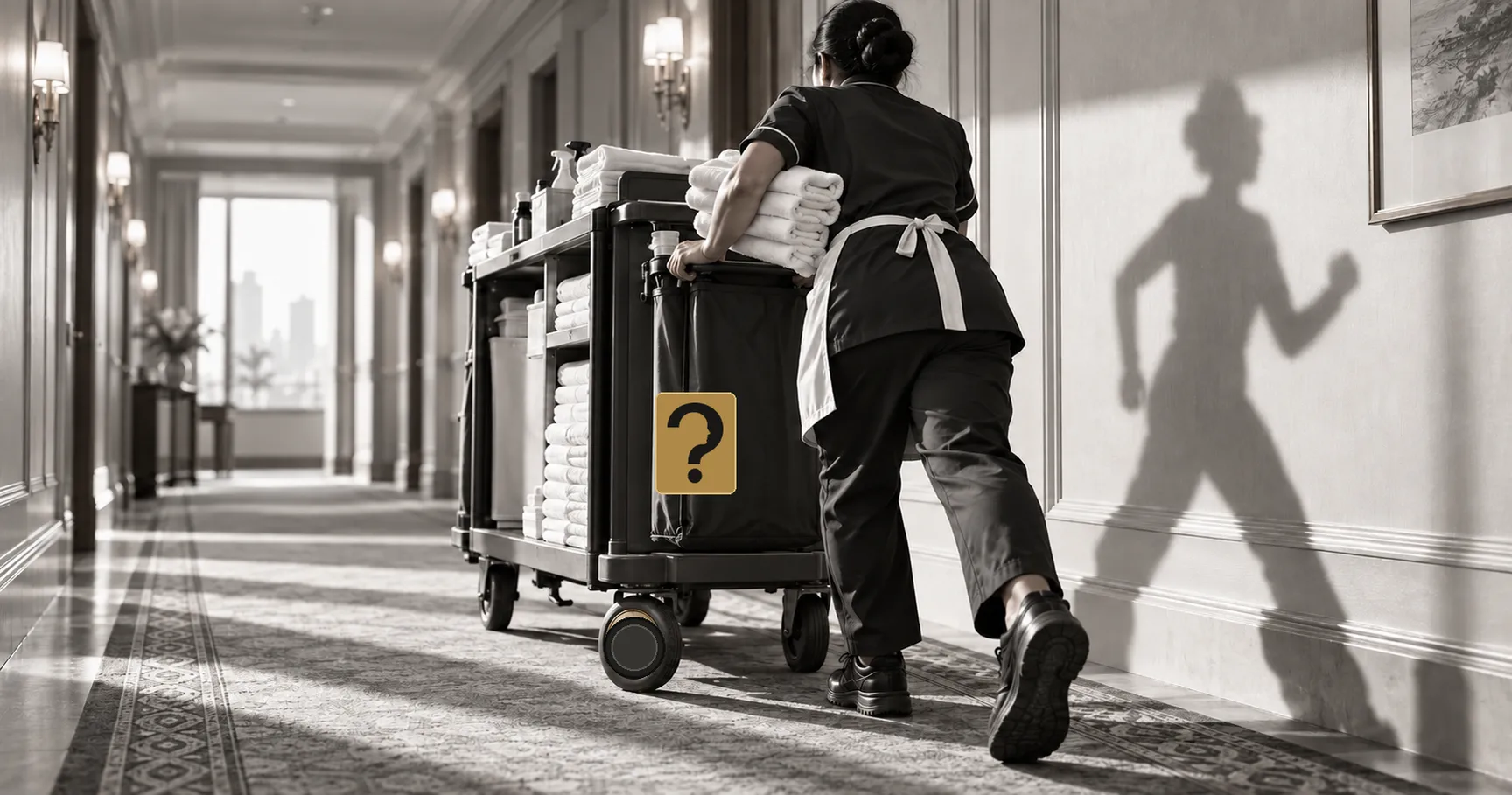
People who saw themselves as less active than their peers were up to 71 per cent more likely to die during follow-up. What that does and does not mean.
By The Why We Project · Medical review: [REVIEWER: name to be added]
Key takeaways
- In Alia Crum and Ellen Langer's 2007 study of 84 hotel housekeepers, those told their work was good exercise showed falls in weight, blood pressure and body fat after four weeks, compared with the others.
- The study was small, assigned by hotel, and may reflect changes in effort; no replication has been found.
- Octavia Zahrt and Alia Crum's 2017 analysis of 61,141 adults found those who saw themselves as less active than peers were up to 71 per cent more likely to die during follow-up.
- That study is observational: it shows an association, not that a belief causes death.
This article is general information about research on how active people believe they are. It is not medical or exercise advice. If you have a health condition, or are planning a significant change in activity, speak to your GP first. Medical review: [REVIEWER: name to be added].
Most advice about exercise is about what you do. A smaller and stranger body of research asks about what you think you do: how active you believe you are, compared with other people. The usual assumption is that belief simply follows behaviour. Two studies by the same researcher suggest it may also run alongside it, and that how active you think you are is worth knowing in its own right.
Eighty-four housekeepers and one piece of information
In 2007 Alia Crum and Ellen Langer published a study in Psychological Science of 84 women who cleaned rooms in seven hotels. Hotel housekeeping is physically demanding work. Cleaning a room involves lifting, bending, pushing and walking, and a full shift adds up to a good deal of activity. Yet when asked, most of the women did not think of themselves as getting much exercise.
Then came one piece of information.
The researchers divided the hotels into two groups. In some, the housekeepers were told that their work was good exercise and met the recommendations for an active lifestyle. In the others, they were not told. Four weeks later, compared with the comparison group, the informed group saw themselves as getting more exercise than before, and showed reductions in weight, blood pressure, body fat, waist-to-hip ratio and body mass index.
David Robson opens The Expectation Effect with this study, at pages 1 and 2, as an example of how a belief can change the body. Later, at page 106, he hedges it honestly, calling it "admittedly, a relatively small study" and raising the possibility that the housekeepers worked harder once they had been told their work counted as exercise. That second possibility matters a great deal, because it would mean the change came through behaviour, not through belief alone.
The design has other limits worth stating. Whole hotels, not individual women, were assigned to each group, so differences between hotels could play a part. The study ran for only four weeks. And we have found no published replication of it, in either direction.
So the housekeepers study is best read as a proof of concept: a small, striking result that showed the question of how active people think they are was worth asking. It cannot carry the conclusion that belief alone changes the body.
It does not say that how active you think you are matters more than how active you are.
Sixty-one thousand adults compared with their peers
A decade later Crum returned to the question with a very different kind of study. In 2017 Octavia Zahrt and Alia Crum published an analysis in Health Psychology of 61,141 American adults from three nationally representative surveys, the 1990 National Health Interview Survey and two rounds of the National Health and Nutrition Examination Survey covering 1999 to 2006.
Each survey had asked people how active they were compared with others their age. Their answers were then linked to national death records, with follow-up of up to twenty-one years. The analysis adjusted for how active people actually were, as measured in the surveys, along with other factors.
People who saw themselves as less active than their peers were up to 71 per cent more likely to die during the follow-up period than people who saw themselves as more active, even after taking their measured activity into account.
It is a striking number.
That is a large study, far larger than the hotel experiment, and it is the one that deserves more attention. It is also observational, which limits what it can show. It found an association between how active people thought they were and how long they lived. It did not show that thinking yourself inactive causes earlier death.
The most obvious alternative explanation is illness. Someone who is unwell, perhaps without a diagnosis, may feel less active than their friends and also be at higher risk of dying, without one causing the other. Adjustment for measured activity and health reduces this problem but cannot remove it, because no survey captures everything about a person's health.
Explanations that run from perception to health, through motivation or stress for instance, are plausible. They are not demonstrated by this design, and the honest reading is that the association is real and its cause is open.
The ledger, set out entry by entry
It helps to set out what this research supports and what it does not, because the two studies are often merged into a single, stronger claim than either makes.
What is reasonably solid:
- How active people think they are and how active they are are different things. The housekeepers did a physically demanding job and mostly did not see it as exercise. Perception and behaviour can come apart.
- Perceived physical activity is associated with mortality. In 61,141 adults, followed for up to two decades, seeing yourself as less active than your peers went with a higher risk of death, after adjusting for measured activity.
What is suggestive but unconfirmed:
- Changing the perception may change the body. The housekeepers study suggests this, but it was small, short and assigned by hotel, and the change may have come through behaviour.
What the research does not show:
- That believing you are active can replace being active. Nothing in either study suggests this, and the studies do not claim it.
- That a belief can cause death. The large study is observational. It cannot establish cause, and illness is a strong alternative explanation for the link it found.
Set out this way, the research is interesting and modest. It says that the way people judge their own activity is worth paying attention to, and that judgements can be wrong in both directions. It does not say that how active you think you are matters more than how active you are. Movement still does the work. Perception may decide how much credit you give it.
What to do with how active you think you are
If the research has a practical message, it is about accuracy, not about positive thinking. Many people undercount the activity in their ordinary lives: walking to the shops, climbing stairs, carrying children, physical work. Comparing yourself with a gym-going friend can leave you thinking you are inactive when you are not.
Recognising the activity you already do is reasonable in its own right, and it may make it easier to build on. Carrying shopping home, taking the stairs and a day spent on your feet all count as movement, whether or not anyone would call them exercise. Whether it changes anything physical on its own is not established. The housekeepers study raises the possibility; it does not settle it.
The opposite error is also possible. Someone who thinks they are fairly active because they compare themselves with less active friends may be doing less than they believe. An honest picture of how active you are, in either direction, is a better starting point than a flattering one.
One simple check, our suggestion rather than anything the studies tested, is to change the comparison. Instead of asking how active you are compared with the people around you, who may be unusually active or unusually sedentary, look at what you actually did over an ordinary week: the walking, the stairs, the lifting and the time on your feet. That turns a judgement shaped by your social circle into something closer to a record, and a record is harder to talk yourself out of in either direction. It is also the kind of picture a GP or physiotherapist can actually use.
Anyone unsure what to do should ask a GP first. These studies are about perception and association, not instructions for what to do with your body.
Common questions
Can believing you are exercising make you healthier?
One small 2007 study of 84 hotel housekeepers by Alia Crum and Ellen Langer found health measures improved after the women were told their work counted as exercise. But it was small, short and may reflect changes in effort, and no replication has been found. It does not show belief alone changes the body.
Does how active you think you are affect how long you live?
A 2017 study by Octavia Zahrt and Alia Crum of 61,141 adults found that people who saw themselves as less active than their peers were up to 71 per cent more likely to die during follow-up, after adjusting for actual activity. It is observational, so it cannot show that the perception caused the difference.
Sources
Crum, A. J., & Langer, E. J. (2007). 'Mind-set matters: exercise and the placebo effect.' Psychological Science, 18(2), 165-171. doi:10.1111/j.1467-9280.2007.01867.x. 84 female room attendants in seven hotels, assigned by hotel; four weeks. No replication located in either direction.
Zahrt, O. H., & Crum, A. J. (2017). 'Perceived physical activity and mortality: evidence from three nationally representative U.S. samples.' Health Psychology, 36(11), 1017-1025. doi:10.1037/hea0000531. 61,141 adults from the 1990 National Health Interview Survey and the 1999-2002 and 2003-2006 National Health and Nutrition Examination Surveys, linked to National Death Index data through 2011; follow-up up to 21 years; up to 71 per cent higher mortality for those perceiving themselves as less active than peers, adjusting for measured activity and other covariates. Per-sample figures not carried. Observational.
Robson, D. (2022). The Expectation Effect. Canongate. Read in full by this publication, 2026-10-08, with a reliability audit. pp. 1-2, the housekeepers unhedged; p. 106, 'admittedly, a relatively small study'.
A note on scope: this is general information, not exercise advice. The weekly-record check is this publication's suggestion.