Inside the Abstinence Violation Effect
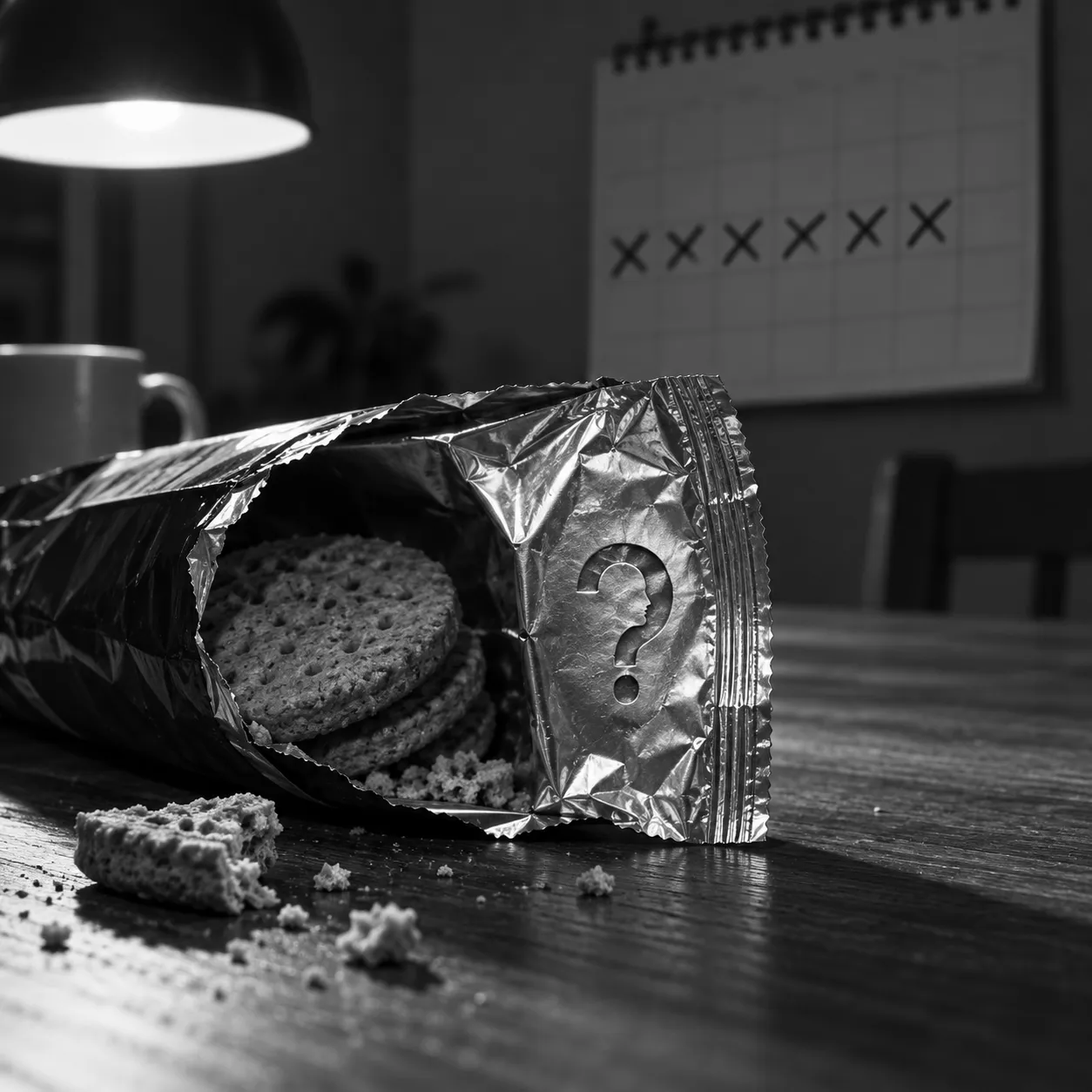
One takeaway can end a no-takeaway month and one dinner can write off a budget. Whether the goal survives depends less on the slip than on the verdict you pass on it.
Answer to the question
Why does one slip make people give up on a goal?
Because of the verdict they pass on the slip. In the abstinence violation effect, one takeaway ends a no-takeaway month because the lapse is read as proof of failure. Alan Marlatt and Judith Gordon described it in 1985, but a 2012 study of smokers found falling confidence mattered more than self-blame, and a 2010 study found one missed day did not derail a new habit.
Key takeaways
- The abstinence violation effect is a single slip turning into abandoning a goal; Alan Marlatt and Judith Gordon set it out in Relapse Prevention in 1985.
- In Peter Herman's 1975 study, dieters ate more ice cream after a milkshake preload, while non-dieters ate less; Herman and Janet Polivy later called this the what the hell effect.
- There is a ceiling: when the milkshake preload was doubled to 30 ounces, dieters and non-dieters alike ate very little afterwards.
- A 2012 study of 1,001 lapses found reactions to the first lapse did not predict relapse, and falling confidence mattered more than self-blame.
- In a 2010 study of 96 volunteers building a habit, missing one opportunity did not materially affect how the habit formed.
You promise yourself a month without takeaways. Late one night at work, tired and hungry, you order one anyway. By the weekend you have ordered three more, and the reasoning feels airtight: the month is already ruined, so the rest of it no longer counts, and you may as well enjoy the food while the rule is broken.
Psychologists call that spiral the abstinence violation effect. A single lapse is small. What follows depends on the verdict you pass on it, and a harsh verdict, delivered fast, can turn one evening into a lost goal. The interesting question is which part of that verdict does the harm, and the research gives a clearer answer than the name suggests.
In Dopamine Nation, the psychiatrist Anna Lembke defines the effect as a steep rise in use after a period of abstinence, in someone whose aim was moderation. She illustrates it with rats bred to be prone to addiction, which binged when access returned after two to four weeks without. Her rats sit at the extreme end, where a reward system left hungrier by the break drives the binge. Most slips in an ordinary life sit at the mild end, and that is where the work on explanations, diets and habits has most to say.
Six ordinary slips that all share one pattern
None of the cases below involves addiction. Each runs on two ingredients: a goal kept as a clean record, and one slip read as a verdict on the person who made it. If any of them sounds familiar, notice where the slip ends and the verdict begins.
1. The spending budget. You set a limit for eating out this month, and a birthday dinner pushes you past it. If the thought arrives that the budget is gone and nothing else counts, the next week can become one impulse buy after another.
2. The no-takeaway month. You order once on a late night at work and declare the challenge over, and the weeks that follow hold more takeaways than an ordinary month would have done.
3. The diet day. A biscuit at eleven becomes most of the packet, the plan moves to Monday, and the rest of Thursday turns into a farewell to food that will supposedly be off limits again.
4. Dry January. You drink one glass at a wedding on the 12th, after you announced the month to friends. Instead of one glass in thirty-one days, January becomes a month that failed, and you abandon it.
5. The gym streak. A flu breaks a 40-day streak and the app resets to zero. If the zero starts to feel like your true score, the visits stop altogether, long after the flu has gone.
6. The savings goal. You plan a no-spend weekend, buy one coffee on Saturday morning, and the afternoon becomes the shopping trip the weekend was meant to prevent.
In every case the slip costs little and the verdict that follows costs most of the goal. Change either ingredient, the clean record or the verdict, and the pattern loses much of its grip.
In every case the slip costs little and the verdict that follows costs most of the goal.
Confidence matters more than blame after slips
The term comes from relapse-prevention work on addiction. In Relapse Prevention (1985), edited by Alan Marlatt and Judith Gordon, the abstinence violation effect is the reaction to a lapse, a single slip after a vow to abstain, that makes a full relapse more likely. A standard encyclopaedia entry on the effect splits that reaction in two. One part is cognitive: the person explains the slip with causes that are internal, stable and uncontrollable, the kind of explanation that sounds like I have no willpower, and feels the clash between the act and the promise. The other part is emotional, in the form of guilt and shame.
Smokers gave that account a demanding test. A 2012 study followed 203 smokers who had quit and recorded their reactions to 1,001 lapses close to the moment they happened. Self-blame, confidence and guilt after the first lapse did not predict relapse. Across later lapses, falling confidence in their ability to stay off cigarettes predicted the next lapse arriving sooner, while rising self-blame went with a slightly lower risk of lapsing.
Eating research leans back towards the original idea, at least on harshness. Claire Adams and Mark Leary found in 2007 that among highly restrictive eaters, college women encouraged to think self-compassionately after eating an unhealthy food ate less afterwards and felt less distressed.
We prefer a revised version of the model, and these studies are why. The first slip did not decide the outcome in either line of work. For the abstinence violation effect, self-blame looks like a weak engine of collapse, and losing faith that the goal can still be reached looks like a strong one. An explanation such as I have no discipline matters because it brings that loss of faith with it. The wedding had a toast and I joined in names a situation that will not come round every night, and it leaves your confidence intact.
Dieters showed the pattern before anyone else
Most of what is known about everyday versions of the abstinence violation effect comes from eating research. In 1975 Peter Herman and a colleague gave dieters and non-dieters no milkshake, one or two before an ice-cream "taste test". Fullness worked as expected on the non-dieters, who ate less ice cream after a milkshake.
The dieters, whom the researchers called restrained eaters, did the reverse, eating more as the preload grew.
Herman and Janet Polivy later named this the "what the hell effect", in a 1980 chapter on restrained eating. Their 2020 summary of four decades of the work describes the dieter as thinking, in effect, "what the hell, my diet is already broken so I might as well eat and enjoy for now."
There is a ceiling. When the milkshake preload was doubled to 30 ounces, dieters and non-dieters alike ate very little afterwards. Polivy and Herman also raise the possibility that restrained eaters do not eat much more than anyone else, and are simply quicker to class what they ate as overeating, particularly when the food is on their own forbidden list.
A broken goal also shapes what people choose next. A 2019 paper titled "You Don't Blow Your Diet on Twinkies" reported six experiments in which every option conflicted with a goal. People picked the option that best served their other goal, even when it was the biggest violation, because it was the easiest choice to justify.
Once the diet is gone, the treat that follows tends to be one that feels worth the damage.
A habit survives a missed day of practice
For the gym streak, habit research has a direct answer. In a 2010 study, Phillippa Lally and colleagues asked 96 volunteers to make an eating, drinking or activity behaviour automatic over twelve weeks, and tracked how automatic it became. Their conclusion on slips is blunt: "Missing one opportunity to perform the behaviour did not materially affect the habit formation process."
A streak counter that resets to zero measures an unbroken record, which is exactly the clean-record framing the abstinence violation effect feeds on. Lally's result says that record is the wrong thing to watch when you are judging how long a new habit takes to settle, because the gap did not undo the repetitions that came before it. An app that shows a zero after a flu is reporting its own rule, and your habit is under no obligation to follow it.
Planned indulgences keep people going for longer
If a clean record is what gives the abstinence violation effect its grip, one remedy is to stop requiring one. Rita Coelho do Vale and colleagues tested this in 2016. In two controlled experiments, one simulated and one with real dieters, plans that included scheduled indulgences kept people more motivated and in a better mood than rigid plans did, and a third study of people pursuing a range of goals found a similar benefit. The paper also frames part of the benefit as restoring self-control resources, a framing that sits uneasily with the replication record on willpower, but the motivation and mood results do not depend on it.
Three habits follow from these studies, though nobody has tested them together as a set.
1. Write goals as rates, like most nights a month.
2. Describe the situation before judging what it says about you.
3. Keep confidence in the goal apart from self-judgement.
When you next break a plan, write one sentence naming what happened, then make your next meal, purchase or drink the one you would have chosen on an unremarkable day, and judge the goal by how the month went as a whole rather than by the one evening that went wrong.
Common questions
Why does one slip make people give up on a goal?
Because of the verdict people pass on the slip, not the slip itself. In a 2012 study of smokers, responses to a first lapse did not predict relapse, and falling confidence mattered more than self-blame. In Phillippa Lally's 2010 study of 96 volunteers, missing one opportunity did not materially affect how a new habit formed.
What are examples of the abstinence violation effect?
One slip that turns into abandoning the whole goal. One takeaway that ends a no-takeaway month, one glass that ends Dry January, or one overspend that writes off the rest of a budget. Dieting studies since Peter Herman's 1975 milkshake experiment show the pattern in the laboratory, up to a point.
Who came up with the abstinence violation effect?
The term comes from relapse-prevention research on addiction, set out in Relapse Prevention (1985), edited by Alan Marlatt and Judith Gordon. It describes how a person's reaction to a single lapse, especially blaming a fixed personal failing, makes a full relapse more likely.
Is it the same as the what-the-hell effect?
They are close relatives. Peter Herman and Janet Polivy named the "what the hell effect" in a 1980 chapter on restrained eating, describing dieters who overeat once a diet feels broken. The abstinence violation effect is the broader relapse term, and it adds a theory about how the slip is explained.
Sources
Lembke, A. (2021). Dopamine Nation: Why Our Addiction to Pleasure is Causing Us Pain. Headline (UK paperback); first published by Dutton. Read in full by this publication, with a reliability audit. The book's definition of the abstinence violation effect (a precipitous escalation in use after abstinence, in someone whose goal was moderation) and its illustration with genetically addiction-prone rats that binge after two to four weeks of abstinence, hedged by the author as possibly specific to caloric drugs or to the rats' genetics; endnoted to Eikelboom and Hewitt (2016), Physiology and Behavior, which this publication has not opened. No page number is recorded in the audit files.
Marlatt, G. A., & Gordon, J. R. (Eds.) (1985). Relapse Prevention: Maintenance Strategies in the Treatment of Addictive Behaviors. New York: Guilford Press. ISBN 0898620090. Abstract read: library catalogue record (editors, publisher, xvii + 558 pages) and the encyclopaedia entry below, which attributes the abstinence violation effect to this book; the book itself was not opened.
Collins, S. E., & Witkiewitz, K. (2013). 'Abstinence violation effect.' In M. D. Gellman & J. R. Turner (Eds.), Encyclopedia of Behavioral Medicine. New York: Springer. doi:10.1007/978-1-4419-1005-9_623. Abstract read: entry preview defining the effect after a return to use following self-imposed abstinence, with cognitive responses (internal, stable, uncontrollable attributions and cognitive dissonance) and affective responses (guilt and shame), within the relapse process introduced by Marlatt and Gordon (1985).
Herman, C. P., & Mack, D. (1975). 'Restrained and unrestrained eating.' Journal of Personality, 43(4), 647-660. doi:10.1111/j.1467-6494.1975.tb00727.x. Abstract read: high-restraint participants' intake varied directly with preload size, low-restraint participants' inversely. The milkshake and ice-cream details are from Lowe (2017) and Polivy and Herman (2020) below.
Lowe, M. R. (2017). 'Ingestive Classics: Herman, C. P., & Mack, D. (1975). Restrained and unrestrained eating.' Society for the Study of Ingestive Behavior. https://www.ssib.org/web/classic17.php. Full text read: forced preload of no milkshake, one or two, before an ice-cream taste test; restrained eaters counter-regulated.
Polivy, J., & Herman, C. P. (2020). 'Overeating in restrained and unrestrained eaters.' Frontiers in Nutrition, 7, 30. doi:10.3389/fnut.2020.00030. Full text read: Herman and Polivy (1980, 'Experimental and clinical aspects of restrained eating', in A. J. Stunkard (Ed.), Obesity: Basic Mechanisms and Treatment, W. B. Saunders, pp. 208-225) called the effect the 'what the hell effect'; the dieter's reasoning quoted verbatim; a 15-ounce milkshake preload raised restrained eaters' later intake, a 30-ounce preload left both groups eating minimal amounts; restrained eaters may be more likely to consider a given amount to be overeating, especially of forbidden foods. The 1980 chapter itself was not opened.
Cochran, W., & Tesser, A. (1996). 'The "what the hell" effect: Some effects of goal proximity and goal framing on performance.' In L. L. Martin & A. Tesser (Eds.), Striving and Feeling: Interactions Among Goals, Affect, and Self-regulation. Psychology Press. Abstract read: publisher's table of contents only, confirming authors and chapter title; the chapter text was not read and no finding from it is reported.
Goldsmith, K., Friedman, E. M. S., & Dhar, R. (2019). 'You don't blow your diet on Twinkies: Choice processes when choice options conflict with incidental goals.' Journal of the Association for Consumer Research, 4(1), 21-35. doi:10.1086/700840. Abstract read: six experiments; when every option conflicts with a goal, consumers choose the option most instrumental for the choice-set goal even when it is the greatest violation, because it is the most justifiable.
Kirchner, T. R., Shiffman, S., & Wileyto, E. P. (2012). 'Relapse dynamics during smoking cessation: Recurrent abstinence violation effects and lapse-relapse progression.' Journal of Abnormal Psychology, 121(1), 187-197. doi:10.1037/a0024451. Abstract read: 203 smokers who achieved abstinence, 1,001 lapse episodes; first-lapse self-blame, self-efficacy and guilt did not predict relapse; across later lapses, drops in self-efficacy predicted faster progression (HR 1.09) and increases in internal blame protected against lapsing (HR 0.98).
Adams, C. E., & Leary, M. R. (2007). 'Promoting self-compassionate attitudes toward eating among restrictive and guilty eaters.' Journal of Social and Clinical Psychology, 26(10), 1120-1144. doi:10.1521/jscp.2007.26.10.1120. Abstract read: college women; a self-compassion induction after an unhealthy food preload reduced distress and reduced eating among highly restrictive eaters.
Lally, P., van Jaarsveld, C. H. M., Potts, H. W. W., & Wardle, J. (2010). 'How are habits formed: Modelling habit formation in the real world.' European Journal of Social Psychology, 40(6), 998-1009. doi:10.1002/ejsp.674. Abstract read: 96 volunteers, eating, drinking or activity behaviour for 12 weeks; 'Missing one opportunity to perform the behaviour did not materially affect the habit formation process.'
Coelho do Vale, R., Pieters, R., & Zeelenberg, M. (2016). 'The benefits of behaving badly on occasion: Successful regulation by planned hedonic deviations.' Journal of Consumer Psychology, 26(1), 17-28. doi:10.1016/j.jcps.2015.05.001. Abstract read: two controlled experiments (simulated and real dieting) and a third study of current goal-strivers; planned deviations helped regain self-regulatory resources, maintain motivation and improve affect.