Is a Feed a Supernormal Stimulus
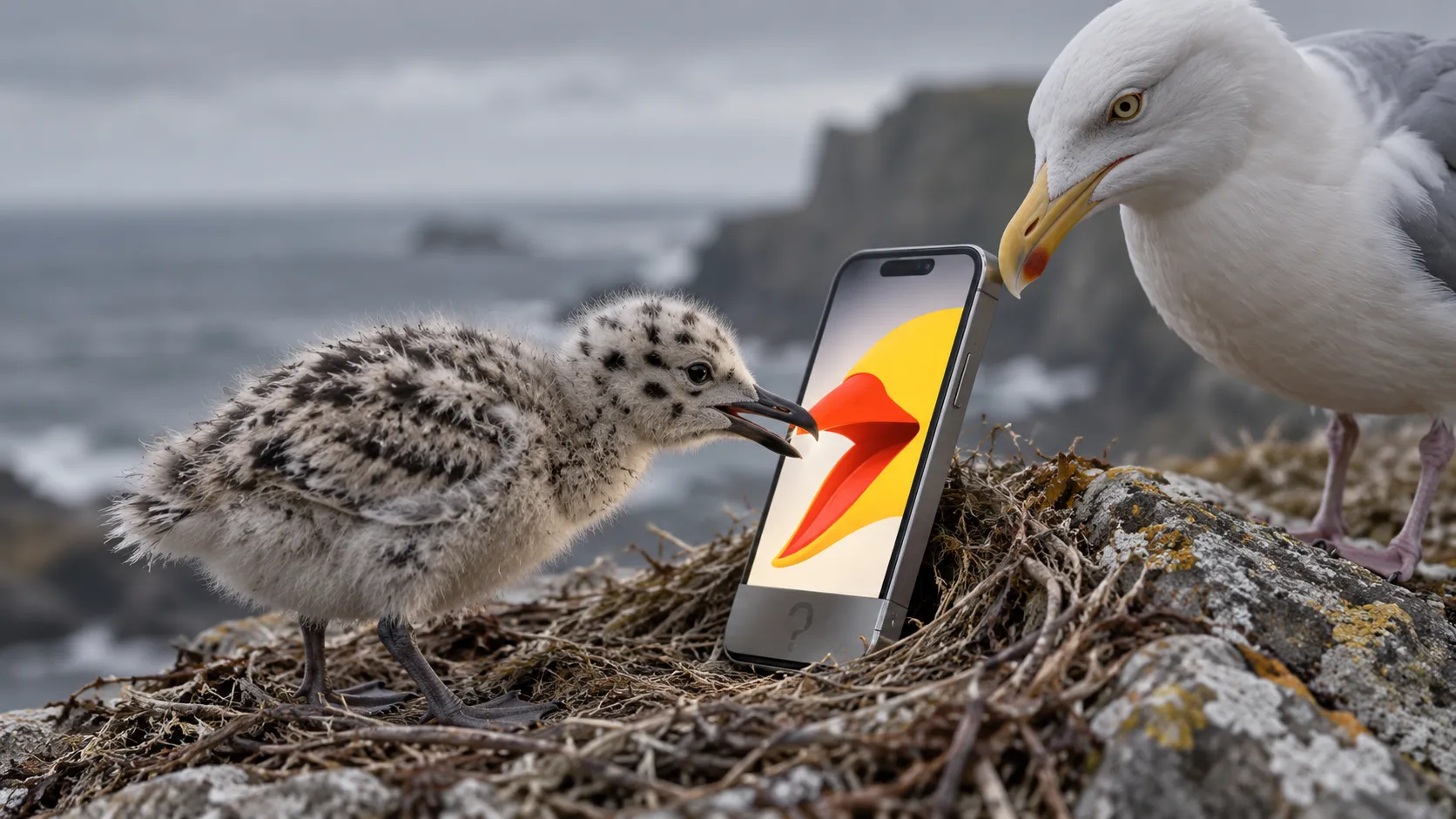
The supernormal stimulus began with gull chicks that pecked harder at some artificial models than at the natural cue. Carr's 2020 afterword to The Shallows applies it to the phone, and the studies he pairs with it have not held up.
Answer to the question
Is a social media feed a supernormal stimulus?
Not as a tested finding. Tinbergen's herring gull chicks pecked harder at some artificial models than at the natural cue, and Nicholas Carr applies the same term to the phone. The salience network offers a plausible mechanism, but the brain drain studies he cites did not replicate, so the label remains an analogy.
Key takeaways
- Tinbergen and Perdeck's herring gull chicks answered a red mark on a long, thin, yellow shape, and some artificial models drew harder pecking than the natural cue. Tinbergen named the effect a supernormal stimulus.
- Gwynne and Rentz (1983) described male jewel beetles trying to mate with brown beer bottles in Western Australia, a second case of an artificial object beating the natural cue.
- Carr's 2020 afterword to The Shallows applies the term to the phone and draws on the salience network, which Seeley and colleagues (2007) separated from the executive-control network in task-free scans.
- The brain drain study Carr cites did not replicate in a 2022 pre-registered replication, and a 2024 meta-analysis of 33 studies and 4,368 participants found no significant overall effect of a phone's presence on cognition.
- A supernormal stimulus is defined by a comparison, the artificial cue against the natural one, so the label for feeds needs a named cue and a named alternative to be tested.
A supernormal stimulus is an artificial cue that pulls an instinct harder than the real thing does. As a description of what a feed is built to do, the phrase fits. As a finding about people, it has not been established. The idea began with newly hatched herring gull chicks and a painted stick.
What Did a Painted Stick Reveal About Herring Gull Chicks?
Herring gull chicks beg by pecking at a red spot near the tip of the parent's yellow bill, and the parent then brings up a meal. The ethologist Nikolaas Tinbergen and his colleague A. C. Perdeck set out to learn what the chick is actually reading. They used cardboard models in place of the bird and reported the results in Behaviour in 1951. The chicks answered a single detail, a red mark on a long, thin, yellow shape, and the rest of the model hardly mattered.
The surprise came from models that departed from nature. Some of the artificial models drew harder pecking than the natural cue did. Tinbergen named the effect a supernormal stimulus and gave it a place in his book The Study of Instinct. The shape of the winning models and the size of the preference are not given here, because the paper's own text was not available for this piece. The chicks were newly hatched and the response was a simple peck, which made it easy to count. The claim stays small as a result: it concerns the pecking of newly hatched chicks at a model, and it says nothing yet about adults or screens.
Darryl Gwynne and David Rentz reported a similar case from Western Australia, in a note of two pages. Males of the jewel beetle Julodimorpha bakewelli tried to mate with discarded brown beer bottles known as stubbies. Press coverage of the authors' 2011 Ig Nobel award adds that the beetles responded to stubbies but not to cans or to wine bottles of a slightly different shade, and that the dimpled base of the bottle may resemble a female's wing covers in the way it reflects light.
A supernormal stimulus is defined by a comparison, the artificial cue against the natural one, and the comparison is made in an experiment.
The two cases share a structure. An animal carries a response tuned to a cue, and an object that no evolution shaped matches that cue so well that it wins. A supernormal stimulus is therefore defined by a comparison, the artificial cue against the natural one, and the comparison is made in an experiment.
How Did a Gull Experiment Reach the Smartphone Debate?
The psychologist Deirdre Barrett carried the concept to human urges in her 2010 book Supernormal Stimuli, whose subtitle says how primal urges overran their evolutionary purpose. Adrian Ward applied the term to the internet in a 2013 commentary in Psychological Inquiry, titled simply "Supernormal". Nicholas Carr adopts it in the 2020 afterword to The Shallows. There the phone is a device built by very large teams to score highly on the features the brain's salience network screens for, among them novelty, social relevance and personal address.
The network is real. A 2007 paper in the Journal of Neuroscience separated a salience network, anchored by the dorsal anterior cingulate and the orbital frontoinsular cortex and strongly linked to limbic and subcortical regions, from a distinct executive-control network. That gives the analogy a candidate for its tuned system, one whose job is to notice what is new and relevant. It does not show that a feed overloads it. Carr's book also belongs to a long line of worries about new media, traced in [Why New Technology Sparks Moral Panic](https://thewhyweproject.com/articles/why-new-technology-sparks-moral-panic), and a borrowed biological term can lend such worries an authority the evidence has not yet earned.
Do the Brain Drain Studies Still Support Carr?
Carr pairs the argument with the 2017 brain drain study by Adrian Ward and colleagues, in which people whose phones were in another room did better on cognitive tasks than people whose phones sat on the desk. The afterword offers it as fresh evidence that the book was right.
One 2023 study in Scientific Reports found a difference. Adults aged 20 to 34 took an attention test with a phone in view or out of sight, and performed less well with it in view on a test of basic attentional performance. The authors read this as the device drawing on limited mental resources.
Two other tests found no effect. A pre-registered replication in 2022 found that the location of the phone made no difference to either of its two tasks. A 2024 meta-analysis led by Andree Hartanto pooled 33 studies, 53 samples and 4,368 participants and found an overall effect statistically indistinguishable from zero, with no moderation by demographics, by self-reported phone dependency or by how presence was manipulated. The mechanism Carr describes stays plausible, but the headline result offered as support for the supernormal stimulus claim has faded.
Would a Feed Pass the Tests the Gull Chicks Passed?
For a feed to be a supernormal stimulus in Tinbergen's sense, three things have to hold. A response must be tuned to a particular cue. A manufactured version must exceed nature on that cue. And the manufactured version must beat the real one when both are on offer. The gull chicks met all three in experiments, and the beetle note describes the same pattern in the field.
The salience network supplies a tuned response, in principle. Exceeding nature is plausible by construction, since a feed can deliver new items faster than a village delivers news. The third condition is a choice, and the brain drain studies tested something else, which was whether a phone's presence changes performance on a task. Preference between a feed and the alternatives to it is a separate question. [Why You Cannot Stop Scrolling](https://thewhyweproject.com/articles/why-you-cannot-stop-scrolling) covers the reward schedules that feeds borrow from the laboratory, and [Both Sides of the Screen-Time Argument](https://thewhyweproject.com/articles/both-sides-of-the-screen-time-argument) sets the sceptics against Carr.
The idea still earns its place as a design question. A designer who says a feed is built to this pattern owes a named cue, such as new items arriving faster than anywhere else, and a named comparison, a natural source that the feed outdoes. The experiments that defined the term varied features of the model, such as the contrast of the red patch and the length of the stick, and watched what the chicks did. A claim about feeds needs the same grain. Until choices between a feed and its alternatives are measured, the label describes a design intention and not behaviour.
Common questions
Is a social media feed a supernormal stimulus?
Not as a tested finding. Nicholas Carr applies the term to the phone in the 2020 afterword to The Shallows, and the salience network gives the idea a plausible mechanism. The brain drain studies he cites did not hold up in a 2022 replication or a 2024 meta-analysis, so for feeds the supernormal stimulus label remains an analogy.
What is a supernormal stimulus?
An artificial cue that triggers an instinctive response more strongly than the natural object it imitates. Nikolaas Tinbergen's herring gull chicks pecked harder at some artificial models than at the natural cue. The term describes a measured comparison in animals, and applying it to humans is an analogy.
Who coined the term supernormal stimulus?
Nikolaas Tinbergen, the Dutch ethologist, who used it for artificial cues that outdo natural ones. His work with A. C. Perdeck on herring gull chicks, published in Behaviour, is the standard source, and he gave the fuller account of instinct in his book The Study of Instinct.
Sources
Carr, N. (2010; updated edition 2020). The Shallows: How the Internet Is Changing the Way We Think, Read and Remember. London: Atlantic Books. ISBN 978-1-83895-258-7.
Tinbergen, N., & Perdeck, A. C. (1951). “On the stimulus situation releasing the begging response in the newly hatched herring gull chick (Larus argentatus argentatus Pont.).” Behaviour, 3(1), 1-39. doi:10.1163/156853951X00197.
Tinbergen, N. (1951). The Study of Instinct. Oxford: Clarendon Press.
Gwynne, D. T., & Rentz, D. C. F. (1983). “Beetles on the bottle: Male buprestids mistake stubbies for females (Coleoptera).” Australian Journal of Entomology, 22(1), 79-80. doi:10.1111/j.1440-6055.1983.tb01846.x.
Barrett, D. (2010). Supernormal Stimuli: How Primal Urges Overran Their Evolutionary Purpose. New York: W. W. Norton. ISBN 978-0-393-06848-1. Cited for its subtitle only.
Ward, A. F. (2013). “Supernormal: How the Internet Is Changing Our Memories and Our Minds.” Psychological Inquiry, 24(4), 341-348. Cited as a commentary.
Seeley, W. W., Menon, V., Schatzberg, A. F., Keller, J., Glover, G. H., Kenna, H., Reiss, A. L., & Greicius, M. D. (2007). “Dissociable intrinsic connectivity networks for salience processing and executive control.” Journal of Neuroscience, 27(9), 2349-2356. doi:10.1523/JNEUROSCI.5587-06.2007
Ward, A. F., Duke, K., Gneezy, A., & Bos, M. W. (2017). “Brain Drain: The Mere Presence of One’s Own Smartphone Reduces Available Cognitive Capacity.” Journal of the Association for Consumer Research, 2(2), 140-154. doi:10.1086/691462
Ruiz Pardo, A. C., & Minda, J. P. (2022). “Reexamining the brain drain effect: A replication of Ward et al. (2017).” Acta Psychologica, 230, 103717. doi:10.1016/j.actpsy.2022.103717.
Hartanto, A., Lua, V. Y. Q., Kasturiratna, K. T. A. S., Koh, P. S., Tng, G. Y. Q., Kaur, M., Quek, F. Y. X., Chia, J. L., & Majeed, N. (2024). “The effect of mere presence of smartphone on cognitive functions: A four-level meta-analysis.” Technology, Mind, and Behavior, 5(1). doi:10.1037/tmb0000123.
Skowronek, J., et al. (2023). “The mere presence of a smartphone reduces basal attentional performance.” Scientific Reports, 13(1), 9363. doi:10.1038/s41598-023-36256-4. Summary read: adults aged 20 to 34, attention test with phone in view or out of sight.