Both Sides of the Screen-Time Argument
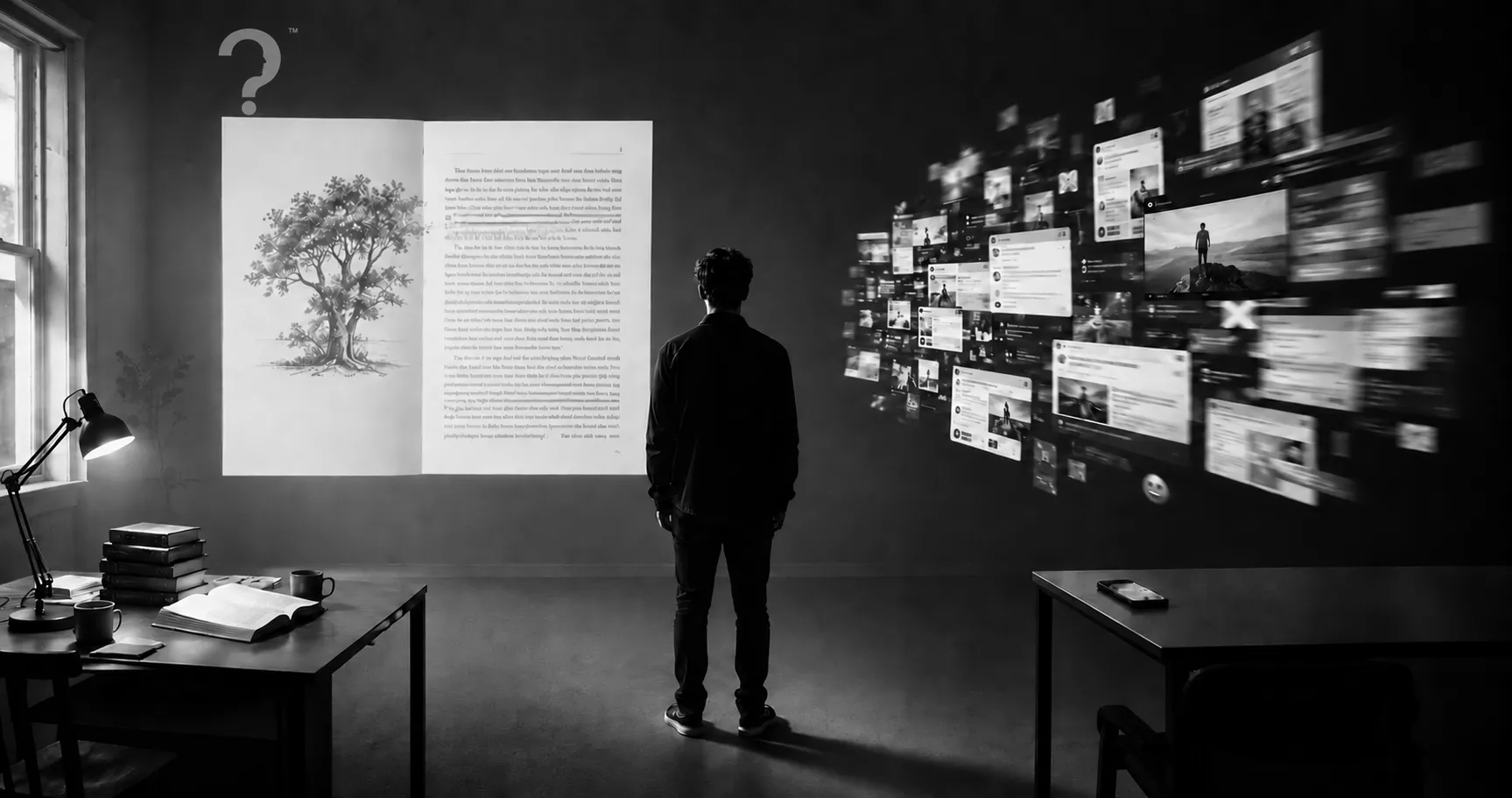
Our position is in the first paragraph. What follows is the evidence for it, both writers on their own terms, and the objection we cannot answer
Key takeaways
- Print anything you need to argue with, and read fiction however you like. Screen reading costs you comprehension on expository text under time pressure, by a small margin, the kind of difference that shows up across thousands of people and would be invisible in any one of them. For narrative text there is no difference the studies could detect. Delgado, Vargas, Ackerman and Salmerón (2018), 54 studies, 171,055 participants.
- It is also the largest surviving effect in the area. The two findings the popular case usually rests on, the Google effect and the phone brain-drain effect, have both come apart, and what remains of them is small and conditional.
- Nicholas Carr and Nir Eyal are working at different altitudes rather than against each other. Carr's historical argument, that contemplative reading is built rather than native, does not depend on the neuroscience that failed.
Our position, stated before the evidence so you can read the rest of this against it. Reading on a screen costs you comprehension when the text is expository and you are working against the clock, and that is worth changing your habits over. The broader claim, that ordinary internet use is eroding attention and memory across the population, is not supported by the current evidence, and the studies usually recruited to support it have not held up. We hold the first firmly and the second loosely, for reasons we get to at the end.
Practically, that comes to one sentence. Print the report you need to interrogate; read the novel however you like.
The finding underneath it is among the better-evidenced things in this area and among the least discussed, which is roughly the relationship those two properties usually have. Pablo Delgado, Cristina Vargas, Rakefet Ackerman and Ladislao Salmerón pooled 54 studies covering 171,055 participants and found [paper beating screens on comprehension](https://thewhyweproject.com/articles/does-screen-reading-cost-comprehension). The gap is small, the kind of difference that shows up across thousands of people and would be invisible in any one of them, and with that many readers behind it, it is unlikely to be chance alone. Virginia Clinton's independent meta-analysis a year later found a gap of much the same modest size, a shade larger. The boundaries are where the interest is: the effect appears for expository text, appears under time pressure, and does not appear for narrative text. The likeliest mechanism is not the screen doing something to the eye but the reader misjudging their own effort, feeling fluent and therefore budgeting less attention than the argument needs.